Splash of Magic
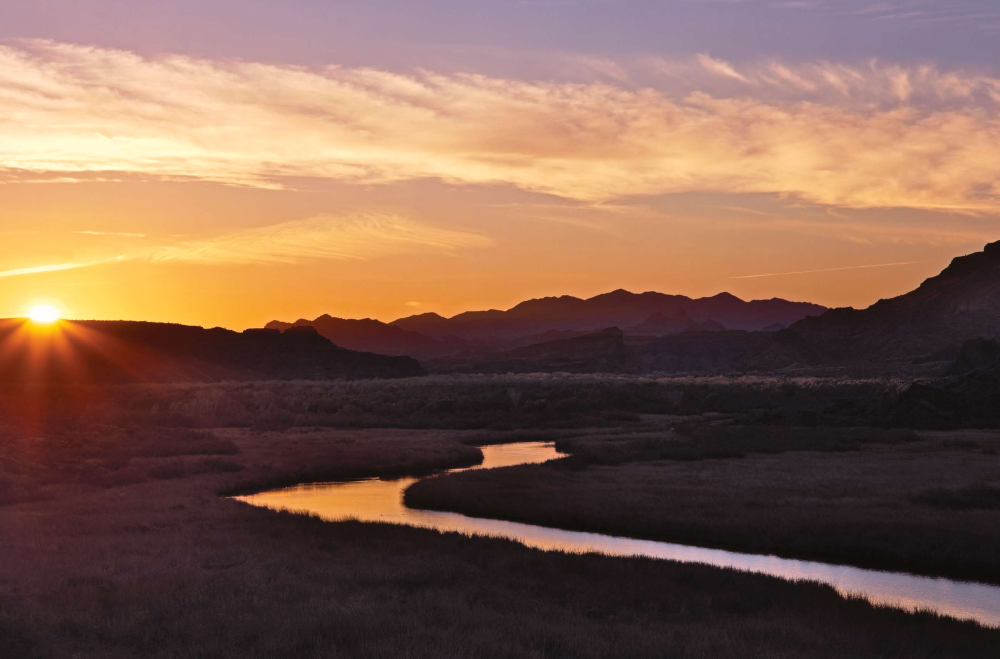
We can name many things to cherish about the desert in winter, from the quality of the light to the bearded, wild-eyed characters this dry land seems to attract in abundance. But water in the desert is the closest we come to universal magic. It never fails to thrill and helps explain the allure of a 38-mile stretch of western Arizona from Parker north to Lake Havasu City. The area sports three Arizona state parks, all with exciting water recreation, including some of the best bass fishing in the West, as well as a calm kind of RV camping. For those more inclined to explore, with or without the accompaniment of water, visitors to the Parker-Havasu strip can also hike into a hidden slot canyon, enjoy country music at a
OF MAGIC River's Spell Slows Time in String of State Parks
by Leo W. Banks photographs by Randy Prentice
She picked it up again with the other hand, and the snake bit that thumb, too.
Western diamondback and reached down to pick it up. The baby rattler jerked its head around and bit the woman's thumb. She promptly dropped it. But thinking, falsely, that she had to capture the snake so her doctor would know what kind it was, she picked it up again with the other hand, and the snake bit that thumb, too.
Although both thumbs turned black, the woman survived, and she learned the first lesson about snakes and scorpions: Let them be. The episode occurred in summer, but rattlers follow no schedule. If it's warm enough, they'll come out to bedevil the foolish.
Driving State Route 95 is part of what makes this trip so pleasurable. The scenery stuns with remarkable consistency. Moonlike black mountains border the winding road for much of the 38 miles, and on many of the turns the vista opens to blue lake, boats on the water and palm trees shading secluded inlets.
I stopped at an overlook at Parker Dam, between Buckskin and Cattail, a 320-foot mass of concrete, much of it underwater, completed in 1938. It's worth seeing, if only for its eye-popping quality.
Another must-stop: The finger of land that juts out into the Colorado River on the far western end of the Bill Williams River National Wildlife Refuge. A hiking trail runs along this narrow, roughly 150-yard peninsula, with benches and interpretive signs along the way.
Other places along State 95 don't show up on tourist brochures. Like the Nellie E. Saloon. Reaching this desert outpost requires some effort, and a modicum of nerve, but the payoff makes it worthwhile. Cienega Springs Road connects with the highway about 4.5 miles north of Parker, then rolls and dips into the Buckskin Mountains. Five miles of dirt road brings visitors to the saloon, which opened in its present form in 1988, on the site of an old mining camp. It looks the part, a weather-beaten, cement-block structure with a stamped tin ceiling, and it's accessible by a covered walking bridge. But the oddest aspect of the place sits on the roof - solar panels. “We might be the only solar-powered saloon in the West,” says 61-year-old owner Ken Coughlin.
The Nellie E., named for an old mining claim, has another distinction: It's open only during daylight hours, noon to sunset. In spite of these eccentric qualities, or perhaps because of them, the bar has become a popular spot to have a drink and listen to live music in a unique setting.
I found treasure of a different sort in a hidden slot canyon, which, like the desert bar, lies off the beaten track. Sara Park Canyon is located just south of Lake Havasu. But the sign on 95 only says “Sara Park.” Travelers must drive for a mile behind the park to reach the trailhead.
From there, I walked more than a mile along a sandy wash into the canyon, using two massive black ridges on the horizon as my guide. The closer I got to the canyon, the more these ridges pressed together, until they literally squeezed against my shoulders.
By then these once-dark rock masses had become lavender cliffs that soared straight up, turning an endless canopy sky into a thin sliver of blue as I entered the shadowy slot.
Just up the highway, in booming Havasu, city leaders tout the London Bridge as its main tourist attraction, and rightly so. All this water in the desert? Duward Cooper marvels at it.
“I came here in 1986 from San Diego, and I had no idea Arizona had a lake like this,” says Cooper, now a year-round Havasu resident. “A 40-mile lake? Impossible in this desert.” But at Lake Havasu State Park, ranger Tim Kristof says that in all the conversations he's had with firsttime visitors, whether RV campers, hikers enjoying its sunset walking trail, pleasure boaters or serious fishermen, the most common reaction is surprise at the size of the lake.
“People are shocked at how big it is, and how blue,” says Kristof. “Everybody knows the Colorado River in the Grand Canyon is gray and muddy, and they expect it to be that way here, too. But Havasu is an Indian word that means blue-green.” For Cooper, though, a 75-year-old retired Navy welder, the word means great fishing.
I caught up with him on a cold morning at Windsor Beach, part of this popular state park, and we talked about the passion he still feels for his boat, his gear, the peace of the water in the early hours, and especially for bringing home a bag full of striped bass.
“Oh, it's the best fish there is. The meat is white and so mild people mistake it for lobster,” says Cooper, whose bearded, grizzled face shows his lifetime love for the water.
Then he turns toward Havasu, now a mass of white-caps from the howling wind. “I love this lake at the crack of dawn,” he says. “It's almost like a sea. I can't get enough of it.” There was magic in his eyes. Water in the desert never fails. Although Leo W. Banks also wrote the preceding story. Randy Prentice would like to return to these state parks someday soon-to do some serious bass fishing. When considering possible places to retire, this area of Arizona looks a little bit more inviting to him with each visit. He lives in Tucson.
Already a member? Login ».