History of Highway Transportation
History of Highway
This is the fifth and last of a series of chronological descriptions of the development of vehicles, roads and bridges.
Part 3-Bridges
Although the earliest stream crossings consisted simply of shallow fords, logs, grapevines, pontoons and ferries, the author purposely launches forth with a description of the larger “engineering” structures. Girders and trestle bridges have been entirely ommitted. -Editor.
55 B. C. Caesar bridged the Rhine. This historic bridge was made of wood on piles driven into the river bed.
Trajan later built a bridge of twentytwo wooden arches across the Danube.
The Romans, during the time they were consolidating their empire, built many bridges where their military roads crossed rivers or gorges, a large number of which were stone arch bridges of such permanent construction that some are still standing and in daily use.
1118 A. D. The first stone bridge in England was built.
1176-The first bridge in the City of London was built.
1757-A wooden arch bridge over the Rhine had a span of 364 feet.
1779 The first iron bridge known as the “Cast Iron Bridge of Coalbrookdale”was built across the Severn River, near Brosely, England. It was built of sections made at the Coalbrookdale Iron Works. This historic bridge introduced the present era of iron and steel construction in bridge building though cast iron was soon replaced by wrought iron and steel.
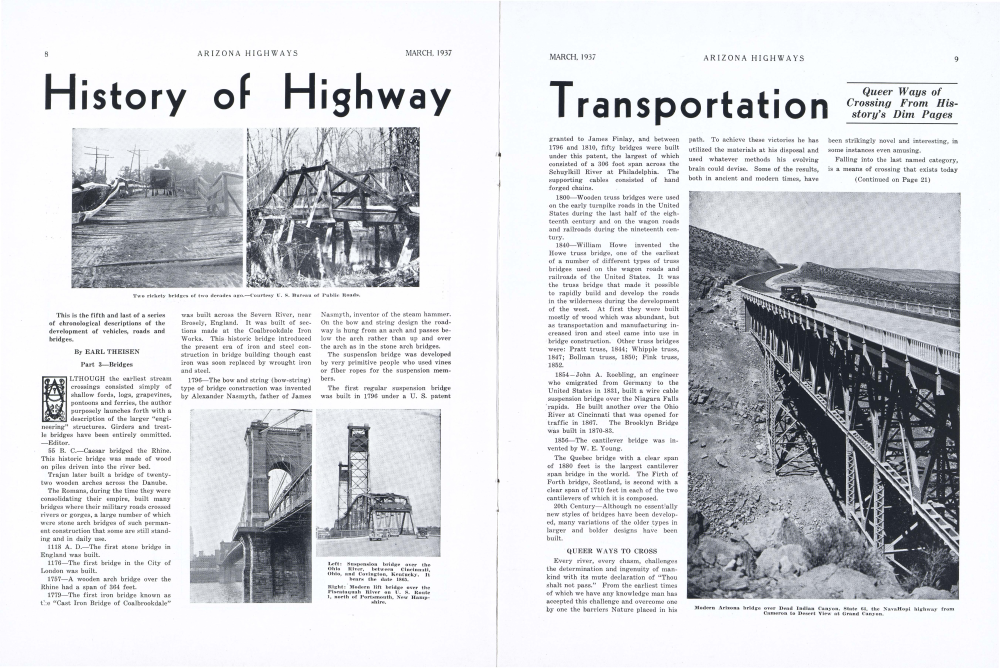
1796-The bow and string (bow-string) type of bridge construction was invented by Alexander Nasmyth, father of James Nasmyth, inventor of the steam hammer. On the bow and string design the roadway is hung from an arch and passes below the arch rather than up and over the arch as in the stone arch bridges.
The suspension bridge was developed by very primitive people who used vines or fiber ropes for the suspension members.
The first regular suspension bridge was built in 1796 under a U. S. patent granted to James Finlay, and between 1796 and 1810, fifty bridges were built under this patent, the largest of which consisted of a 306 foot span across the Schuylkill River at Philadelphia. The supporting cables consisted of hand forged chains.
ARIZONA HIGHWAYS Transportation Queer Ways of Crossing From Hisstory's Dim Pages
1800-Wooden truss bridges were used on the early turnpike roads in the United States during the last half of the eighteenth century and on the wagon roads and railroads during the nineteenth century.
1840-William Howe invented the Howe truss bridge, one of the earliest of a number of different types of truss bridges used on the wagon roads and railroads of the United States. It was the truss bridge that made it possible to rapidly build and develop the roads in the wilderness during the development of the west. At first they were built mostly of wood which was abundant, but as transportation and manufacturing increased iron and steel came into use in bridge construction. Other truss bridges were: Pratt truss, 1844; Whipple truss, 1847; Bollman truss, 1850; Fink truss, 1852.
1854-John A. Roebling, an engineer who emigrated from Germany to the United States in 1831, built a wire cable suspension bridge over the Niagara Falls rapids. He built another over the Ohio River at Cincinnati that was opened for traffic in 1867. The Brooklyn Bridge was built in 1870-83.
1856 The cantilever bridge was invented by W. E. Young.
The Quebec bridge with a clear span of 1880 feet is the largest cantilever span bridge in the world. The Firth of Forth bridge, Scotland, is second with a clear span of 1710 feet in each of the two cantilevers of which it is composed.
20th Century-Although no essentially new styles of bridges have been developed, many variations of the older types in larger and bolder designs have been built.
path. To achieve these victories he has utilized the materials at his disposal and used whatever methods his evolving brain could devise. Some of the results, both in ancient and modern times, have been strikingly novel and interesting, in some instances even amusing.
Falling into the last named category, is a means of crossing that exists today
(Continued on Page 21)
QUEER WAYS TO CROSS
Every river, every chasm, challenges the determination and ingenuity of mankind with its mute declaration of "Thou shalt not pass." From the earliest times of which we have any knowledge man has accepted this challenge and overcome one by one the barriers Nature placed in his
Already a member? Login ».