John Vukcevich: The Story of an American
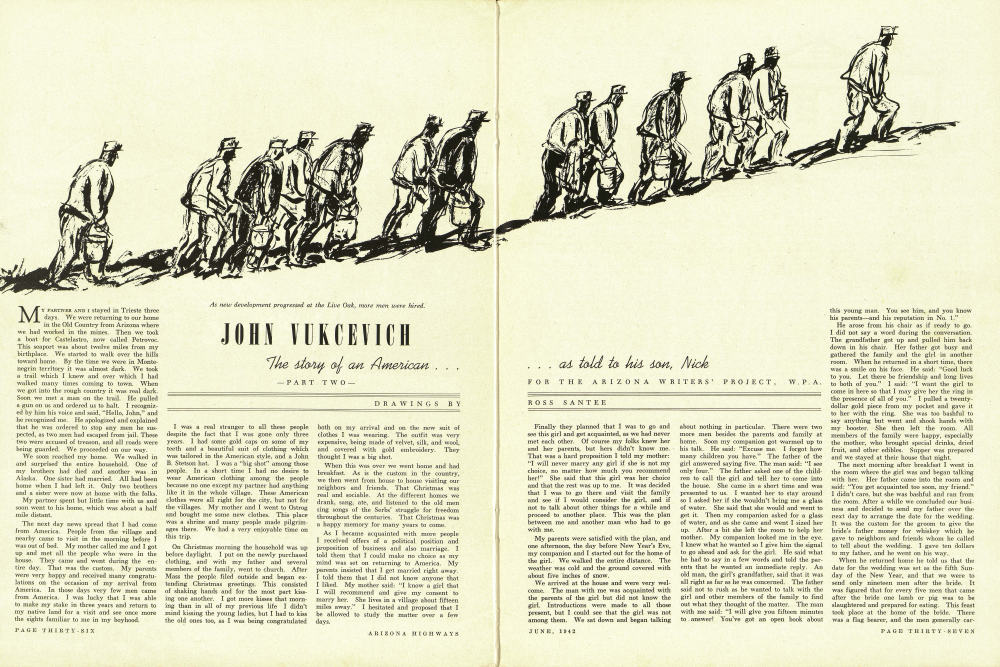
MY PARTNER AND I stayed in Trieste three days. We were returning to our home in the Old Country from Arizona where we had worked in the mines. Then we took a boat for Castelastro, now called Petrovoc. This seaport was about twelve miles from my birthplace. We started to walk over the hills toward home. By the time we were in Montenegrin territory it was almost dark. We took a trail which I knew and over which I had walked many times coming to town. When we got into the rough country it was real dark. Soon we met a man on the trail. He pulled a gun on us and ordered us to halt. I recognized by him his voice and said, "Hello, John," and he recognized me. He apologized and explained that he was ordered to stop any men he suspected, as two men had escaped from jail. These two were accused of treason, and all roads were being guarded. We proceeded on our way. We soon reached my home. We walked in and surprised the entire household. One of my brothers had died and another was in Alaska. One sister had married. All had been home when I had left it. Only two brothers and a sister were now at home with the folks. My partner spent but little time with us and soon went to his home, which was about a half mile distant. The next day news spread that I had come from America. People from the village and nearby came to visit in the morning before I was out of bed. My mother called me and I got up and met all the people who were in the house. They came and went during the entire day. That was the custom. My parents were very happy and received many congratulations on the occasion of my arrival from America. In those days very few men came from America. I was lucky that I was able to make my stake in three years and return to my native land for a visit and see once more the sights familiar to me in my boyhood.I was a real stranger to all these people despite the fact that I was gone only three years. I had some gold caps on some of my teeth and a beautiful suit of clothing which was tailored in the American style, and a John B. Stetson hat. I was a "big shot" among those people. In a short time I had no desire to wear American clothing among the people because no one except my partner had anything like it in the whole village. These American clothes were all right for the city, but not for the villages. My mother and I went to Ostrog and bought me some new clothes. This place was a shrine and many people made pilgrimages there. We had a very enjoyable time on this trip. On Christmas morning the household was up before daylight. I put on the newly purchased clothing, and with my father and several members of the family, went to church. After Mass the people filed outside and began extending Christmas greetings. This consisted of shaking hands and for the most part kiss ing one another. I got more kisses that morning than in all of my previous life I didn't mind kissing the young ladies, but I had to kiss the old ones too, as I was being congratulated both on my arrival and on the new suit of clothes I was wearing. The outfit was very expensive, being made of velvet, silk, and wool, and covered with gold embroidery. They thought I was a big shot. When this was over we went home and had breakfast. As is the custom in the country, we then went from house to house visiting our neighbors and friends. That Christmas was real and sociable. At the different homes we drank, sang, ate, and listened to the old men sing songs of the Serbs' struggle for freedom throughout the centuries. That Christmas was a happy memory for many years to come. As I became acquainted with more people I received offers of a political position and proposition of business and also marriage. I told them that I could make no choice as my mind was set on returning to America. My parents insisted that I get married right away. I told them that I did not know anyone that I liked. My mother said: "I know a girl that I will recommend and give my consent to marry her. She lives in a village about fifteen miles away." I hesitated and proposed that I be allowed to study the matter over a few days.ried arms. This is an old custom dating from early times when this escort was used as a means of protection from the enemy. Long ago there were instances where a band of men waited in the road and fought with the party, sometimes kidnaping the bride. This occurred along the borders of Turkish and Albanian territory. That was why people were permitted to carry arms openly when the country was under Montenegrin rule. The new government does not permit the carrying of firearms and has abolished that and many other rules and customs of that country as the Turks, since the Balkan and World Wars, have ceased to be a menace. My father sent word to all friends and relatives that I was to be married on the first Sunday in February, and invited them to the wedding. We prepared food, wine, and liquor, enough to last the guests for three days. I mean this was expensive too. Time passed rapidly. I was almost tired thinking of all the hard work at hand and the problems of keeping all these people peaceful and happy. Help was to come voluntarily from the friends and relatives in preparing the wedding feast and the other meals. This was the custom and it was understood that they were also to act as cooks and waiters. They also brought gifts such as money, a pig, lamb, a ham, some ten gallons of wine and large loaves of bread, which were about five times larger than the potato loaf in America; and others brought quarts of whiskey and brandy. The guests arrived Saturday evening, and when they came supper was ready and waiting for them. That night it was arranged who was to be in the bridal escort party. The lead er, toastmaster, guards of the bride, the best man, and the rear guard of the svatove (pro cession). These men were supposed to be prepared to go for the bride either on foot, horse back, or auto, depending on the condition of the country and the distance to be traveled. The toastmaster gives the instructions as to how each is to act on their way for the bride. One of the men carries an artistically carved wooden vessel shaped like a canteen about the size of a half-gallon, which is filled with wine. As they pass through the villages the man carrying the container stops at some homes and calls on the head of the house offering him a drink of wine and telling him that the svatove are on
their way for the bride. If he accepts a drink it is understood that he will meet the group on their return trip and offer them a zdravica, a small gift such as cigars, a gallon of wine, or a cup of coffee. When the party arrives at the home of the bride they remain outside the house, that is all except two, the best man and another. These two enter the house to see if the bride is ready to go and make the journey. They also present to her the wedding ring and a pair of shoes that she is to wear. If all is in readiness, these two men go out and fire a shot apiece. This is the signal to the rest of the group that all is well and that they now can enter the house. Inside, a long table has been set with food and drink. They take their places at the table and begin to eat. At the time they are halfway through the meal, the toastmaster tells the two guards of the bride to get her and bring her to the table. The master of the house, sitting by the toastmaster, says that there is plenty of time for the bride to come over. On the second call from the toastmaster the two guards arise and go after the bride. But it seems that she is being guarded either by her brother or nearest relative. He will not surrender her till the guards offer him some money. They begin by offering him a dollar. He says that there is nothing doing. They raise the ante a half-dollar. That is not enough either, he says. They bribe him with two dollars and he lets them take the bride. The participants in these antics appear very serious, but they are only furnishing a bit of horseplay for the occasion. When the girl puts in her appearance the group begins singing. The toastmaster gets up holding a glass of wine and drinks a toast to the bride, wishing her good luck and many years of happy life. Others of the group pro pose toasts, each trying to outdo the other in eloquence. When the meal is over, the leader of the svatove rises. All stand and he makes a toast. When he finishes all the men go outside to make ready to escort the bride to her future home. The bride takes her place in the middle of the group, and after the guards fire two shots, they are on their way amid much singing and shouting. The parents and those remaining at the house show their approval and delight by answering the shots. As previously stated, they are met in the villages through which they Pass by the people who offer them the zdravica and their blessings. The toastmaster calls on an individual to take the zdravica and offer thanks to the giver. The bride and the svatove walked the fifteen miles from her home to the church over the same trail that I had been on at the time I went to become engaged. They came about noon time, passing our home on their way to the church. One of the svatove came to get me and I went with him to the church. The priest was ready and started his stuff. The bride and I were placed in front of the altar with the best man standing behind us. Then the priest placed wreaths on our heads and changed the rings on our hands, putting my ring on her and hers on mine. Then he asked me for my birth certificate and asked me if I was taking this bride with the full desire to be my wife. I answered in the affirmative. He asked her the same question and she answered: "Yes," after which he began the ceremony. In a short time he gave me a piece of bread and a sip of wine. He went to her and gave her a piece of bread and a sip of wine out of the same glass. Then he changed the wreaths, putting her wreath on my head and mine on hers. He told me to hold her hand and to rise and walk around the table. We did and stopped in front of the altar. He told us to bow our heads while he continued his chant. The best man held his hand on our heads to keep the wreaths from falling. Three times we walked around the table and bowed our heads. Then he said: "I pronounce you husband and wife." He shook hands with us and told us to kiss the best man and shake hands with everybody. I asked him how much I owed him. He said: "Whatever you give me. It is up to you." I paid him and being glad that it was over, invited him to come with us to the wedding feast. He thanked me and said he would come later. The svatove shook hands with us and offered congratulations. We left the church and started home which was not far from the church. The houses of the village were alongside the road, and many zdravica were offered by friends and neighbors. When we got home the old man had one too. It was a gallon of wine with a large quince on the mouth of the container. The toastmaster called the best man to take the offering and we started into the house In the doorway was a small boy waiting for the bride to walk into the house with him. This is another of the customs of the country. It seems that some superstition is attached to this custom, also, as it is done so that the bride may be fertile and the first child born will be a male child. After entering the house, the bride is met by the mother, sisters, and other relatives and friends of the groom. No member of the bride's family attends the first day of the wedding feast. Everybody is happy, and there is much merry-making.
The people sit behind a long table. Toasts and speeches are given, by the leader, toastmaster, best man, and many of the other svatove. The toastmaster called my father to give a blessing to the bride and groom. He came by the table with a jug of wine. Then he began his speech: "My dear friends and guests, I am very happy that I have lived to this hour to see all of you in my happy home at the wedding of my son. I hope that my dearest daughter-in-law will be a success and good fortune for this home; to be proud of this home, her husband, her parents, and all her friends; to fill the house with nine male heads like the mother of the Yugoviches." The guests gave a great applause to the old man's speech, and everyone began singing. The older men got their guzzle and began singing heroic and comic songs. In a short time a kolo (dance) was started and almost the entire company joined in the dancing and singing.
The following day the feast continued much in the same way. Soon people began getting up to leave, those having the farthest distance to travel leaving first. Little by little all the people left except my sisters and mother, and an aunt. They stayed for the third day. I was busy all the time and did not have much time with my wife till all these people were gone. This was from Sunday to Wednesday. I had been working pretty hard to please all my friends, and I was glad it was over.
At the week-end of the wedding the wife wanted to go to visit her parents. This was another of the customs, so she went with my brother and cousin. They are called jeveri (bodyguard). I was lonesome but thought it was a punishment. Some of my friends teased me saying that maybe she wouldn't come back. When they returned, I was told that I was invited to visit my wife's parents with her. I said: "Some day I will go alone and take my time. Now I am a married man and supposed to be obligated for all the demands of the family as eight of us lived togther." Soon I began to feel this burden on my head. Still I felt pretty good as long as my money lasted. I thought that I would have something to say in the household now that I was married, but I was sadly mistaken. I became one of the smallest members of the family. I said to myself: "I will turn myself loose from this quickly. I will go back to America, the land of the free!" Time passed along. I never revealed my intentions to anybody.
I was getting letters from Arizona that were not so good. Mines were closing down and the panic still gripped the copper industry. I decided to wait a little longer. Springtime came. All farm work was done by hand. I had worked like the rest of the peasant farmers, and the wife had to do her part. Nothing was unusual because everybody had something of their own. They own their own homes and farm and a little livestock. That is the life the peasants live. On Sundays they go to church and on market day to the town bazaar. Then the planting of summer crops must bedone. Everybody is busy when the time comes to cut the corn. People call one another to help harvest the crops.
When I received letters from my friends in Arizona that times were beginning to look better for the copper industry, I figured that my time was too valuable to be spent here any longer. So I told my wife that I was going back to America. She said that she would go with me. I then went and told my parents what I had in mind. They began to cry and told me that the father of my wife would never consent to my taking her to America. I told them that I had never made a contract with anyone as to what I could do. That almost broke their hearts.
I applied for a passport for myself and my wife. The official in charge told me that I would have to serve as a recruit in the army for one year before a passport would be granted. I went to the highest authority but to no avail, so there was nothing left for me to do but to go home. I didn't like that because it made it impossible for me to return to the U.S.A. before the six-month leave on the passport expired. The result was that I lost my right of residence for intention of citizenship.
At that time the country was mobilizing all men from sixteen to sixty years of age and sending them to the borders of Austria and Albania. This was during the annexation of Bosnia and Herzegovina, by Austria. I was sent with the first group of men as a private. Our orders were to take food enough from our homes to last forty-eight hours. We also were to take a good pair of shoes. The government furnished a rifle and 100 cartridges. We were given strict orders to guard the Border and not to fire upon anybody who crossed the Border, unless they refused to surrender. We were to be on the lookout for soldiers in uniform especially, and were not to build any fires at night. After forty-eight hours we were relieved and went home until we were again called upon to take our turn, which was at least once a week. This went on for six months.
Then one day an order came from the brigadier for all battalions of the two countries to gather at the munitions magazine storage house to return all ammunition. We were to keep the rifles and be responsible for the same, and buy cartridges if we wanted to use them privately. All men were registered as home guards. There were sergeants, lieutenants, a bugler, and a flagbearer for each group of 100 men. We were to practice military training at least ten days out of the year, and put in ten days labor on the road.
The government began this type of military service back in 1895, taking men from eighteen to twenty-four, for six-month periods. Later it was for one year. The time I served on the Border did not count in my service as a recruit. This the brigadier told us when we returned our cartridges. That no young man was to be exempt from being recruited was made clear, that is, if he was physically fit. He also told us to be prepared as good soldiers, that there may be a war some of these days, but not this time. He gave each of us twenty-five cents with which to buy tobacco. This was equivalent to ten cents in American money, and that was our pay for six months service.
I was disgusted with that sort of discipline. Just think: for six month's service I was paid ten cents and had to furnish my own food, clothing, and shoes from home. I was glad when this was over because if one left the country during service of this kind, he was called a slacker. I told my wife that I was going back to America. She wanted to go with me, but I told her that we couldn't get a passport to go together. She knew it was a bad risk to leave the country without a passport. I told her that I had my old passport and could get by on it. Besides, I spoke a bit of English which made it easier for me.
I kept this a secret, not even telling my parents anything of my intentions. My wife was sad that she could not go with me to America, so I told her that I would take her on a trip before leaving for America. We went to Os trog, to the Cathedral of St. Vasilija. This was the same place I had been to with my mother. There were thousands of people gathered there. I met some people that I had seen in Arizona. Temporary business places had sprung up covering an area of about a city block. Barracks had been erected and many tents set up, as there was no hotel except for the royal family and the cardinal. This celebration lasted three days, and it was an annual event.
I saw Prince Michael when he came from the cathedral. He went to salute five hundred volunteers from Austria. These men were Austrian citizens but were Serbians and Orthodox by religion. There were seven priests and many other high ranking men. These men had left their homes and families to come to Montenegro as volunteers to fight against Austria. They were great patriots to the country of Montenegro. When the annexation of Herzegovina took place they left their homes. They knew it was dangerous for them to return because Austria knew they were against her rule. These men talked with the prince and asked him to assist them in going to a foreign country such as America and other places. I heard the prince: "We thank you very much for your loyal support as volunteers, but there will be no war this time. I have no authority to promise you anything. I suggest you form a committee to see my father. He will do what he can for you." He gave them 500 Krone as a gift about $100.
I met the cardinal and another high official who I knew was acquainted with our family. The official called me and I went toward him. I stood at attention and saluted him. He introduced me to the cardinal who asked me who my father was, and who I was with on the trip. I told him that I had my wife with me and that she was at the cafe. He said: "You go and get her and come to my agency, and I will treat you to a cup of coffee. Your father treated me when I passed through your village last month. I saw him working in the field with a team of oxen. When I came by with my deputies, he came to the road and met us. Your mother brought chairs and set them in the shade of a mulberry tree. I was thirsty and the mountain water was very cool. Your mother brought fresh cream cheese, brandy and water" I was not at home that day, nor was my wife, when the cardinal passed through the village and stopped at our home. I told the cardinal that it would not be necessary to bring my wife in his audience to occupy his time. He said: "You must come and bring your wife."
This friend of mine was very pleased that he had introduced me to the cardinal. This man was one of the bodyguards of Prince Michael, and was Godfather to one of my brothers. When I told my wife that we were to visit the cardinal she didn't believe me, thinking I was joking. She was worried as to what she had to do and how she was to behave in his presence. I told her he was just like any other man except that she would have to kiss his hand.
We went to the place and were met at the door by a man. I told him that we were being expected by the cardinal. He went in and told the cardinal that we had arrived. He called us and took us in where the cardinal was seated with his guests, which consisted of fifteen priests from different parts of the country. I was a bit puzzled as to what I should do. I said: "Good day, your excellency, and guests," and went to the cardinal, kissed his hand, and bowed to the priests. My wife did the same and we took our seats. The cardinal made an introduction saying: "This is the son of the ex-captain and flagman, hero of Fundina in the war of 1877." He then asked me from which family my wife came. I told him and he told the guests that her grandfather was a well known commander-colonel and a hero in the battle of Vuci Do, and that he captured two cannon from the enemy and put them to retreat after many lives were lost on both sides. His battalion was the one that the king decorated with gold medals of Obilich's head. This was the highest decoration of the country. I was very proud of the cardinal's introduction. We arose and thanked him. The cardinal was a hero himself. I could see that he also was wearing the gold medal of Obilich on his chest. He was the highest ranking man of the Orthodox Chuch in Montenegro.
Soon a servant came in with a large tray filled with cups of coffee. He came first to my wife. She took a cup and then I took one, after which he went around taking coffee to the others. During this time the cardinal continued talking, telling stories of his trips; and in the half hour we spent with him, he had the floor alone. We arose and thanked him. He said: "Give my regards to your father and mother."
My parents were glad to see us back. I told my father that we had been invited by the cardinal and the other friend and that we had a pleasant trip. My mother asked me if it was very nice when I was recognized and invited because of my parents. I told her that I thought it was. The following day upon our return home I went to visit my wife's parents. I told them that I was leaving the country in a couple of days. They were very sad when they heard this news as they realized that I would be unable to take my wife with me on account of the passport regulations.
I left them and when I arrived home it was dark. I told my father I was leaving in the morning. He looked at me and asked: "Leaving? For where?" "For America!" I told him. My mother began crying, and the rest of the family were sad. I told them if anybody asked for me to tell them I had gone to Austria, which was partly true as I had to go through Austria on my way to America. My mother and wife accompanied me to the coast where I was to take a boat for Trieste. Upon my arrival there I kissed my mother and wife and was soon on my way. I took a train for Basel, Switzerland, and from there went to Paris and Havre where I took a White Star Liner. We crossed the Atlantic in six days and nights. At quarantine I passed the physical examination in fine shape. I had enough money to show the officials that was the main thing. I took the Rock Island train, and in four days, I was back in Globe, Arizona.
A short time after I began working in the mines again. I sent money to the old country and was soon joined by my wife. America was strange to her at first, but she soon felt as much at home as I. I found many old timers that I left in Globe.
They had been away and had come back. Mines everywhere were working again. The Miami mine was developing and building a concentrator. The Inspiration was drilling with churn drills. The Live Oak was working a few men, and the Black Warrior mine had 100 men on the job. The Gibson mine was working too; in fact all mines in the Globe district. The town was booming again, and miners were building homes. Everything was moving. A railroad was built to Miami, and Cleve Van Dyke started the Miami townsite.
He began plowing and cutting streets in August, and was selling lots for business and resi dence. On Gibson Street and Miami and Key stone Avenues, the first houses were built. The first postoffice was on the southeast corner of Live Oak Street and Miami Avenue. The first concrete building was built by John Fitzpatrick, a saloon man. The Cobb brothers ran the first grocery store.
On September 11, 1909, an excursion day by train was held in Miami on the opening of the Miami townsite. Barbecue and coffee was furnished by the company, and each person who bought a train ticket at the depot in Globe to go to Miami, was given a chance on a lot which was to be given away in a drawing. It happened that some young woman won the lot. Also the company gave a lot to the first family having a boy born in Miami, and this was won by the Despot family.
I heard Mr. Van Dyke that day when he made a speech telling the people to "Buy now!" He said that the time would come when the price of a lot in the business section would be $500 a front foot. He was right. I know of a lot that was priced for $400 and fifteen years later the same lot was sold for $9000. Van Dyke was a good business man. He boosted the town a lot. He owned the paper, water, and electric plant. He gave every man a chance to own his own home, and every investor was protected by Van Dyke, because he kept his price up instead of down. He called the Miami people "home folk," and he never turned a good man down. Some men have worked for him ever since he came to Miami almost thirty years ago. He organized the Van Dyke Copper Co., and he was never too big to meet any man, whether that man came to Miami on business or otherwise. He is a friend to the working man and loyal to all nationalities.
He knew the future of Miami and was able to see farther ahead than many other men who came to the district before he did. He realized that millions of tons of copper ore were blocked out by the Miami and Inspiration copper companies. They worked with churn drills all over the hills where the mines are now in operation. Van Dyke bought out a few men who owned a few acres of land on the flats. Then he bought out John Davis' mining claims. This is now called Davis Canyon. At the present site of the Catholic church, Davis had a saloon, the Miami. Later, he opened another saloon, about one mile below the Live Oak camp down the wash west of Keystone mine. On opening day, Davis gave a free drink of champagne to every miner who come into the saloon during the grand opening.
Mr. Obideer built a dance hall a short distance above the saloon. At this place I saw for the first time, a gasoline operated motion picture machine. This was being carried on a wagon through the country and being shown in the towns. This was in the horse and buggy days about fifteen years before the hills got full of stills, and moonshine took the place of champagne, whiskey, beer and wine. It was before the days the wiggly tail, jackhammer, and plugger took the place of hand drilling by single and double jacks. It was before the miners began getting dust in their lungs in the days when every miner was hefty and strong. Hand drilling contests, both single and double jack, for fifteen minutes in hard granite rock, were often held. For a quarter of an hour they struck the drill without missing a stroke, or if they did get hit they waited till the contest was over before receiving attention. Sometimes they drilled through the rock and started another hole. Thirty to forty inches was a common distance for contest drillers. This was the miners' game of sport and practically every mining town in the West had its champion.
The big events took place on the Fourth of July, and Labor Day. Sometimes as much as $500 was awarded the winners of first places. Another tough game in which the miners took part was the tug-of-war. There were six men on a team and prizes were donated by the mine operators and business men. In 1904, at Bisbee, I witnessed a tug-of-war between teams representing the Calumet Arizona and the Copper Queen mines. The contest lasted for one hour and forty minutes before the Calumet team, composed of Slavic miners, were declar ed winners. I took part in some of the tugs-ofwar held in Globe and Miami, and the Slavic miners were always among the strongest. These contests were tough.
Not so long ago I met Mr. Van Dyke at his home in Miami. We had a long talk about many thing of the past. He asked me: "What became of those young husky and healthy Slavic fellows who used to be here? That was the finest bunch of men I ever saw." I told him that many of them rested in the cemeteries of Globe and Central Heights. Others went back to their fatherlands during the Balkan War. During the World War many belonged to the Allied countries of Serbia and Montenegro, and Serbians born Austrian citizens but always sympathizers of Serbia, left and joined the Serbian army as volunteers when the Serbian army mission came to this country to call men under colors for the Salonika National Front. Others joined the American Army and Navy and were killed in action. Many died or were killed in the Balkans when General Makinson occupied Serbia and Montenegro and placed the men and women in concentration camps in Borogazon, Hungary, where they were the victims of disease due to bad food and other unsanitary conditions. The bones of one of my brothers lie somewhere in that concentra tion camp cemetery.
In a very short time Miami was well populated with Slavs. Besides lodges and other beneficial organizations, a musicians' band of only Slavic members was formed. It was a fine band made up of young men who had been trained in military bands in the Old Country. This band led all celebrations, parades, and funerals in the Miami and Globe districts.
The Live Oak mine changed hands and management, going under the name of Inspiration Consolidated Copper Company. I went to work for the Miami Copper, getting a job as machine man. I drove a drift to the line of the Inspiration ground, and afterward was put to work at a place I didn't like. I went to the Inspiration Mine, which had just begun operations, to look for work and was hired in the first ten men to start work at the Joe Bush Shaft. The shaft had been sunk 300 feet previous to consolidation with the Live Oak. As new development progressed, more men were hired each day; and contracts were let in drifts and raises, then in new shafts, and the surface work became greater and greater. The company bought the Black Warrior Mine and camp and built a concentrator on the site of the old camp. Today millions of tons of concentrate tailings cover the property.
Shortly afterwards I quit my job at Inspiration and went into the grocery and merchandise business. I had two partners. Our stock and fixtures amounted to $5000. We did a lot of business. Most of it was on credit. That was pretty hard as in those days payday fell every thirty days, and then, too, competition was very strong. I was out most of the time soliciting orders and delivering them by horse and wagon. Soon I began to realize I wasn't getting any returns for my time and investment. My partners were giving too much credit, and no money was coming in for the merchandise. In a short time we had over $2000 in bad accounts of people who had left town. I became disgusted with the business. I did not know what to do. It was pretty tough because I was not qualified to run the business by myself. I didn't want to be in the partnership any longer.
When I went out of the grocery business, I took over the boardinghouse and my wife helped me. We had quite a few boarders, most of them were kinfolks. In a very short time I had a little cash on hand. I went into town one day and passed a little tin shack on Sullivan Street This was the real estate office. I looked at the blackboard which read: Business Lot-Bargain -For Cash. I went inside and asked the man the location of the lot. He told me that it was across the street. I went and looked it over. The sidewalk had been built and also a retaining wall along the creek. The lot was not very level and lots of stumps and brush were on it. There were no buildings on the block on either side of the street, except the tin shack of the real estate office. I bought the lot for $1000.
I went home and told my wife that I had bought a business lot. She didn't say much. Some of my cousins and friends told me how many acres of land I could buy in the Old Country for that sum. One said I did a wise thing.
The year 1912 started with bad luck. One of our boarders, a cousin of mine was killed in a mine accident. Then came October, 1912. The Balkan states declared war on Turkey. They called for volunteers for the defense of the fatherland and so many signed to go that it broke up the colony, lodges, and boarding houses. There were about a thousand Slavic people in the Miami and Globe district. Many homes were sold for almost nothing. They left their good jobs and went. One morning more than 500 left the district, and all went on their own expense to the Old Country. Some went later on as soon as they could get ready. I didn't go because I was neither physically or financially prepared.
In two months we received a letter that my wife's father had been killed in battle at Scutari. We also learned that more of our friends, some of whom were boarders, were killed there too. After firing ceased, some of the fellows who went from here began coming back. I was very glad to see those I knew here and also some newcomers who had never been to America before. Two of my brothers came to this country in 1913. They wired me from Ellis Island for transportation. I got them here as I did others who called on me for help.
These fellows got jobs here without much trouble as all the mines were working at that time. Once again the Slavic colonies in Globe and Miami began to grow. A social and athletic club was organized under the name of Ser bian Eagle and Falcon. These people had some thing in their minds about another war, for they began practicing drills of military form, and learning bugle calls. It seems that the organization in the Old Country, of which this was a branch, knew that the Sarajevo gathering of the so-called Falcon clubs might bring re sults of annexation of Bosnia and Herzegovnia, and it did. Ferdinand was assassinated because he came with his army to stop the demonstra tion of the Falcon whose members came from all parts of Serbia and Montenegro as well as some under Austrian rule. Ferdinand, like other Germans, wanted to take the people's liberty and stop that gathering and celebration. But while he was riding through a Sarajevo street, a young Serb stilled his breath. The assassination brought matters to a head and Austria declared war on Serbia. Montenegro was in alliance with Serbia and joined in. Those fellows who had just began to making a living went into the World War just as they did in 1912. What happened here characterized their actions in other parts of the United States, Canada, South America, Australia and other countries where they were living. Our colony was again drained of Serbs and Montenegrins, not only at the outset of the war when they went as volunteers to their native country, but when the United States entered the battle, all able bodied boys enlisted in the American Army and Navy.
In this abbreviated story of my experiences, I have told what led me to America, how I made my way and my living, and about the Slavs who crossed the nation to the West to take up hard rock mining. When I came here there was nothing for me to do except to work in the mines. There were thousands just like me from my native land. Some lost their lives in and about the mines, and some returned to their homeland. A few old timers, loyal citizens of the Slavic race, are still living and have perpetuated their kind. The young generation is among the cream of American youth.
I ask you young American Slavs to never change your name or desert your nationality. Will Rogers was an Indian, and I have heard him say that he was proud of it. This took place at the Coolidge Dam on the day of the dedication of that beautiful structure which is guarded by two eagles looking downstream toward the west. The late president and Mrs. Coolidge shook hands with Mr. Rogers and found a place for him to sit at the banquet table near him who was president of the United States of America for seven years. Mr. Rogers happened to arrive late, and the banquet was already in progress. He made his approach through 15,000 people, to the 400-foot-long table. He said that he came rushing from California to see how much water that state would get from the dam. He called the presi dent, "My Pal." He never lost the common touch, and was indeed a great humorist and philosopher.
If your name doesn't sound like Smith or Jones, it matters not; for such names will never make a man of you if you don't make a man of yourself. The names of good men are easy to remember, and spell. This is not a day of criminal exiles, making it necessary to change names and live in the wilderness. This is the Twentieth Century. The whole world knows who is who. Good American pioneers know of their forefathers, even some of those who sailed on the Mayflower. Today, athletics symbol izes the spirit of American youth, and I am proud when I see Slavic names among those of Anglo-Saxon, Scandinavian, Greek and Latin origin, and also those of Asiatic countries. The American Indians took Anglo-Saxon and Span ish names when they took to civilization. Some Indians still carry their names by the numbers that the government gave them. I know that the Constitution of the United States gives these privileges, but any time you change your name you desert yourself and cheat someone. It is known that mistletoe grows on trees, but not its own.
When I came to this country I had more chance to desert my name than I have at this time when government checking of everything is possible. When I worked at the Live Oak Mine the law sought one of the men, who, al though he had changed his name, did not es cape detection.
Yes, I am sure that the young generation of American Slavs will follow in the footsteps of their fathers, keeping the American Eagle and the Stars and Stripes above all, letting them fly unmolested high in the sky, making it their oath.
.. ROAD PROJECTS.. Under Construction
DISTRICT No. 1 Joe DeArozena, District Engineer
AS OF JUNE, 1942
Wallace and Wallace, Contractors, have a contract for the furnishing and placing coarse and fine aggregate base course and the mixing and placing of a special bituminous treated surface using SC-2 road oil on approximately six miles of the recently constructed realignment at Parks and extending easterly to the present highway near Belmont. The work is to be completed by June 15, 1942. SNFA Project No. 89-G (2) (1942) A. F. E. 6647. H. B. Wright, resident engineer.
Packard Contracting Co., has been awarded a contract for grading and draining the roadway; furnishing and placing coarse and fine aggregate base course; salvaging, mixing and relaying the oil cake; the widening of four concrete structures over 20 feet clear span, and other work incidental to the reconstruction of 634 miles of the Ashfork-Flagstaff highway, beginning about two miles east of Williams and extending toward Flagstaff. While the date for completion has been set for May 3, 1942, actual construction will not start until spring. SNFA Project 89-D (7) (1942) A. F. E. 6648. H. B. Wright, resident engineer.
Packard Contracting Co., has been awarded a contract for grading and draining the roadway over an alignment which follows the existing road closely for the entire distance; furnishing and placing imported borrow; select material; aggregate base course and mixing and placing special bituminous surface treatment using SC-2 road oil on approximately 4 miles of the Flagstaff-Fort Valley highway, beginning about 3 miles north of Flagstaff and extending northwesterly. Construction will start when weather permits in the spring. The work is to be completed by July 15, 1942, F. A. S. Project No. 24-A (1) (1942) A. F. E. 607. H. B. Wright, resident engineer.
State Forces are improving by widening and backsloping U.S. Highway 89, Prescott-Wilhoit. WPA participating. A.F.E. 8934. C. S. Benson, resident engineer.
DISTRICT NO. 2 R. C. Perkins, District Engineer W. E. Orr Contractor has a contract for the grading and draining the roadway; furnishing and placing coarse and fine aggregate base course and mineral aggregate; processing road mix using SC-4 road oil and applying a type B seal coat. The construction of one structure over 20' clear span, six long concrete boxes and other work incidental to the construction of 3 miles of the Superior-Miami highway on a relocated line beginning 1 mile west of Miami. The contract also includes the placing of a road mix and type B seal coat on 1 mile of road beginning at the east end of the construction project and extending to Miami. The work is to be completed by October 31, 1942. SNFA Project 16 (4) (1942) A. F. E. 7031. C. B. Browning, resident engineer.
Wallace and Wallace, Contractors, have a contract for grading and draining the roadway; the furnishing and placing of select mineral aggregate base course and mineral aggregate. The furnishing, mixing and laying a road mixed bituminous surface using SC-4 road oil and other work incidental to the construction of 5.8 miles of the Holbrook-Winslow highway beginning 12.3 miles west of Holbrook and extending westerly. The work is to be completed by June 15, 1942. Work shut down for winter. Non-F. A. Project 40 (1942) A. F. E. 6658. F. A. Berg, resident engineer.
Martin Construction Co. has a contract for the reconstruction of the Morristown Overpass; grading and draining the approaches; furnishing and placing imported borrow; select material aggregate base course; and a plant mixed bituminous surface using SC-6 road oil and type В seal coat. The project begins about 42 miles northwest of Phoenix and extends toward Morristown, a distance of .6 of a mile on the Phoenix-Prescott highway. The work is to be completed by July 5, 1942, S.N.F.A. Project No. 84-D (2) (1941-42) A. F. E. 8917. J. A. Parker, resident engineer.
Martin Construction Co., has a contract for SC-6 road oil and a type B seal coat on 1.5 miles of the Phoenix-Prescott highway. The work is divided into two Federal Aid Projects, one on each end of the Morristown Overpass reconstruction project above. S.N.F.A. 76 (4) 8917. The work is to be completed by July 5, 1942. J. A. Parker, resident engineer.
Geo. W. Orr has a contract for grading and draining the roadway, furnishing and placing coarse and fine aggregate base course; and a special bituminous surface treatment; the construction of five concrete boxes; two multiple span 10'x8' concrete structures and one 4-span special concrete slab bridge 140' long and other work incidental to the construction on a new alignment of 334 miles of the Duncan-Clifton highway, beginning about 3 miles southeast of Clifton and extending toward Duncan. The work is to be completed by May 4, 1942. F. A. Project 138-B (1) (1942) A.F.E. 7510. R. J. Holland, resident engineer.
H. L. Royden has a contract for grading and draining the roadway; furnishing and placing imported borrow; select material, aggregate base course and a road mixed bituminous surface using SC-2 road oil and a type D seal coat; the construction of one multiple span 10'x7' concrete box, the construction of the abutments, piers and deck; driving steel H column piles and steel piles for a 150-foot steel pile concrete deck bridge; the steel for which is state furnished and other items incidental to the relocation of 2.1 miles of the Showlow-Holbrook high-
Way. The contract also includes the furnishing and placing of a road mixed bituminous surface, and type D seal coat on .7 of a mile adjoining the above construction. The project begins at Snowflake and extends northerly 2.8 miles toward Holbrook. The work is to be completed by May, 20, 1942. Non-F. A. project 131-K (1941) and 136-K (1942) A.F.E. 7716. F. A. Berg, resident engineer.
D. A. Flickinger Contractor has a contract for grading and draining the roadway; the construction of two small and one large concrete arch structure on 2.9 miles of the Globe-Young highway beginning 17 miles northwest of Globe on the Apache Trail and extending northerly toward Young. The construction is on a new alignment. The work is to be completed by July 31, 1942. Federal Aid Secondary Project No. 17-A (1) (1941) A. F. E. 608. C. B. Browning, resident engineer.
State Forces are changing alignment and constructing curve west of Buckeye on U. S. 80. WPA participating. A. F. E. 8010. J. A. Parker, resident engineer.
State Forces are seal coating on U. S. Highway 60-70 east and west of Globe; WPA forces participating. A. F. E. 2205. C. B. Browning, resident engineer.
State Forces are widening with PCC pavement U. S. 80, east of the town of Mesa. WPA participating. A. F. E. 8053. Jas. A. Parker, resident engineer.
Bids have been called for May 29, 1942 for the grading and draining the roadway; furnishing and placing coarse and fine aggregate base course; a road mixed bituminous surface and a type B seal coat and the widening of present structures on 234 miles of the West Chandler highway beginning just east of the railroad tracks at Chandler and extending easterly. The work is to be completed by August 15, 1942. AW-FAS Project 25-A (3) (1942) AFE 616. J. R. Van Horn, District Engineer
DISTRICT No. 3
Lee Moor Contracting Company has a contract for grading and draining the roadway; furnishing and placing imported borrow, select material; coarse and fine aggregate base course; the construction of 10 small concrete structures and four multiple span 10'x7' to 10' concrete structures over 20 foot clear span and other items incidental to the construction of 9.6 miles of the Benson-Steins Pass highway beginning 17 miles northeast of Benson and extending northeasterly 912 miles toward Willcox.
"We sure outran that submarine!"
The work is to be completed by April 30, 1942. SNFA project 137-C (11) (1942) A. F. E. 8622. A. J. Gilbert, resident engineer.
Wallace and Wallace Contractors, have a contract for grading and draining the roadway, furnishing and placing imported borrow, select material, coarse and fine aggregate base course and mineral aggregate, processing road mix using SC-2 road oil and a flush coat of SC-2 road oil. The construction of two single span timber bridges and one multiple span timber bridge, the construction of 17 concrete arch culverts and other work incidental to the construction of 4.9 miles of new highway adjacent to the northeast boundary of the Fort Huachuca Military Reservation, beginning at Fry and connecting with the existing highway emerging from the reservation at the northeast corner. The work is to be completed by August 31, 1942. Defense Access Project No. DA-WC1 (1) (1942) A.F.E. 9201. Sam Dysart, resident engineer.
State Forces are grading, draining, surfacing and fencing State Route 82, Nogales, Patagonia-Sonoita highway. WPA participating. A. F. E. 8223. S. R. Dysart, resident engineer.
State highway engineering forces are planning and supervising the construction of 2.25 miles of State Route 82; west from junction of State Route 82 and 92. Work accomplishment by WPA. A.F.E. 9202. S. R. Dysart, resident engineer.
State Forces are grading, draining and surfacing 13.5 miles of U. S. Highway 80, Florence-Junction highway, Oracle Junction north. WPA participating. A.F.E. 8064. D. J. Lyons, resident engineer.
FEDERAL WORKS AGENCY PUBLIC ROADS ADMINISTRATION
New Post Office Building Phoenix, Arizona May 1, 1942 G. L. McLane, Senior Highway Engineer.
W. R. F. Wallace, Highway Engineer.
W. P. Wesch, Highway Bridge Engineer, Bridge Engineer.
E. F. Strickler, Associate Highway Engineer, Highway Planning Engineer.
J. H. Brannan, Associate Highway Engineer, Supervising Engineer.
PUBLIC ROADS ADMINISTRATION PROJECTS IN ARIZONA PROJECTS UNDER CONSTRUCTION—
Route 33, Catalina Mountain Highway, Coronado National Forest Project consists of grading and draining of a highway with prison labor on the south side of the Catalina Mountains, between a point approximately 17 miles northeast of Tucson, Arizona, and Soldier Camp Ranger Station near the summit. Grading has been partially completed from the foot of the mountain to a point 15.0 miles toward the summit. Claude Hillman, construction superintendent.
Route 3, Flagstaff-Clints Well Packard Contracting Company, Phoenix, Arizona has contract in the amount of $125,809.95, for construction of Arizona Forest Highway Project 3-H, approximately 16 miles south of Flagstaff. Work consists of grading and construction of drainage structures. Length of project 8.3 miles. Work was about 98% complete when shut down for the winter on December 10, 1941.
Boulder Dam National Recreational Area Tanner Construction Company, Phoenix, Arizona has contract in the amount of $349,387 for grading, installation of drainage structures, and placing bituminous treated surfacing on 15.26 miles of roadway within the Boulder Dam National Recreational Area adjacent to Pierce Ferry. Work was about 73% complete when shut down for the winter on January 13, 1942. H. H. Woodman, is resident engineer.
Organ Pipe Cactus National Monument Fisher Contracting Company, Phoenix, Arizona, has contract in the amount of $310,401.28 for grading, installing drainage structures, placing base course, bituminous treatment, and incidental work on Organ Pipe Cactus National Monument Route 1, Pima County, Arizona. Length of the project is 22.7 miles, extending from the Mexico-United States Border to the north boundary of the monument. Construction work is about 25% complete. R. M. Rutledge is resident engineer.
This fine road, cuts its way through a mountain to join other roads in the perfect system of highways that leads to all points in Arizona.
JUNE, 1942
PAGE FORTY-THREE
THAT OLD BOOJUM TREE:
I note one In the April issue of your fine magazine ARIZONA HIGHWAYS, mistake that I believe would stand correction, if, for no other reason than justice to a very strange plant. Reference is made to the caption under the cut of part of the rock garden at the Southwestern Arboretum showing some "Boojum Trees." These are mentioned as coming all the way from Australia. As a matter of fact the very "trees" shown, I helped dig up and carry down a rough canyon to the waiting truck near Puerto Libertad, Sonora, Mexico. I "discovered" these trees in that area some twenty years ago while exploring that section while on a fishing and hunting trip to Puerto Libertad. Soon after that time a trip was made from the Carnegie Desert Laboratory. Tucson. Ariz., in company with Dr. D. T. MacDougal, Godfrey Sykes, and others, to officially examine and collect these plants and other semi-named vegetation. At that time my father, Godfrey Sykes named the plant the "Boojum Tree." the name coming from the poem concerning the "Walrus and the Carpenter." He took one look at the plants when we approached them and said, "Why there ain't no such vegetable, it must be a 'Boojum Tree." And that is the way one plant got its name, anyway. Perhaps nothing very scientific about it, but, on the other hand, fitting! Later on the University of Arizona and again later Dr. Crider, then Director of the Arboretum, made trips down to Libertad to collect these and other plants and some of those shown in the photographs are part of the last mentioned collection. The plant grows in great abundance on Baja California but this small colony below Puerto Libertad is the only one known on the mainland and as far to the north. The scientific name of the "Boojum" is Idria Columnaris and it is more or less a cousin of our ocotillo. Gilbert Sykes, U. S. Forest Service, Nogales, Arizona.
BEAUTY UNSPOILED:
With the coming of each new issue of ARIZONA HIGHWAYS, I want to find a higher housetop from which to tell my friends of the greatness, the glorious beauty and the gracious hospitality that your state showered us with during vacation days last summer. Thanks to the article in Filmo Topics about the photogenic possibilities of Monument Valley, I am now the proud possessor of many feet of very interesting movies as well as several hundred fine color stills. Like millions of others in this great land of ours I knew there is a state named Arizona and that it lies in the southwest. Little did I dream that the place just reeks with natural beauty beauty unspoiled as are all too many places we visit when on vacation. Much of the credit for our impression goes to The Gouldings. Harry and Mike, and to our guide Maurice Knee. We barged in on them late in the day unannounced but were taken in and properly fed and housed. Yes, I shall return at the very first opportunity to do another portion of that uncompleted task-seeing Arizona. Dr. Martin C. Beilke, Chicago, Illinois.
AT AN ARMY CAMP:
Having been inducted into the armed forces seven months ago, and now being stationed at Ft. Snelling, Minnesota. I have received, as a gift, a year's subscription to the ARIZONA HIGHWAYS magazine. It is indeed most invigorating to receive this fine magazine each month. Having been born and reared in Phoenix, Arizona, I often become lonely for its great deserts, mountains and other scenic splendors. But now this is all re-captured in the excellent pictures presented each month in the ARIZONA HIGHWAYS. When I have read my copy of ARIZONA HIGHWAYS, I place it in the day room where over two hundred soldiers have access to it. They seem very interested in the magazine and ask many questions about the state. I thought you might be interested in noting one small way in
Yours Sincerely and Sincerely to You
which ARIZONA HIGHWAYS is doing its bit for national defense, and also the great distance it travels every month from Arizona to Minnesota.
P.F.C. William J. Smith, Co. H, 3rd Inf.. Ft. Snelling, Minnesota.
VIVA ROTARIA:
It is my pleasure to transmit to you the following resolution which was unanimously adopted by the 111th District of Rotary International at its 18th Annual Conference held at Safford, Arizona, on April 19th and 20, 1942: "WHEREAS, the ARIZONA HIGHWAYS magazine has pursued the 'Good Neighbor' Policy in its publication; BE IT RESOLVED, that the appreciation of this Conference he conveyed to its Editor, Raymond Carlson, and, BE IT FURTHER RESOLVED that the suggestion be made to the several Clubs of the 111th District that they consider the beneficial effects of combining a subscription of this outstanding magazine with each subscription of Revista Rotaria, which is now being sent to our neighbors to the South."
J. J. O'Dowd, Governor 111th District, R. I., Tucson, Arizona.
TRIBUTE TO LORENZO HUBBELL:
My purpose in writing is to thank you for your splendid tribute to Lorenzo Hubbell. I had the pleasure of meeting him at Oraibi this last summer, and we spent a day talking and trading with him. At that time he was a very sick man but he still had time to be a gracious host and a true friend to the many Navajo and Hopi who came in while we were there. We were honored to be asked to have lunch with him before we left. It was evident in the devotion of his Hopi staff, Timothy, Emerson and Sheila how fine a man he was to the Indians, and it was a great shock to learn of his passing on to the Happy Hunting grounds this winter. Arizona has certainly lost one of her great citizens, we have lost a dear friend, and the Indians have lost a great man who understood them as few of us have. In our brief visit we got some insight into his feeling for them and his special desire to foster their welfare through their artistry. That Lorenzo Hubbell was a man to appreciate the best in Indian art was evident in the collection of fine old Navajo and Hopi works that he had collected, beautiful old, heavy, simply decorated concho belts, the finest old and new Navajo blankets, and extraordinary examples of Hopi basketry at its best. These were not for sale at any price. Lorenzo kept them there because he loved them and because so many of them were gifts and remembrances from his friends on the reservation. We wonder what is to become of that collection-not large or unusual but so full of meaning. By rights it should have been buried with him on Hubbell hill according to true Navajo custom, but I think he would like to see it go to a museum in Arizona where all may come to see it. It will stand in memory of him and as a symbol of the skill, craftsmanship and artistry of his Indians, the development of which he was so instrumental in fostering. It brings us sorrow to think that we shall no longer be able to travel to Oraibi to trade and talk with Lorenzo Hubbell. but those of us who knew him will remember. Your tribute was as fine as we could wish and speaks for all of us I know, and I hope that my suggestion regarding his collection, if feasible, will bear fruit through your good offices. Donald B. Tower, Harvard Medical School, Boston, Massachusetts.
Already a member? Login ».