The Arizona Rangers
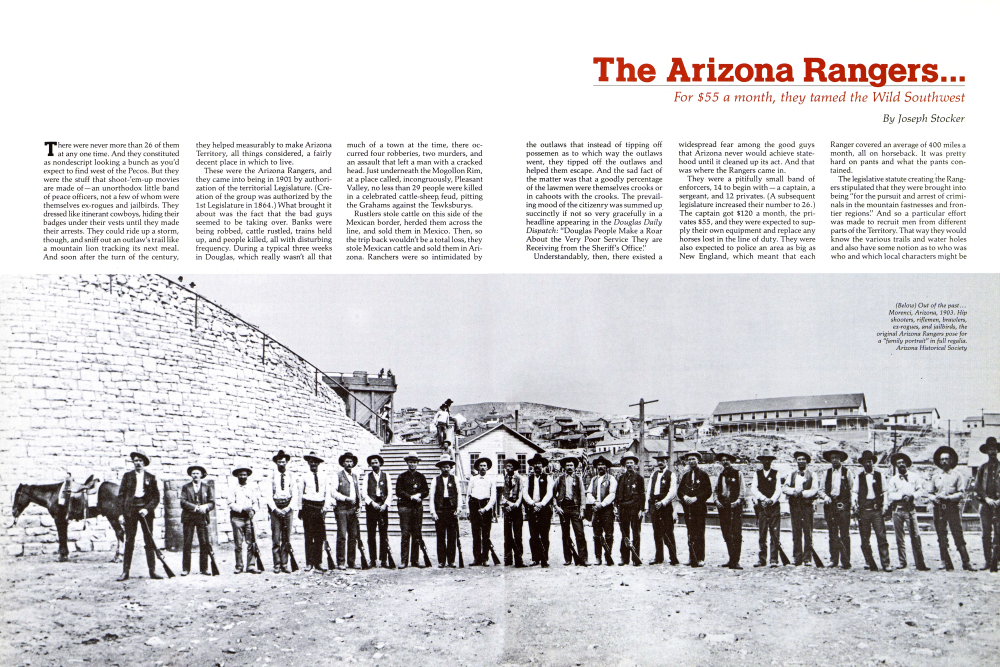
The Arizona Rangers... For $55 a month, they tamed the Wild Southwest
the outlaws that instead of tipping off possemen as to which way the outlaws went, they tipped off the outlaws and helped them escape. And the sad fact of the matter was that a goodly percentage of the lawmen were themselves crooks or in cahoots with the crooks. The prevailing mood of the citizenry was summed up succinctly if not so very gracefully in a headline appearing in the Douglas Daily Dispatch: "Douglas People Make a Roar About the Very Poor Service They are Receiving from the Sheriff's Office!" Understandably, then, there existed a widespread fear among the good guys that Arizona never would achieve statehood until it cleaned up its act. And that was where the Rangers came in.
They were a pitifully small band of enforcers, 14 to begin with a captain, a sergeant, and 12 privates. (A subsequent legislature increased their number to 26.) The captain got $120 a month, the privates $55, and they were expected to supply their own equipment and replace any horses lost in the line of duty. They were also expected to police an area as big as New England, which meant that each Ranger covered an average of 400 miles a month, all on horseback. It was pretty hard on pants and what the pants contained.
The legislative statute creating the Rangers stipulated that they were brought into being "for the pursuit and arrest of criminals in the mountain fastnesses and frontier regions." And so a particular effort was made to recruit men from different parts of the Territory. That way they would know the various trails and water holes and also have some notion as to who was who and which local characters might be (Below) The third and last commander of the Arizona Rangers, Harry C. Wheeler, left, in 1907. By this time, the public image of the "26 Men" was severely tarnished. A bill abolishing the force was passed in 1909.
Arizona Rangers
(Opposite page, top) Deputy Sheriff C. H. Farnsworth, left, and Ranger W. K. Foster. Fearless "hardcases" themselves, the Rangers often cooperated with the local constabulary to bring order out of the chaos that was Arizona around the turn of the century.
(Opposite page, center) Steely-eyed and appropriately posed by the photographer, Ranger John Redmond "awaits the outcome of a stakeout at Pusch's Steam Pump Ranch," December 4, 1908. Arizona Historical Society Rynning was what was known in the trade as a cool customer. Looking for a notorious horse thief named Wood, he walked into a saloon containing a substantial number of the fugitive's friends and Wood himself.
"I want you, Wood," said Rynning. Wood got off a shot and missed. Rynning drew and shot off Wood's trigger finger. It was a bravura performance that made its point with Wood's buddies. While they watched, no one making the slightest move for his gun, an intimidated bunch of roughnecks if there ever was one, Rynning treated the injured horse thief. He trimmed the ragged stump with his pocket knife, dipped it in a glass of whiskey to disinfect it, and wrapped it in a rag. Then he hauled the poor fellow off to the slammer.
Under Rynning the Rangers expended considerable effort rounding up cattle thieves. In 1903 and 1904 the little band of lawmen caught no less than 100 rustlers. Nor were they the easiest miscreants in the world to catch. Not infrequently a rustler was known to masquerade as an honest rancher.
One such was a cattleman in Cochise county named Taylor (his first name has vanished in the mists). His neighbors were positive he was branding their calves, but they couldn't get the goods on him. So Rynning and another Ranger, Johnny Brooks, roped 13 unbranded calves belonging to neighbors of Taylor. Then they made a small slit in the gullet of each calf and inserted a Mexican half-dime into it. It didn't hurt the calf, but it made a unique trap for Taylor to fall into. For what Rynning and Brooks did was drive the 13 calves onto Taylor's spread. Then they returned a short time afterward to find all 13 calves bearing his brand. Confronted with the evidence, he promised, if let go, to sell his ranch and cattle for about oneeighth of what they were worth and vamoose. And he did.
Not only were presumably honest ranchers discovered on occasion to be dishonest but so were presumably honest jurists. A Ranger named Billy Olds found one such justice of the peace along the border near Nogales. Olds just by damn couldn't get a rustler conviction in the
court of that particular j.p. for the simple reason that the j.p. was in cahoots with the rustlers. The officer set about solving the problem in the typically direct fashion of the Rangers. After a particularly egregious instance of miscarried justice in that particular court, Olds grabbed the j.p., tied him to a mesquite bush, and didn't let him go until he promised to interpret the law without fear, favor - or taking rustler booty under the table.
By now, though, the Rangers found that, for all their dash and derring-do, their luster was acquiring a bit of tarnish. One reason was that they kept messing around in copper-camp strikes and invariably on the side of the copper companies. When rioting broke out during a strike at Morenci, the Rangers under Rynning helped restore peace. Also, while they were at it, they helped put down the strike, and in return for his services the mining companies gave Tom Rynning a gold watch.
Then, not long afterward, Rynning stirred up a political hornet's nest. He “invaded” Mexico.
A strike was under way in an American-owned copper mining operation some 70 miles south of Bisbee, at the Mexican town of Cananea. The strike was called by Mexican miners for the very understandable reason that they were being paid less than Americans doing the same work in the same mines. Violence occurred, and Americans in the town sent panicky telegrams to Bisbee pleading for help.
At Bisbee a mob formed up and headed for the border. Tom Rynning and a handful of Rangers decided to take charge. At the border they were met by the governor of Sonora, Rafael Yzabel. Hot pursuit of lawbreakers was one thing, but intervention in the internal affairs of Mexico was quite another, he suggested indignantly.
Rynning came up with an idea. Let him and his men cross the border. Then they could be mustered into the Mexican army as “volunteers!” Governor Yzabel hesitated.
“If you don't take my advice,” warned Rynning, “all hell ain't going to hold this bunch back.” The governor acquiesced. Rynning and his ragtag force boarded a train and headed for Cananea, pursued by a barrage of anxious telegrams from the governor of Arizona, Joseph H. Kibbey, who knew that what Rynning was doing was essentially international vigilantism. Rynning subsequently confessed that he handed the telegrams to a compatriot without reading them. That way he could - and did say that he never really saw the telegrams until he got back.
Arriving in Cananea, Rynning's ersatz Mexican “army” was quickly confronted by the real thing-the Mexican Rurales under an improbable character named Emilio Kosterlitzky. The son of a Russian cavalry colonel, Kosterlitzky was himself a Russian naval cadet who jumped ship, joined the Mexican army, and worked up through the ranks.
“Get the hell out of Mexico, Tom, or I'll shoot you out!” Kosterlitzky said to Rynning, as the two forces faced each other in Cananea.
“You s.o.b.,” Rynning barked back, “get your troops up in those rocks where you can put up a fight, and I'll show you one that'll make you think you never were in one before!” Nothing came of all the tough talk. Indeed, this may have been the time, place, and situation in which the term “Mexican standoff” originated. The Rurales held their fire. The Rangers gathered up the local Americans some 300 of them and loaded them on a train bound for Bisbee. And in due course the strike wound down.
Governor Kibbey called Rynning on the carpet and fired him forthwith. “You'd better give that another thought, Governor,” said Rynning. (At least that's what he said he said in his subsequent autobiography.) “Right this minute I'm sort of a hero in Arizona. If you tied a can on me now, you'd be liable to get mobbed.” Kibbey quickly changed his mind and reinstated Rynning. A year later, after Rynning was succeeded by the third and last commander of the Rangers, Harry C. Wheeler, Kibbey made Rynning superintendent of the territorial prison at Yuma.
But the blush was off the Rangers' rose. They'd won widespread admiration for their heroic exploits, but they'd also drawn criticism. A charge of police brutality - so familiar in today's social context - dogged their trail. They were accused of harassing Hispanics. They were reproached for their strikebreaking activities. The sheriffs didn't like them, resenting their prestige, feeling that Ranger successes reflected on the sheriffs' own effectiveness. And now and again a Ranger would get involved in a drunken and widely-publicized brawl.
What finally laid the Rangers low was none of this, however, but simple partisan politics. Governor Kibbey was a Republican, the legislature, Democratic. A bill abolishing the Rangers was passed in 1909. Kibbey vetoed it. The legislature passed the bill over his veto.
“They were probably the only police force in history to be disbanded because they were too efficient,” comments Historian Marshall Trimble. “To the Arizona Rangers more than any other thing,” said a contemporary writer in Harper's Weekly,” may be traced the passing of the bad man.” Something else passed with the passing of the Rangers - what might be called the John Wayne era of Arizona history. From that point on, life in Arizona was never as dangerous as it had been-possibly also never quite as interesting.
Three years after the disappearance of the Rangers, statehood finally arrived-hastened a little, attained a bit more easily, perhaps, by the fact that the Rangers were here for awhile. And while they were here they got things rather nicely tidied up for those of us who came afterward.
Already a member? Login ».