Rodeo
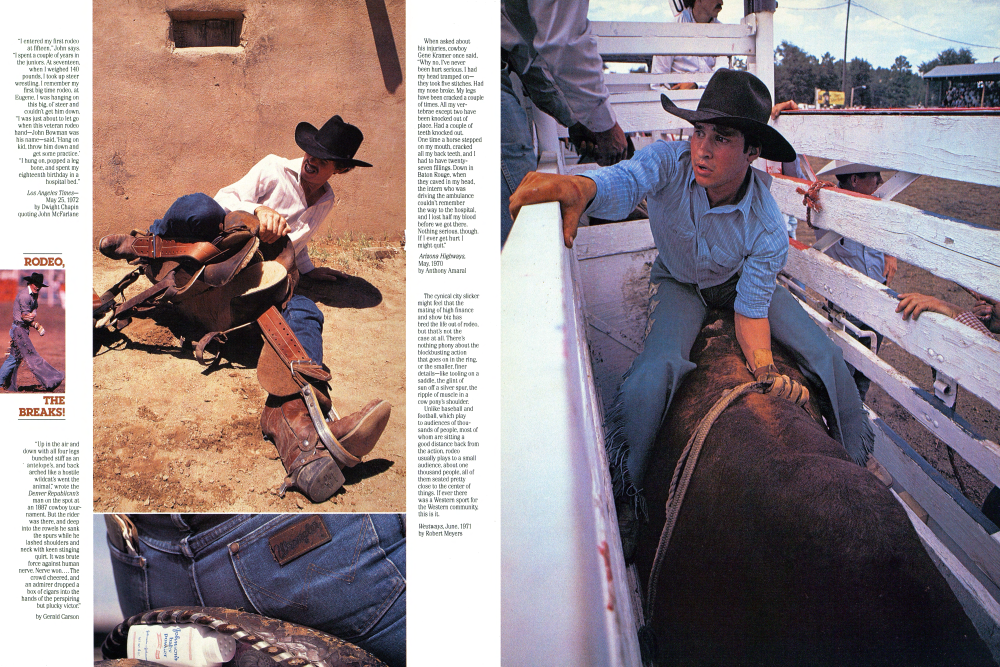
IN RODEO, COWBOYS GET ALL THE BREAKS!
Rodeo. What's it all about? Well, it's fun. Or it's supposed to be. Given, we all have to do something. Theories prevail that the animals at rodeos have a better time than the human participants. But maybe not, too. Rodeo is a contest. Combat. Struggle. But then, is not football? So, rodeo. Men and women, manipulating. Enduring. Prevailing. And animals at least, participating. Maybe, enjoying. Have you ever thrown a 190-pound man into a grandstand?
"I entered my first rodeo at fifteen,"John says. "I spent a couple of years in the juniors. At seventeen, when I weighed 140 pounds. I took up steer wrestling. I remember my first big time rodeo, at Eugene, I was hanging on this big, ol' steer and couldn't get him down.
"I was just about to let go when this veteran rodeo hand-John Bowman was his name said. "Hang on kid, throw him down and get some practice.' "I hung on, popped a leg bone, and spent my eighteenth birthday in a hospital bed."
Los Angeles TimesMay 25. 1972 by Dwight Chapin quoting John McFarlane
RODEO, THE BREAKS!
"Up in the air and down with all four legs bunched stiff as an antelope's, and back arched like a hostile wildcat's went the animal," wrote the Denver Republican's man on the spot at an 1887 cowboy tournament. But the rider was there, and deep into the rowels he sank the spurs while he lashed shoulders and neck with keen stinging quirt. It was brute force against human nerve. Nerve won.... The crowd cheered, and an admirer dropped a box of cigars into the hands of the perspiring but plucky victor." by Gerald Carson When asked about his injuries, cowboy Gene Kramer once said, "Why no, I've never been hurt serious. I had my head tramped onthey took five stitches. Had my nose broke. My legs have been cracked a couple of times. All my vertebrae except two have been knocked out of place. Had a couple of teeth knocked out. One time a horse stepped on my mouth, cracked all my back teeth, and I had to have twentyseven fillings. Down in Baton Rouge, when they caved in my head, the intern who was driving the ambulance couldn't remember the way to the hospital, and I lost half my blood before we got there. Nothing serious, though. If I ever get hurt I might quit."
Arizona Highways, May, 1970 by Anthony Amaral The cynical city slicker might feel that the mating of high finance and show biz has bred the life out of rodeo. But that's not the case at all. There's nothing phony about the blockbusting action that goes on in the ring. Or the smaller, finer details-like tooling on a saddle, the glint of sun off a silver spur, the ripple of muscle in a cow pony's shoulder. Unlike baseball and football, which play to audiences of thousands of people, most of whom are sitting a good distance back from the action, rodeo usually plays to a small audience, about one thousand people, all of them seated pretty close to the center of things. If ever there was a Western sport for the Western community. this is it.
Westways, June, 1971 by Robert Meyers
"Without trying to slander 'em, I'd have to say that bulls are about the meanest and sorriest creatures on earth." Mahan states. "If a horse bucks you off, and you fall in his path, he'll prance away from you. "It's really hard to love a bull, though. They get a kick out of stepping on guys, and if they have horns they're only too happy to oblige you that way, too. You don't even have to be thrown by bulls for them to hurt you: a lot of 'em like to whip a rider forward and then pancake his face into the back of their dumb, thick skulls. That winds up in a lot of missing teeth, black eyes, broken noses, and caved-in faces."
Los Angeles Times West magazine, June 25, 1972 by Lawrence Linderman quoting Larry Mahan "I thought I was dead in there," he said, shaking the bull fighter's hand. "Naw, you were just hung up." said Romer, stuffing chewing tobacco into his mouth. "You're looking better out there these days. At least you're getting hung up in style."
Arizona, March 28, 1982 by Paul Perry quoting Rhett Lamont Hardcastle
RODEO, THE BREAKS!
"I am about as funny," says Wick, "as a funeral in the rain. He is a rodeo bullfighter. Most people say he is the best in the business at saving a fallen bull rider from a cantankerous Brahma. But Wick doesn't feel very important. Other bullfighters costume themselves as clowns, but the role doesn't suit Peth's skills or temperament. He wears snug red tights, a striped shirt and low-topped football shoes. In his only concession to the theatrical nature of rodeo, he'll crown his head with a fright wig. "I wore makeup when I first started," he recalls, "but one day I forgot it and nobody said anything. I thought, oh, hell, what's the use?"
The San Diego Union, March 14. 1973 by Jack Murphy. Sports Editor quoting Wick Peth "I've always liked Prescott, even though I've broken my leg three times here," Bobby Romer, the "Bull Dancer" grins as he applies the powder over his clown make-up for the final performance of the Frontier Days Rodeo. And every once in awhile you get thrown up in the air. Lemme give you this picture here. That bull only threw me about ten feet off the ground, but the camera angle makes it look like I'm above the announcer's booth." Romer reaches into his mouth and removes half his upper teeth. He leaves the plate on the kitchen table of his deluxe travel trailer. "That's from a bull horn, too."
By Bob Farrell Overheard at the Prescott Rodeo "There's one basic thing that makes rodeo the greatest," he suggested. "You're on your own. You don't hand the ball to anybody. You can't blame somebody else for missing a block if you don't get through the hole. When you screw up, you have to face yourself."
Los Angeles Times, May 22, 1974 by John Hall quoting Larry Mahan Some cowboys say that a good bucking horse is really the aristocrat of the horse world. He has learned that if he can dump a man off in short order he only has to work eight or ten seconds about thirty times a year and the rest of the time languish in green pastures or eat the finest of scientifically rationed grains to keep him in peak physical condition. After attempting to break and ride some of these horses in my younger days, I am inclined to agree.
The Saturday Evening Post, July/August 1973 by Dollie Cole
Rodeo. The word comes from the Spanish rodear, to "encircle" or round up." Those in the business, the American cowboys, have anglicized it to ro-dee-o. Call it this in Payson.
This year in August. Payson celebrates its rodeo centennial. In 1884, two years before the townsite was established, local cowhands, vying to show their skills, gathered in a meadow in the center of the settlement. Later the contest outgrew the meadow, and the activity moved to the main street, a dusty "arena" fenced in by wagons, buggies, and Model T's. A way of life was born.
Among contestants a spirit of camaraderie existed. They competed to win but were free in lending their horses, advice, and money. In the early days, some people were so determined to get to the Payson rodeo they walked, sometimes from as far away as Camp Verde. Today, with the automobile, Payson is "just a half tank of gas away."
Now the town is tightening its saddle cinches planning new rodeo grounds for the next 100 years. -Marguerite Noble Bareback riding is the most punishing event in rodeo, according to Mahan. "Your hand in the rigging is the only point of control between you and the horse," he said. "The jerk and strain through the hand and arm to your body are tremendous, and you keep spurring as wildly as you can. You look like a big flying bird that's hooked onto the horse."
Sports Illustrated by Edwin Shrake quoting Larry Mahan The mesquite brush along the San Pedro River in southeastern Arizona was so thick that it was all a horse could do to force his way through, let alone catch a wild cow in that thorny tangle. A lot of people would never give it a thought, but that is the reason why Arizona has produced the fastest calf ropers in the world. A cowboy down in that country gets about one throw, and most of the time not a good, clear throw, at a calf; if he doesn't get him with that loop chances are he'll never see him again. You watch one of these boys in the rodeo arena when that calf breaks the barrier and that old pony comes out a-fogging-that cowboy will swing that little loop a couple of times and let fly. Nine times out of ten he'll make a good catch. They sure as hell didn't learn to rope like that out in the middle of a wheat field!
Trail Dust & Gun Smoke, 1965 by Jack Grant (BACK COVER) The Haught Ranch, under the Tonto Rim. Zane Grey often used the site to color the scenes of his 111 Western novels. Nyle Leatham photo
RODEO, THE BREAKS!
Already a member? Login ».