SPRING
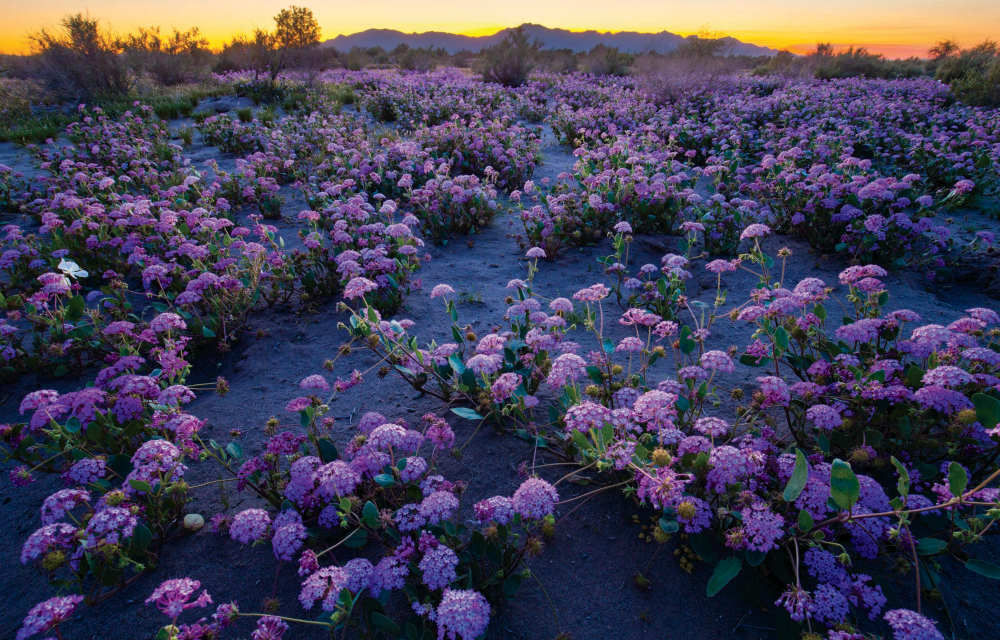
During winter, the soil is in repose. Then one day there is a warming caress in the touch of the sun. Then it’s spring, always a magic word, always a magic season. There is the sun and there is always the soil, but often there is no rain, and rain, of course, is the third portion of the alchemy that makes the land bloom in beauty. If winter rains are heavy and there is rain in early spring, the desert floor becomes a carpet of color when millions of seeds come to life.
If there is rain … February, March, April in the desert are the colorful months. The color parade starts early in the sand dunes near Yuma, and as the days pass, the carpet of blossoms of all shapes, shades and hues is unrolled to the higher elevations.
If there is rain … May is a colorful month on the high plateaus, and even in the slick-rock country of the Navajos, usually a burned brown in the sun, spring works her charms. Spring’s invitation has a particular appeal to those with a touch of the wanderer in their makeup.
— Raymond Carlson, February 1955
Joel Hazelton
With the Sierra Estrella in the background, blooming sand verbenas carpet the bed of the Gila River at sunset. From its headwaters in New Mexico, the Gila crosses Arizona from east to west before emptying into the Colorado River in Yuma, but some stretches, including this one, are dry for most of the year.
CANON EOS 6D, 13 SEC, F/16, ISO 320, 16 MM LENS
Paul Gill
Lupines and a handful of Mexican goldpoppies surround a variety of cactuses — prickly pear, barrel and saguaro — and ocotillos on a hillside near Superior. This spot is near the inactive Silver King Mine, said to have been the most productive silver mine in Arizona’s history.
CANON EOS 5D MARK III, 1/4 SEC, F/11, ISO 100, 24 MM LENS
Guy Schmickle
Desert wildflowers anchor a view of the Ajo Range, a defining feature of Southern Arizona’s Organ Pipe Cactus National Monument. Owing to its size and varied terrain, the 330,000-acre monument is home to more than 650 plant species.
FUJIFILM GFX100S, 1/10 SEC, F/11, ISO 100, 50 MM LENS
Claire Curran
Vibrant wildflowers contrast with rippled sand on a dune in the Havasu Wilderness. Covering parts of Arizona and California along the Colorado River, this 18,000-acre wilderness area is managed by the U.S. Fish and Wildlife Service.
CANON EOS 5DS R, 1/80 SEC, F/14, ISO 400, 24 MM LENS
Sue Cullumber
A lupine grows amid a backdrop of Mexican goldpoppies in Gilbert, a suburb of Phoenix. Typically, Sonoran Desert wildflowers bloom in March and April, but the extent of the bloom depends heavily on the previous year’s rainfall.
CANON EOS 5D MARK III, 1/1600 SEC, F/2.8, ISO 640, 100 MM LENS
Suzanne Mathia
Blooming ocotillos and brittlebushes define a view at the Grand Canyon as clouds clear from the gorge. This photo was made during a rafting trip down the Colorado River, one of the most immersive ways to experience Arizona’s best-known natural wonder.
CANON EOS-1DS MARK III, 1/13 SEC, F/11, ISO 100, 85 MM LENS
George Stocking
Brittlebushes and teddy bear chollas contribute to a thicket of vegetation on a hillside above Bartlett Lake, northeast of the Phoenix area. The reservoir, formed by a dam on the Verde River, is known for its spring wildflower displays.
CANON EOS 5D MARK II, 1/30 SEC, F/4, ISO 100, 35 MM LENS
Paul Gill
The first of dozens of blossoms begin to open on the arm of a saguaro cactus, an iconic Sonoran Desert species. Saguaro blossoms, Arizona’s official state flower, typically open in May or June and are pollinated by bats, bees and birds.
CANON EOS 5D MARK II, 1/40 SEC, F/11, ISO 100, 45 MM LENS
Jack Dykinga
The rolling foothills of the Huachuca Mountains, near Arizona’s border with Mexico, cradle a landscape of prickly poppies and oaks at sunrise. In the distance are the Whetstone Mountains, home to Kartchner Caverns State Park.
WISTA 4X5, FUJICHROME VELVIA, 3 SEC, F/32, ISO 50, 75 MM LENS
Gurinder Singh
Countless Mexican goldpoppies and a smattering of other wildflowers blanket a hillside in the Tonto National Forest of Central Arizona. Covering nearly 3 million acres, the Tonto is the largest national forest in Arizona.
NIKON D800, 1/125 SEC, F/22, ISO 400, 34 MM LENS
Paul Gill
Mexican goldpoppies form the backdrop for a delicate wildflower in the genus Gilia. Flowers in this genus typically are found in sunny, well-draining soil in desert or semi-desert habitats.
CANON EOS 5D MARK III, 1/1000 SEC, F/8, ISO 800, 65 MM LENS
Claire Curran
Saguaros and chollas rise from a sea of desert globemallows and brittlebushes near Theodore Roosevelt Lake, east of Phoenix. Both of these Sonoran Desert wildflowers typically bloom in late winter and early spring. FUJIFILM GFX100S, 1/200 SEC, F/16, ISO 200, 56.3 MM LENS
Already a member? Login ».