

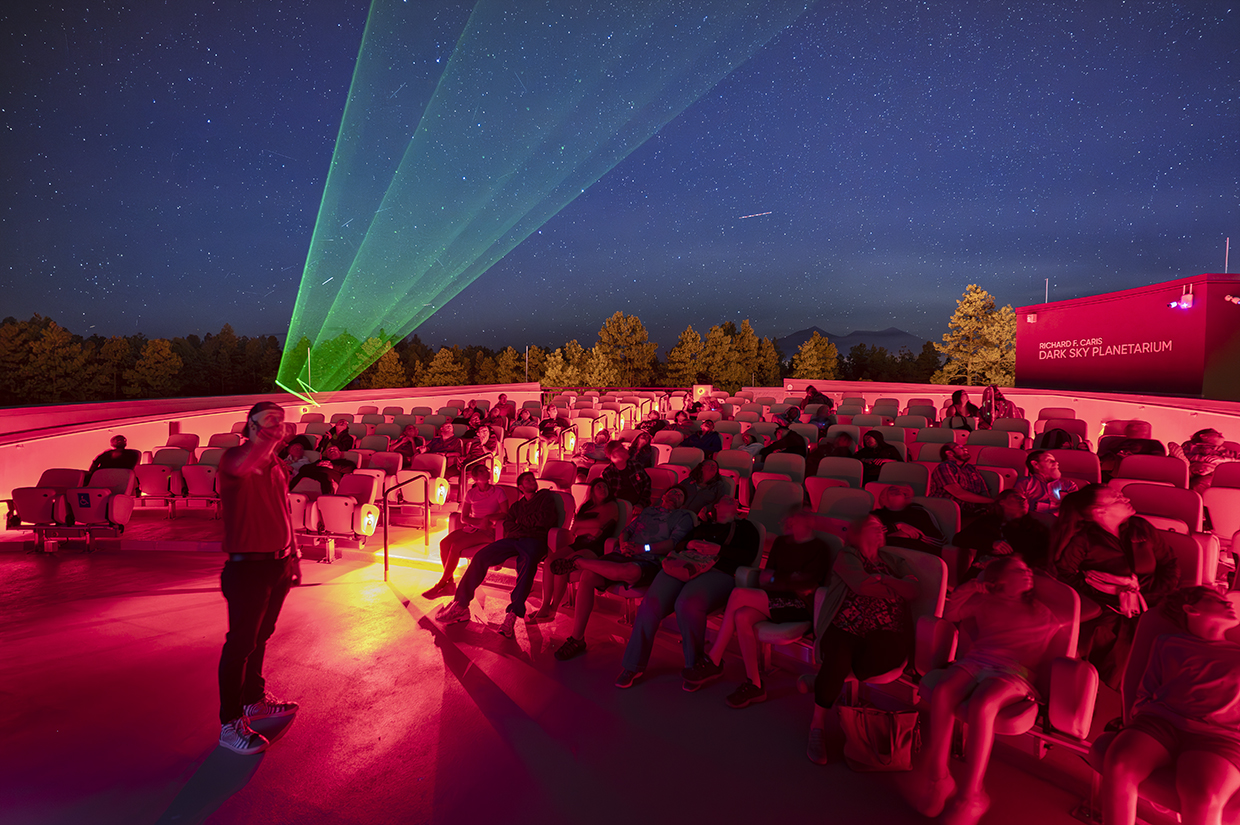
Most planetariums are indoors, where images are projected onto a domed ceiling to create a digital facsimile of the cosmos. But there’s no ceiling above Lowell Observatory’s new Richard F. Caris Dark Sky Planetarium. “Why build an indoor planetarium when you have a site like this?” asks Lowell historian Kevin Schindler.
It’s a bright, chilly winter day, and Schindler is standing on the roof of Lowell’s Astronomy Discovery Center, where the Dark Sky Planetarium is located. The vantage point offers a view of the San Francisco Peaks to the north, a ponderosa pine forest surrounding the observatory campus and Flagstaff far below.
Despite record growth over the past several decades, Flagstaff has gone to great lengths to protect its renowned dark skies against light pollution. Even though the city’s population now exceeds 77,000, the Milky Way is still visible from most residential streets on clear nights. Schindler says these conservation efforts have made it possible for Lowell, which attracts more than 100,000 visitors annually, to build a unique open-air planetarium less than
2 miles from downtown.
“Here, you can just lean back and look at the real thing, instead of something projected onto a ceiling,” he adds. It helps that the planetarium’s comfortable theater-style seats are heated to ward off the evening chill at Lowell’s 7,000-foot elevation.
But the open-air planetarium is just one part of a whole new visitor experience offered at the observatory since the $53 million, 40,000-square-foot Astronomy Discovery Center opened in November 2024 — on the heels of the completion of the Giovale Open Deck Observatory in 2019. The upgrades mark a leap forward for Lowell, which was established in 1894 as one of the first astronomical research institutions in the United States. And Newsweek recently took notice, naming Lowell the best science museum in the country as the result of public voting for the magazine’s Readers’ Choice Awards.
When Percival Lowell arrived in Flagstaff 130 years ago, he was interested in searching for signs of intelligent life on Mars. Flagstaff still lacked electric lights, so a forested hilltop just west of town made the perfect observatory site. Other astronomers were also drawn to what became known as Mars Hill, and one of them, Lowell scientist Clyde Tombaugh, famously discovered Pluto there in 1930. The Coconino Sun (now the Arizona Daily Sun) called the find the “scientific achievement of the century.”
Astronomical research has continued at Lowell since its founding. But Schindler points out that inviting non-scientists to learn about the cosmos has also always been part of the observatory’s mission. “Percival Lowell would welcome the public to the observatory on Saturday nights and let them look through the telescope,” he says. “I think it’s amazing that visitors on the Open Deck Observatory today are looking through telescopes in the same location as scientists did a century ago.”
Historic facilities, including the telescope used to discover Pluto, have long been part of visitor tours, and the campus was designated a National Historic Landmark in 1965. But a high-tech viewing experience is now possible, too: Six advanced telescopes are powerful enough to capture distant cosmic wonders such as the Andromeda galaxy, the Lagoon Nebula and the Pleiades star cluster.
Meanwhile, the Astronomy Discovery Center is filled with immersive indoor exhibits that teach visitors about the universe. The Orbits Curiosity Zone, for young children, includes an air-powered rocket launcher and an infrared camera that measures body heat. The Stardust Lab, for older children and adults, features an exhibit that approximates the smells of the universe. (Interstellar gases, for example, give off the odor of “charred meat,” according to astronauts.) There’s also an IMAX-like 180-seat theater. But the capstone is the nighttime view from the open-air planetarium beneath Flagstaff’s exceptionally dark skies.
On a clear evening in the winter, as on many cloudless nights, every spot in the 155-seat planetarium is taken. A presenter guides visitors on a tour of the velvety black sky, using a green laser pointer to highlight planets and constellations. She shares stories about the cosmos from Greek mythology and teaches the audience how to identify the North Star.
Wrapped in blankets and puffy jackets, people rock back in their heated seats and gaze up. Contemplating the heavens from this comfortable vantage point is both cozy and awe-inspiring. And because light pollution prevents about 80 percent of Americans from being able to see the Milky Way, the star-spangled sky above Lowell is a rare treat for many visitors. Even as the show concludes, visitors linger in their seats, seemingly filled with wonder.
“Could there be life on other planets?” the presenter asks. “Are we alone in the universe?” On this hilltop, surrounded by the infinite twinkling lights of the universe, Percival Lowell’s existential questions feel as relevant as ever.
FLAGSTAFF Lowell Observatory, 1400 W. Mars Hill Road, 928-774-3358, lowell.edu