

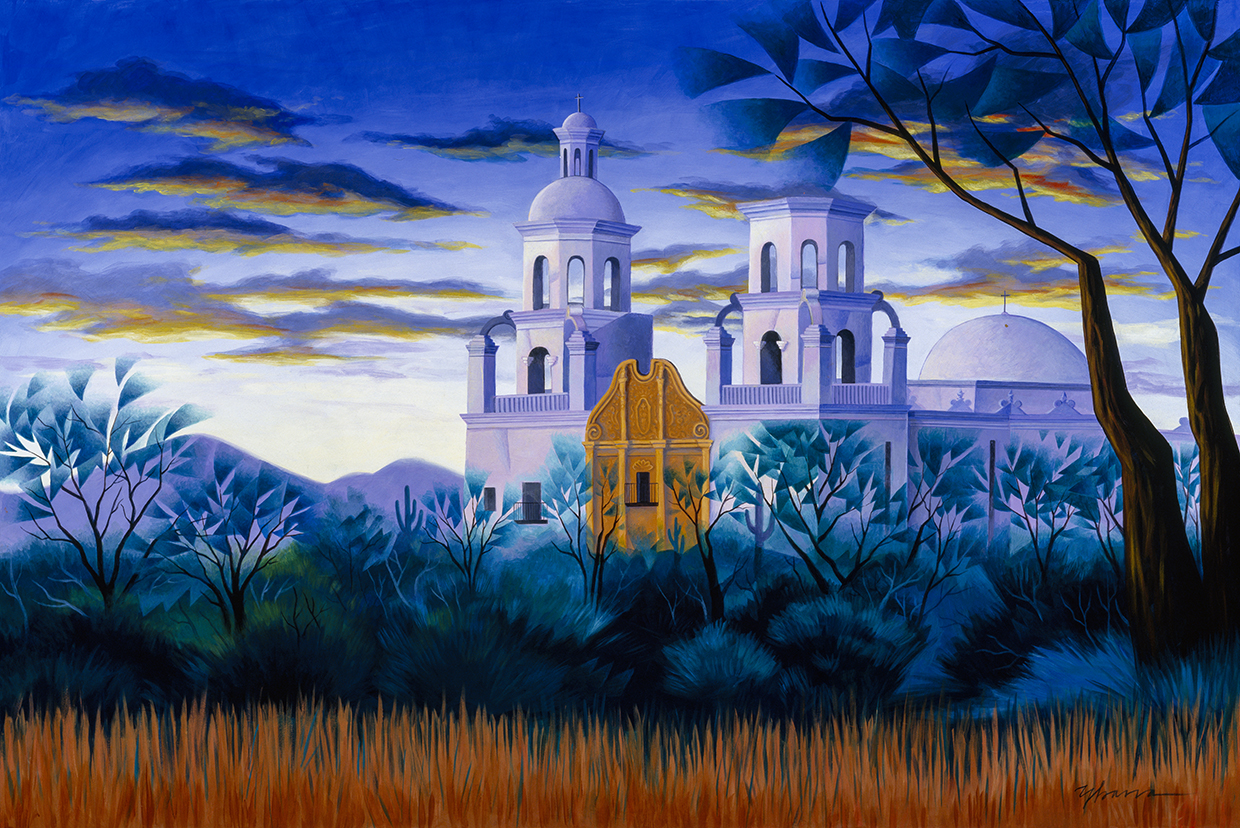
Editor's Note: In December 1941 — 85 years ago this month — we published this story about San Xavier del Bac. In it, our gifted writer explained that the mission had been a place of peace for centuries, and "a temple in which there are no races, no classes and no divisions among the followers" of Jesus. Subscribers would have gotten their issues around the first day of the month. A week later, Pearl Harbor was attacked by Japanese pilots.
THE HOUR WAS NEAR TO MIDNIGHT. THE December air was cold. Stars pricked the dark dome of Heaven and shadows receded from the illuminated towers of San Xavier del Bac. Even the circling rim of silhouetted mountains seemed to wait in the breathless hush that enveloped the desert. Quietly from the nothingness of blackness came figures that passed under the majestic arch of the mission's doors.
... Now when Jesus was born in Bethlehem of Judaea in the days of Herod the king, behold, there came wise men from the east to Jerusalem ...
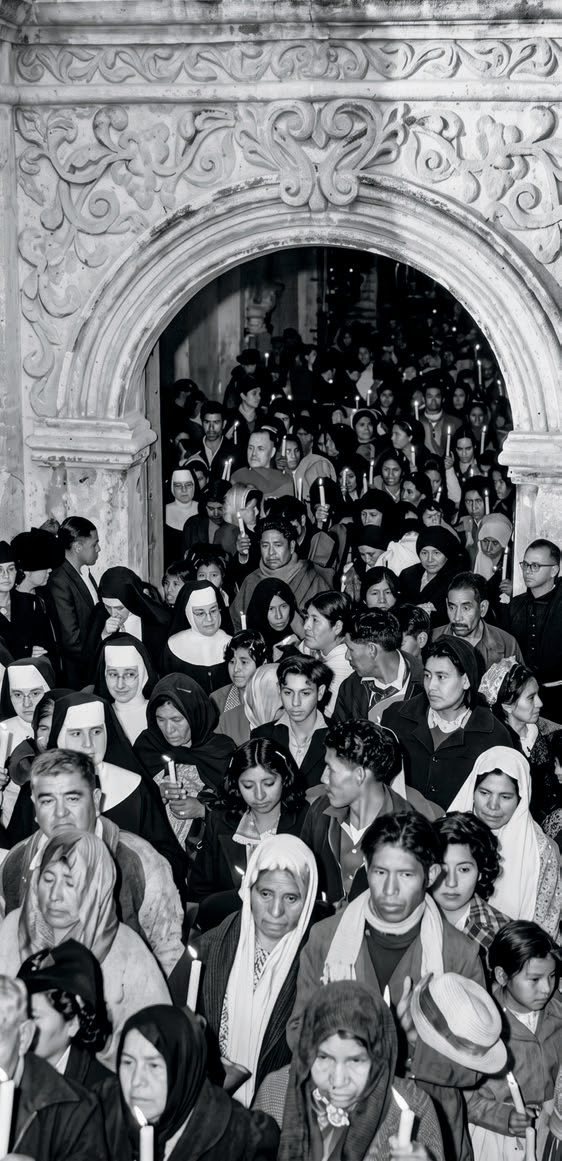
AS FOR ONE THOUSAND NINE HUNDRED AND forty one years, men came to rejoice that Christ was born. They came to San Xavier not on camels, as did the wise men. They came from afar by foot and creaking wagon from the Papago Indian Reservation. They came in tin Lizzies and limousines from Tucson. Races and stations were forgotten. Rich and poor occupied the pews, knelt in prayer. Indians, Mexicans, Americans were one, come to rejoice with exceeding great joy that the son of Mary had been born.
And from above in the towers came the sound of trumpets. To the four winds were sent Christmas carols played by two Papago men. They had forgotten their people’s ancient god, Etoi — the little god of Baboquivari Peak who sat down to think when confronted by a problem, the little god who bravely slew the Great Monster of Quitovac to free the Papago people. They trumpeted carols for the Christ child.
Then the bells of San Xavier rang out of the darkness and the night. Wildly, joyously they pealed. Tingles crept down spines of those in the crowded mission below. Vibrations set to quivering the banners and streamers spun garishly in colorful lengths between the stately arches, about the statues of saints and across ancient murals. Candles flickered at the stations of the cross, in the chapels and before the altar.
THEY MOVED BEFORE THE SHIMMERING LIGHT OF THE ALTAR, BENEATH GILDED PILLARS, CARVED CHERUBS AND THE STATUE OF THE MISSION'S PATRON, ST. FRANCIS XAVIER.
Sharp-edged, the night air slipped along the floors where mongrel dogs were pushed backward from hand to hand toward the doors. Babies snuggled closer in warm folds of mothers' arms and small children whimpered against parental legs. As the bells quieted, there were heard the sibilant sounds of pages turned in prayer books and the faint click of moving rosaries. There were lined faces whose age fell away as prayers formed on thin lips and the young bloomed under spiritual thoughts.
A hush filled the vaulted interior as the door of the Sacristy opened. The high mass was about to begin. The celebrant of the mass — this year of 1941 he will be Father Edmund — appeared, attended by seven Papago altar boys in bright cassocks and surplices. The priest's gold chasuble picked up candlelight as it hung from his shoulders, showed in its lustrous folds the colored needlework portrait of St. Francis Xavier, and partly hid the white alb, deep edged with lace, that hung beneath.
They moved before the shimmering light of the altar, beneath gilded pillars, carved cherubs and the statue of the mission’s patron, St. Francis Xavier. Above them was the Holy Virgin and high, high in the shaded remoteness of the upper altar was the Creator of all.
The priest and altar boys formed a candle-lit procession, moved from the altar, down the steps, and across, east, to the Epistle chapel. There Indians had arranged a manger scene with a figure of the infant Christ in an unusual, swinging crib. These the priest blessed. Then he lifted from the crib the Christ child figure which he carried back to the high altar and placed above the tabernacle. He began to sing the gospel, rich Latin phrases resounding in the old mission, coming to ear filled with meaning and awakening to memory the thousands of times these massive walls have heard the words said.
He began to sing the gospel, rich Latin phrases resounding in the old mission, coming to ear filled with meaning and awakening to memory the thousands of times these massive walls have heard the words said.
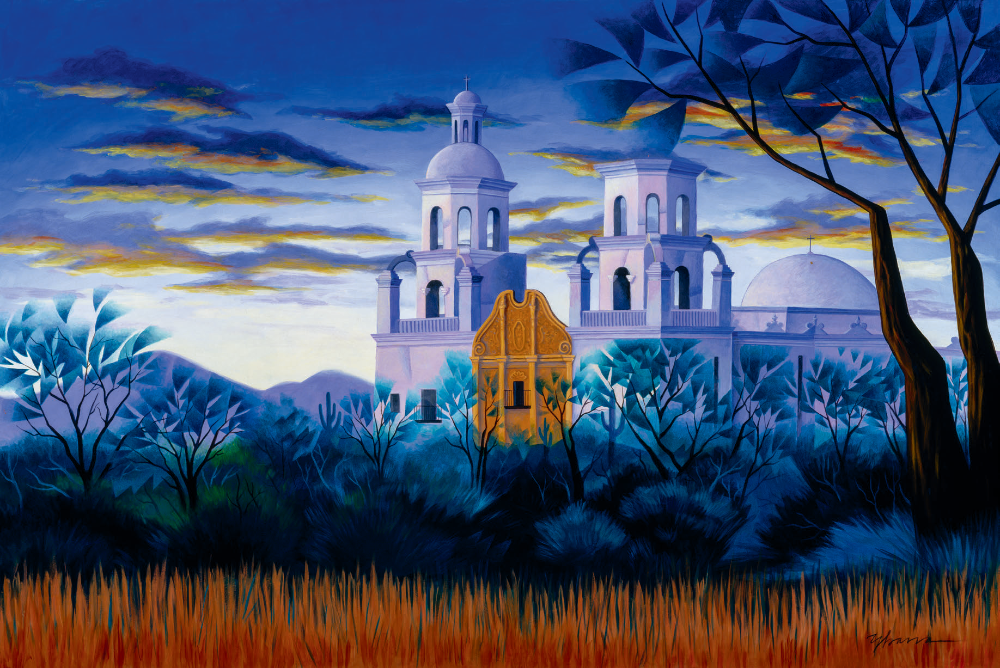
Only remotely does one hear, now, the Papago choir of fourteen voices intone the Kyrie in Latin. The eye no longer sees the dresses of Indian women, the black of Mexican shawls, or the furs of a winter visitor. Lost, too, are the tissue streamers and bright paper flowers. The mind has wandered back to pay tribute to the past.
Empires have risen and fallen, kings have been crowned and crumbled to dusty history since San Xavier del Bac was founded. Three nations have held dominance over the land on which it stands, but this is meaningless before the mission's spiritual message. It has seen the revolt of peaceful Indians, known the raids of Apaches, and been used for "stable, barns and barracks," but these have not stained it. Today, it is called the greatest and most beautiful of Spanish missions within the United States. It is the best preserved and the only one still in use by descendants of the Indians for whom it was built. But San Xavier knows no strutting pride.
There clings to this mission the spirit of its founder, Padre Kino, and the spirit of all the subsequent priests who forfeited homelands and comforts to bring to the Indians of the desert the story of a child born in a manger in Bethlehem.
Of the Jesuit Order, Padre Kino first visited the rancheria of Bac on the Santa Cruz River in 1692, established a visita among the Indians and dedicated it to St. Francis Xavier — Apostle of the Indies. On April 28, 1700, he helped to lay the foundations of the original mission north of the present one. He did not live to see his peaceful Indians revolt nor to know that Charles III of Spain expelled the Jesuits from New Spain in 1767.
Other priests took Padre Kino's place in the years that followed. They knew "blood, sweat and tears" in bringing a new culture to a raw, new land. Apache raids made necessary a Spanish presidio in Tucson, which was built in 1776 to protect the church and priests nine miles to the south.
The church in which mass is now being said was begun in 1785, built from raw materials brought from valley and mountain and its construction directed by the tireless priests. It was finished in 1797. Mexico won independence from Spain in 1822, confiscated all missions, and let loose dark days for San Xavier. Papago people hid the church treasures. The village of Bac was deserted. Soldiers slept in the nave and stabled their horses in the church the Franciscans called "La Paloma Blanca del Desierto" — The White Dove of the Desert.
Americans bought southern Arizona from Mexico in 1854. The twin towers of the mission became a guide to covered wagon trains. Security came with ever increasing numbers of Americans living in the valley, in Tucson. The hidden bells, statues and vestments were returned to the church. Indians once again held their feasts to St. Francis, responded to the call from the belfry to masses and decorated the church for Christmas eve midnight mass. Years of neglect ended when the Franciscans returned in 1911 to San Xavier to take permanent charge of the lovely structure.
THROUGH THE MIND HAD SWEPT THE CENTURIES. With a sense of guilt one realized that the priest had read the gospel, the choir had sung the Credo and the sermon had been spoken. The sermons are usually said in Papago, respoken then in English and Spanish. This year of 1941 Father Edmund, not speaking Papago, may delegate that duty.
The Papago choir sang the other songs of the high mass, Gloria, Sanctus and Agnus Dei ("Lamb of God"). The figures at the altar reformed in procession taking the figure of the Infant Christ back to its swinging crib in the creche. Through the mission floats the Adeste Fideles and then, softly, Silent Night.
The mass is over. Many move through the great doors into the sharp night air and the darkness. Silks rub against denim jackets patched at elbow, lace mantillas catch on English tweeds, perfumes and scents mingle with garlic and chili smells, and murmuring voices are hidden by the awakened cries of children and the yap of dogs trod upon as they try to find their masters.
But behind, near the altar in the mission, linger many of the Papago parishioners. They have formed a line that leads to the manger in the Epistle chapel. Patiently they wait. As each reaches the manger he takes his turn at swinging the crib. One by one they leave. The old mission is gradually emptied. Once again man has rejoiced at the birth of Christ, acknowledged peace on earth, good will toward all men. Faith has been renewed and assurance given for the future of a troubled people in a world of turmoil.
Peace is within San Xavier del Bac, a peace that has transcended centuries of human travail, the ambitions of kings and despots, the changing patterns of civilizations. So it must continue through the centuries, a monument to man's spiritual hunger and courage, and a temple in which there are no races, no classes and no divisions among the followers of the Man who died to make men holy and free.