

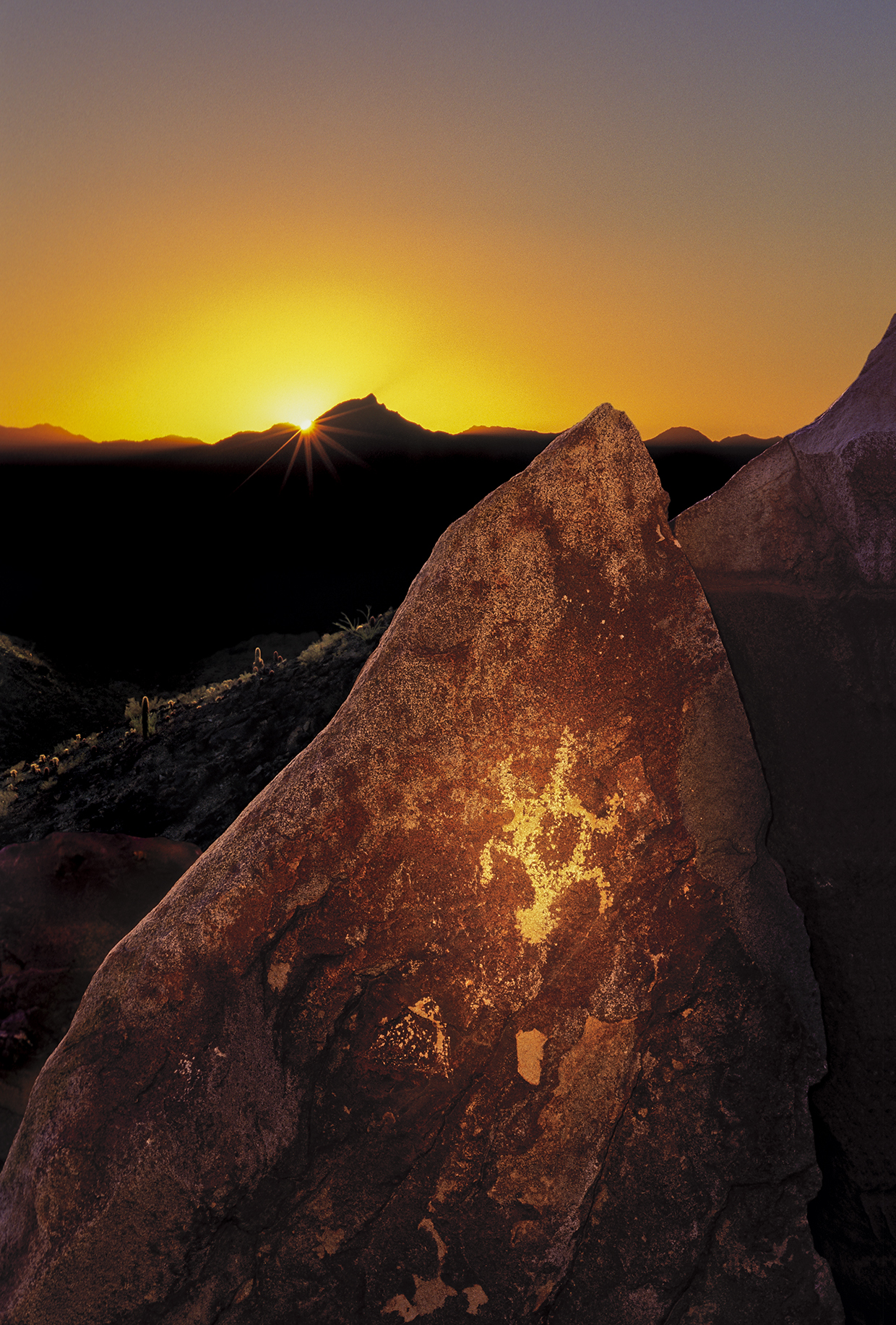
WHERE SUNLIGHT TOUCHES THE EARTH, a calendar forms, a natural sundial. The alignments can be uncanny. The perfect shadow of an enormous mountain lion stalks down the face of the Superstition Mountains in March and again in September, formed by the natural happenstance of the mountain and of the spring and fall equinoxes. When the cat appears, you can tell the week and month of the year.
Shadow marks have been observed and noted for thousands of years. These are human-made, left by ancient agrarians who pecked into rock with bone awls and hammerstones. Early calendar makers left spirals and circles within circles, some associated with celestial movements, a way of talking with the sky. Every human civilization has done this in one form or another, counting days, naming months, giving lengths to years, predicting eclipses. Not far across the border into Chihuahua, Mexico, the 15th century city of Paquimé, also known as Casas Grandes, stands in ruins, its effigy mounds, ball courts and adobe walls aligned with solar positions. The east half of this once great settlement has a different architecture than the west, the two equally divided by a clearly built wall. The side that greets sunrise is constructed into squares and rooms, living and work spaces, and the side facing sunset is made of walls and open-air mounds, public spaces for markets, ceremonies, gatherings.
At S’edav Va’aki Museum, an ancient Hohokam platform mound complex in Phoenix formerly known as Pueblo Grande, a shaft of light connects doorways on both the winter and summer solstices, identifying the two midway points of the year. These Indigenous ancestors were certainly looking up. Elsewhere they used sun daggers and shapes made by shadows, aligning them with the sky using peckings and paintings.
We are in one of their times right now. The winter solstice is on us, coming every year around December 21. On this day near Montezuma Castle — a Southern Sinaguan cliff dwelling built in the Verde Valley around the year 1125 and occupied for centuries — a light dagger crosses a wall of intricate, interlocked petroglyphs. Shaped like a long, sharp tooth, this light enters a clearly pecked ring of three concentric circles with a dot in the middle. Like a finger, the light touches the dot.
Each time of year comes back exactly as it had, the sun and its seasons returning with only slight variation, not enough to move the sundial from its pecked circles. It’s not that anyone a thousand years ago would have forgotten it was winter; this would have been a marker reminding them that winter will end, which is maybe why calendars started. The question has long been asked: When will the sun return?
WINTER’S HARDLY A THING TO COMPLAIN ABOUT. The Southwest gets more sunshine than most of the planet, but the days are measurably shorter, the shadows longer. The sun sets like a rock dropped in water. Christmas lights have gone up as if pushing back the night.
On good years, snow piles up in the high country, mounding the cabin roofs, plowed off the highway through Alpine, Pinetop-Lakeside, Payson. The low country goes cold, arms of saguaros drooping where they froze overnight.
Saguaros can be used as markers of this winter or that, when clusters of arms went down, their tips pointing askew as if indicating dates on a calendar. Markers like this are visible anywhere, sunlight landing on a picture in a frame, or casting a shaft on a rug that you see no other time of the year. Timepieces are ticking all around us. Noticing makes a calendar.
On the day of the winter solstice, the sun ends its journey to the northern horizon. This is where it turns around, promising spring, summer, fall, ad infinitum. Long ago, there must have been a fear shared by people worldwide that the sun would keep going, setting earlier, rising later, until finally it would wink out and only night would remain. A calendar guarantees restoration, a stamp of seasonal approval. In the depth of winter, you can now think about moving ahead.
The year 1125 along the Verde River, with its pale high-rise cliff dwellings, would have come with the same shapes and timing of shadows and tones of light as we have today. By the winter solstice, most leaves would have fallen from cottonwoods and sycamores. The dry remaining few bat around in an afternoon breeze. Two daggers reach across a rock face covered in petroglyphs, and one meets these nested rings of circles, every year the same week at the same time.
The human mind desires pattern, constancy, something to return to. Religions and ceremonies are built around it, cathedrals aligned to cardinal directions, winter announced with celebrations, reasons to not wither in the dark.
I can’t say what people of the time were doing at the moment of these alignments, if it was shells and smoke like a Tibetan monastery, a pinch of corn pollen and a gesture at the directions, or if people were gathered in a rave of celebrations like a rowdy basket dance, bare feet pounding the ground, shell tinklers and small copper bells on their ankles ringing out. What is sure is that they saw the moment the same as we do, shadows and light precise. It may have felt different back then, but search deep and you’ll remember. Who isn’t afraid the light will wander off and never come back?
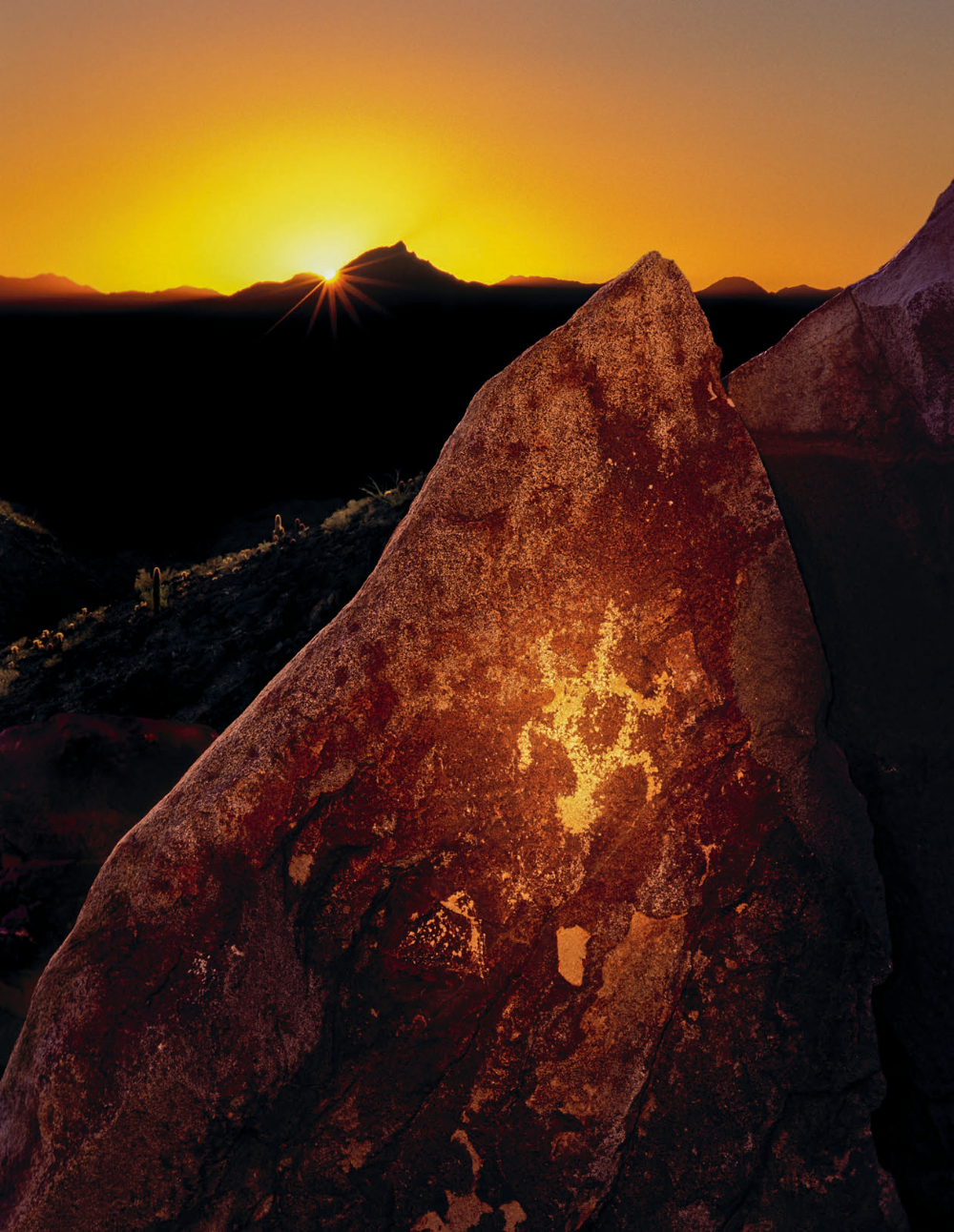
SOLSTICE IS FROM THE LATIN SOLSTITIUM, which means “the sun stands still.” It happens twice a year, once in the summer on the longest day and again in the winter, the shortest day. The sun sets and rises at its farthest points on the horizon. Like a yo-yo pausing before it returns, the Earth hangs, or stands still, the Northern Hemisphere leaning as far into darkness as it gets. You might have waited with bated breath to see us start swinging back after several days, dials of sunlight moving back the way they came.
Northern countries worldwide have their winter observances. Streets in Lithuania are stacked with bonfires on this night, ancient hill forts across the Baltics lit with fires built in trash-can lids, leaving charred circles in the winter grass come morning. In Baltic tradition, a mythical white nine-horned stag is said to bring the newborn sun back on its antlers after the solstice has passed, the stag associated with the sun goddess, Saulė, who brings growth and life to the world. This is why the moment is marked. If it doesn’t return, we all will be left stumbling cold and scared.
Humanity is defined by looking outward and up, taking our cue from birds who navigate by stars, turning the heavens into a timetable. We’ve codified and refined the observations. The summer solstice steals the archaeoastronomical show in Arizona, the state lighting up with documented petroglyph alignments like fireworks, but I find the season too busy, too showy and, frankly, too hot. Winter feels like curling up in a shell, metabolism relaxing. It is a time of needed rest. When a sun dagger entered its winter spiral, people would have felt not only fear or hope, but also reverence, a reminder that this is the time we turn inward, the center of our own kind of hibernation. Growing season is over. Now we subsist off of what we gathered.
From the rugged chain of South Mountain at the edge of Phoenix, where petroglyphs are innumerable, the horizon is delineated into seasons, sunrises and sunsets connecting with images on the ground. The same happens inside the city, where rocky slopes and tops of inner-urban buttes are dotted with petroglyphs. The city roars all around. Between Thunderbird Road and Dunlap Avenue, in the sprawl of North Mountain, a circle with a dot in its center was placed many centuries ago. This small petroglyph is on a boulder with a pointed tip, and if you position yourself superimposing the tip on the horizon, the winter solstice sunrise will break through, as if pointed to by an arrow. Next to this circular petroglyph is the image of a person, perhaps a sun watcher.
It says, Stand here on this day and this is what you will see.
CLIMATES LIFT AND FALL: decades and centuries of drought, rainy years, glorious snowpacks. Civilization grows and shrinks and grows again, ushering in new faces, voices, languages. One kind of ware becomes another, Pueblo black-and-white pottery to Coke bottles. What has not changed is the way the sun reaches the Earth. Mountains and boulders stand where they have for millennia. The 23.5-degree tilt of the planet keeps our seasons in line, and lanes of shadow and light watched by ancient observers are now watched by us. These planetary, astronomical time frames are much slower than our own, inching by thousands of years, and millions. We don’t notice the change. The finger of light still touches the button.
On the summer solstice in Petrified Forest near the Puerco River, a varnished rock face decorated with petroglyphs receives a narrow beam of light. This light moves into a circular image pecked into the rock, put there by Hopi and Pueblo ancestors, similar to the concentric circles along the Verde. First light fits like a key. On another boulder nearby, the winter solstice brings a long triangle of light, a sharp tooth, that passes through a pecked spiral, the same kind of story unfolding at so many sites.
This part of Arizona, out past Holbrook, is windblown and colorful with its painted hills and red-brown fields of boulders. It can be bracing in the middle of winter, snow as dry as sawdust scattered in pockets. Horizons are infinite, as if you were inside a vast bowl. At the moment of sunrise, light goes everywhere. A thousand years ago, someone must have gone out to see the winter solstice meet its marker. A clan priest perhaps, a farmer, a curious traveler would have worn a turkey-feather blanket to keep off the chill, looking at the same boulders and brittle butte tops as we see now.
Wherever you are, this is the time of year to step outside in slippers and look to the sunrise, to stand in the kitchen as light rises in the east. Today, the many eyes of the winter solstice are lighting up, observatories cracking open. A new year is coming, the planet celebrating its own turning by putting a warm, golden light on your face.