
Shane McDermott
Tonto National Forest
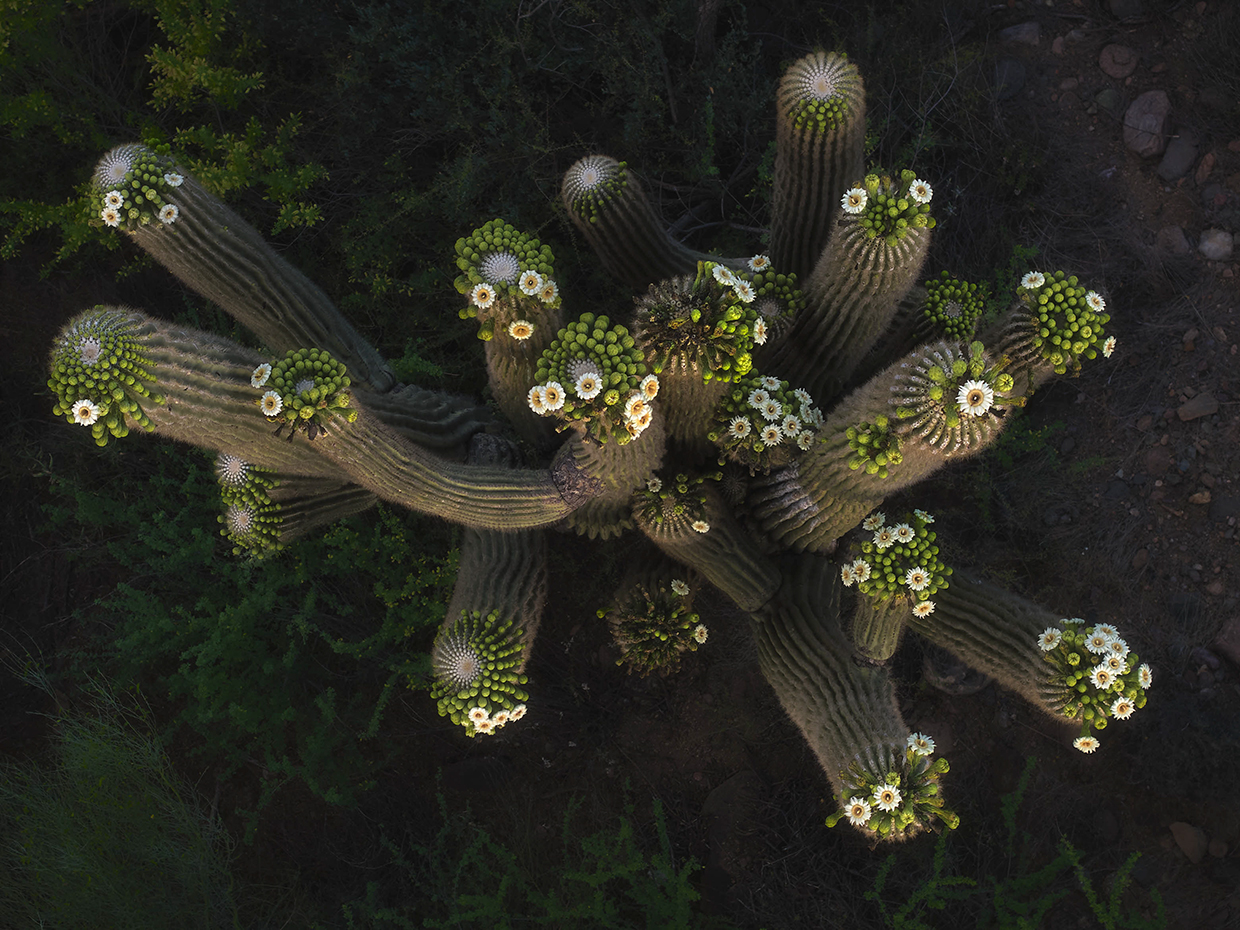
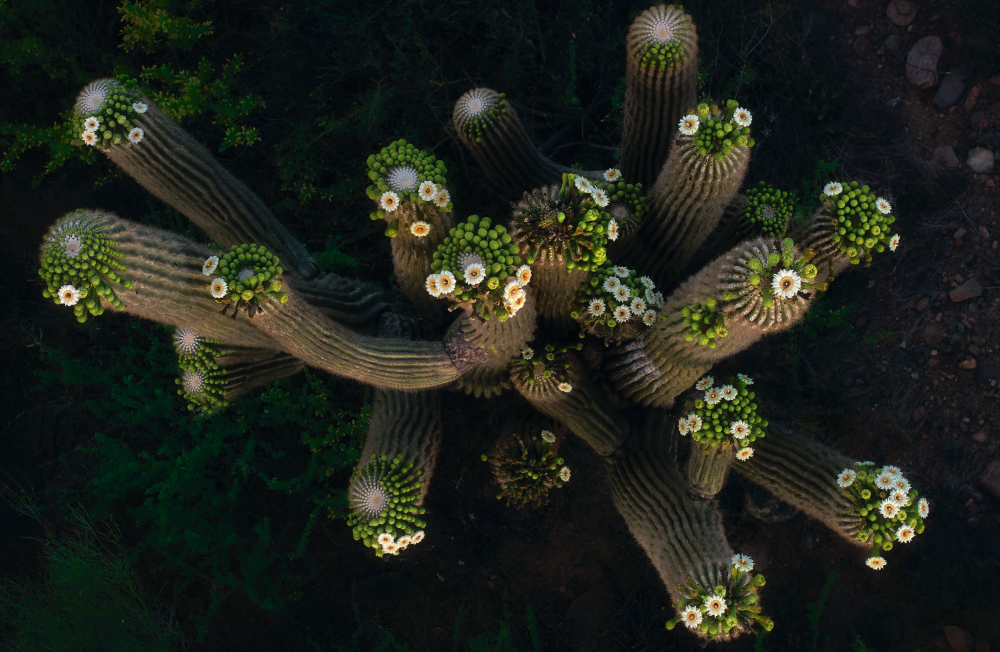
“This shot was about six years in the making,” Shane McDermott says. “I’ve tried shooting saguaro blooms in the past, taking a more traditional approach from the ground, but I always came away disappointed. I had a vision of photographing saguaros with a drone about six or seven years ago. At the time, drone technology wasn’t very good and didn’t allow me to capture low-light images like this one. I could see the images I wanted to capture in my mind’s eye, and knew that if the conditions came together, the images would be breathtaking. Because of their immense height, most of the saguaro blooms go unnoticed. I’ve been motivated for years to try to capture the mystery and mystique of their concealed beauty. Saguaro blooms tend to open at night for the feeding bats, so the best time to photograph them is early morning, before the sun rises. Last year, the conditions were perfect. There was no wind, which allowed me to photograph the saguaros in early dawn light before the sun was up. Because the saguaros are so tall, they catch the first soft dawn light, and the ground below them remains very dark. No wind, coupled with a strong seasonal bloom, allowed me two different mornings to photograph the saguaros with my drone using slow shutter speeds. I tried to photograph them again this year with my drone, but came away with nothing. It was a weak seasonal bloom, and every morning I tried, there was a subtle wind that blurred all the images. For me, it makes the images I have even more precious.”
DJI, 1/80 SEC, f/2.8, ISO 100, 19.35 MM LENS
Paul Gill
Superstition Wilderness
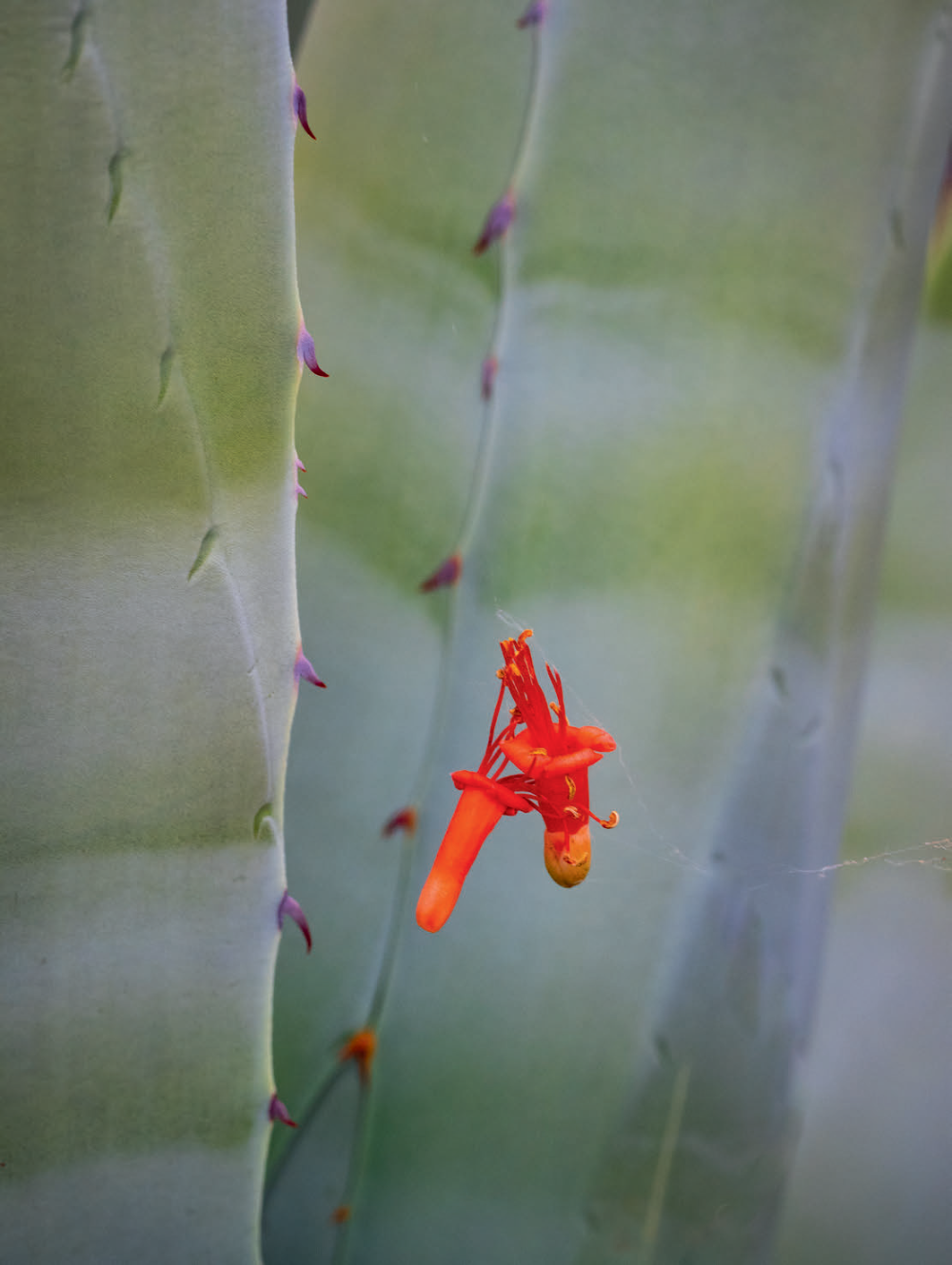
“In this image, you’re looking at a couple of ocotillo blooms that fell onto a spiderweb, which was draped across a century plant in the Superstition Wilderness,” Paul Gill says. “I spend a lot of time looking down — keeping an eye on the ground — when I’m out hiking. That’s how I find a lot of the vignettes I use in my macro photography. It all started when I’d be out photographing carpets of wildflowers. Because of how delicate they are, I’m always careful to watch where I step. And so, my eyes are usually focused on the ground. In most cases, I carry a macro lens, a 4-foot reflector and a diffuser. I’d say that about 80 percent of my images are taken on a tripod that’s set low to the ground. Most of my work has been shaped by four years of composition, color theory, illustration and film photography at Arizona State University; a career of art directing for companies like the Scottsdale Center for the Performing Arts; and then turning my hobby of nature photography into a full-time business in 2000, when I was published for the first time in Arizona Highways.”
Olympus E-M1 MARK II, 1/200 SEC, f/8, ISO 800, 100 MM LENS
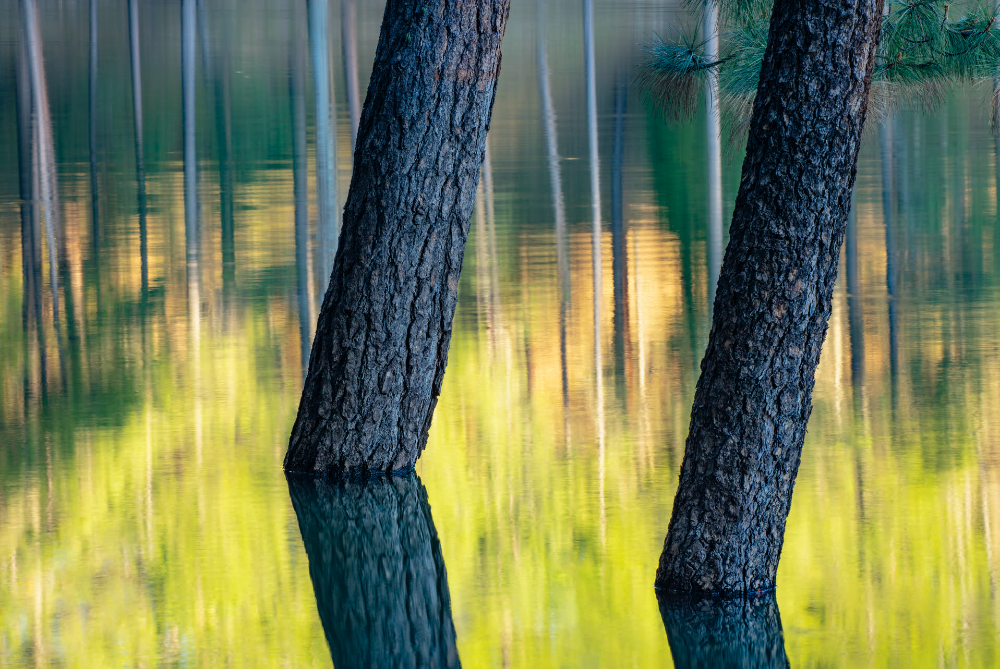
Joel Hazelton
Mogollon Rim
“I was camping on the Mogollon Rim a few years ago, after a very wet spring produced plenty of new growth and filled up the lakes and creeks with snowmelt,” Joel Hazelton says. “This lake, Potato Lake, was a few feet higher than normal, which is why these pine trees were partially underwater. I generally show up to a location with a classic landscape in mind: a strong foreground, background and sky, and a lot of front-to-back depth. However, the conditions I encountered were not conducive to that sort of image. The small lake is in a basin that doesn’t receive late-evening light, the sky was uninteresting, and there were few foreground options. Two aspects of this lake did capture my attention, though: the partially submerged trees near the shoreline, and the afternoon light producing brilliant reflections of the aspens on the opposite shore. I took out my mid-range zoom lens and spent my afternoon working to combine these two elements into a single, cohesive image.”
CANON EOS 5DS, 0.8 SEC, F/18, ISO 250, 135 MM LENS
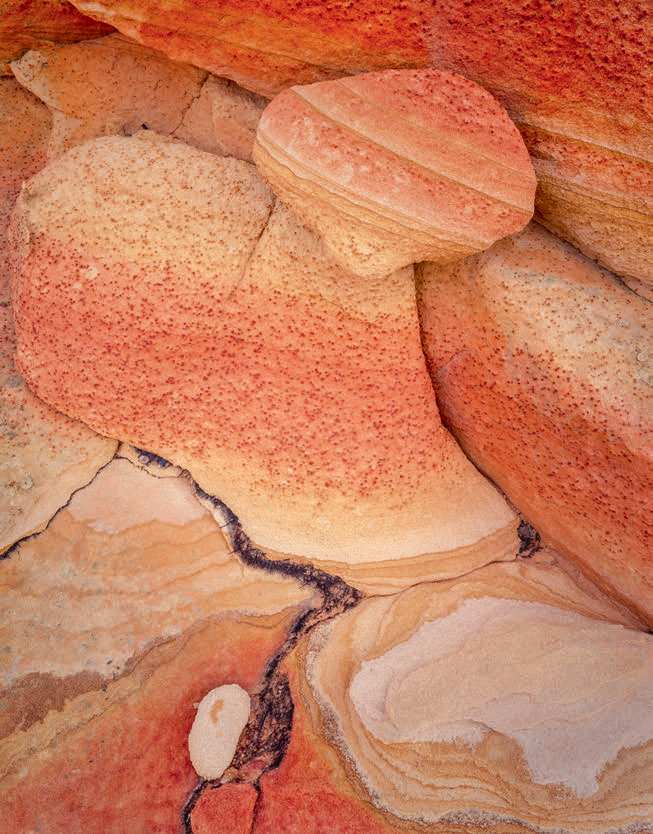
Jack Dykinga
Vermilion Cliffs National Monument
“I’m always on the lookout for juxtapositions and textures,” Jack Dykinga says. “So, amid the striated sandstone, a rounded eroded nodule checked both boxes. Whenever an image in nature can tell a story, it magnifies its impact. Moving through any given place, I always seem to be looking for the micro oddity that speaks to a place in a macro sense. I’m drawn to the unusual. In essence, a good photograph is a window into a world that a viewer may never actually experience. My photojournalistic training is always working in the background — a curious mind helps. Making an image is really an amazing thing. As Jay Dusard, my recently departed fellow photographer, said, ‘You impose a window on the landscape, deciding what’s in and what’s out.’ The details supply the flavor and texture, and, with the broad overview, provide a deeply personal sense of place.”
ARCA-SWISS F-FIELD 4X5, 3 SEC, F/32, ISO 50, 180 MM LENS
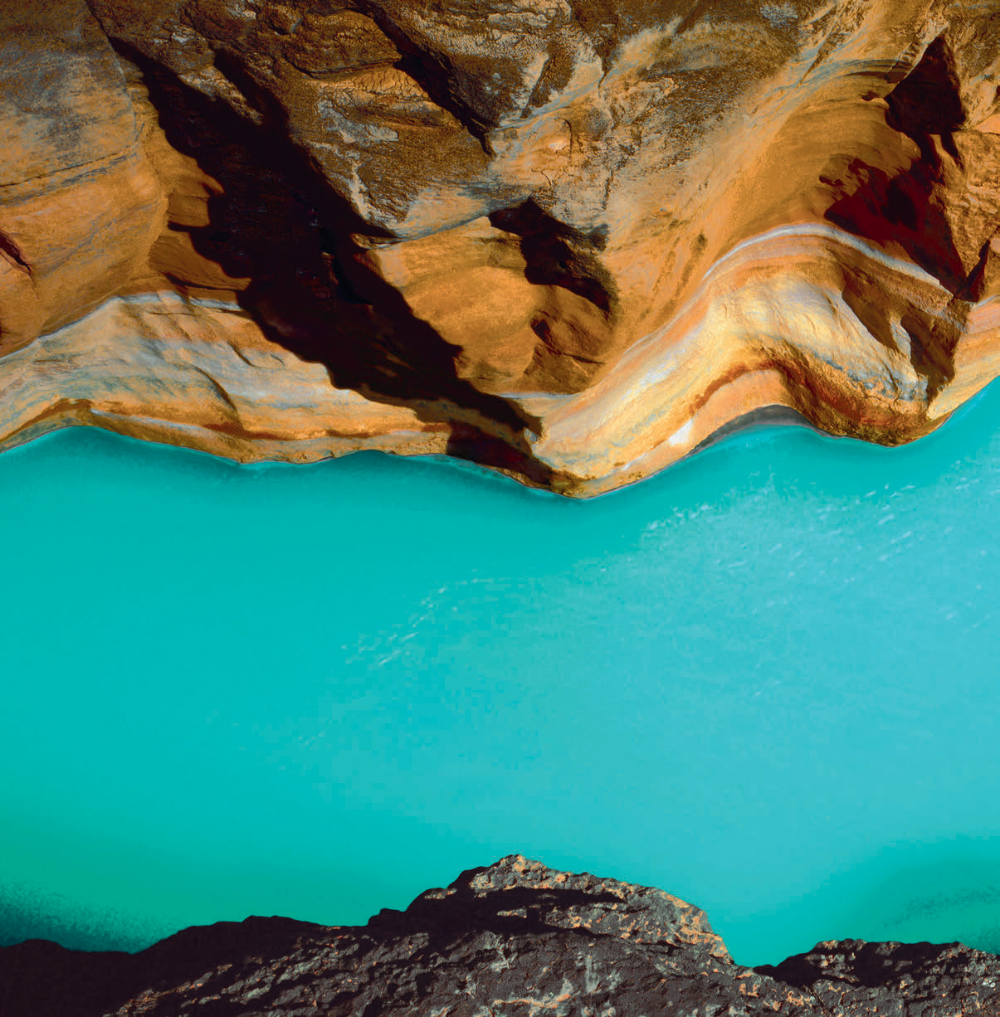
Wes Timmerman
Grand Canyon
“I made this image while on a float trip in September 2012,” Wes Timmerman says. “As anyone who’s ever been there knows, looking into the Havasu Creek Narrows is thrilling and spectacular. I knew this was my chance, maybe my only chance, to use my Tachihara 4X5 on a windless, perfect day. I ran back to the raft that was rodeoing against the river canyon wall and retrieved my camera kit and tripod, while the rest of the group went up to Beaver Falls. Now alone and accompanied by a pretty good dose of adrenaline, I set up the camera and worked out the overall composition, focus and exposure without being in a hurry. I had to keep the tripod legs folded in quite a bit to allow me to get as close to the edge as possible — I moved very slowly and cautiously. I like to include texture, pattern and rhythm in an image, if I can get them.”
TACHIHARA 4x5, 1/8 SEC, f/45, ISO 100, 90 MM LENS
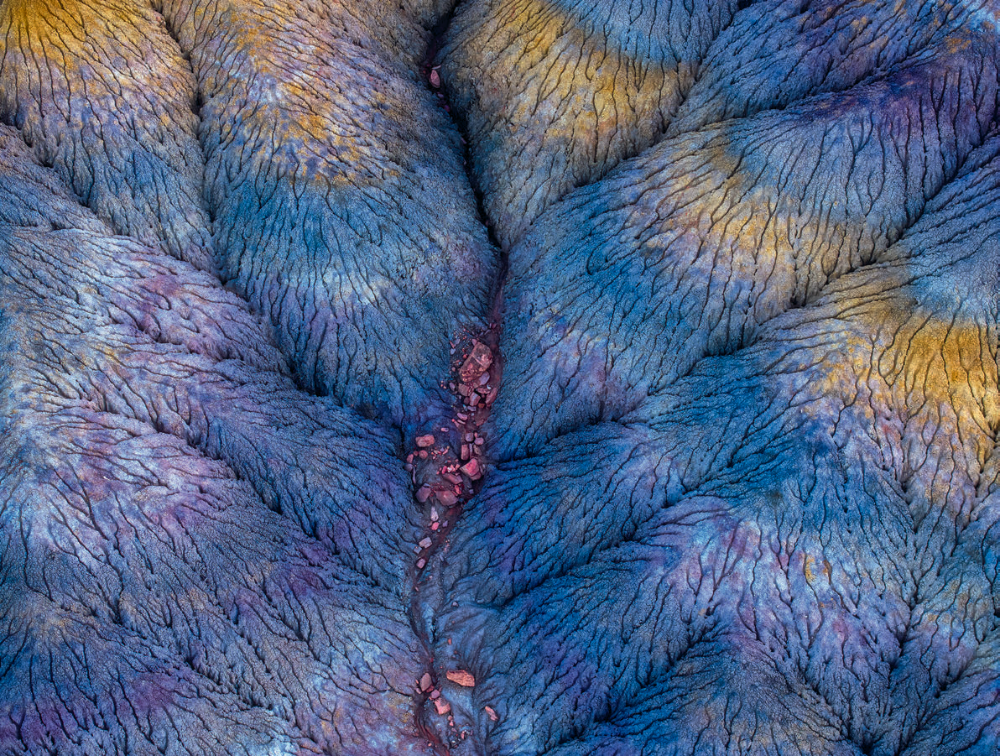
Shane McDermott
Northern Arizona
“This is an extremely fragile area,” Shane McDermott says. “It’s an incredibly beautiful and colorful area, about a quarter-mile in length; however, the ground is very soft, similar to walking in sand. Every step leaves a deep impression on the Earth’s crust. This, coupled with extremely steep undulating hills, made it impossible to photograph from the ground without destroying the subtle textures and leaving footprints that would last for years. I’ve wanted to photograph this area for a long time, and I realized that using a drone would be the best approach to leave no trace, while still capturing the incredible beauty. After many years of using a drone, I’ve become more interested in what I’m calling ‘aerial intimates’ or ‘macro aerials.’ I find myself flying into areas that would be inaccessible by foot and getting very intimate perspectives, 1 to 3 feet off the ground or away from a cliff edge. I love capturing drone images that viewers think I captured from the ground.
DJI, 1/50 SEC, f/2.8, ISO 100, 19.35 MM LENS
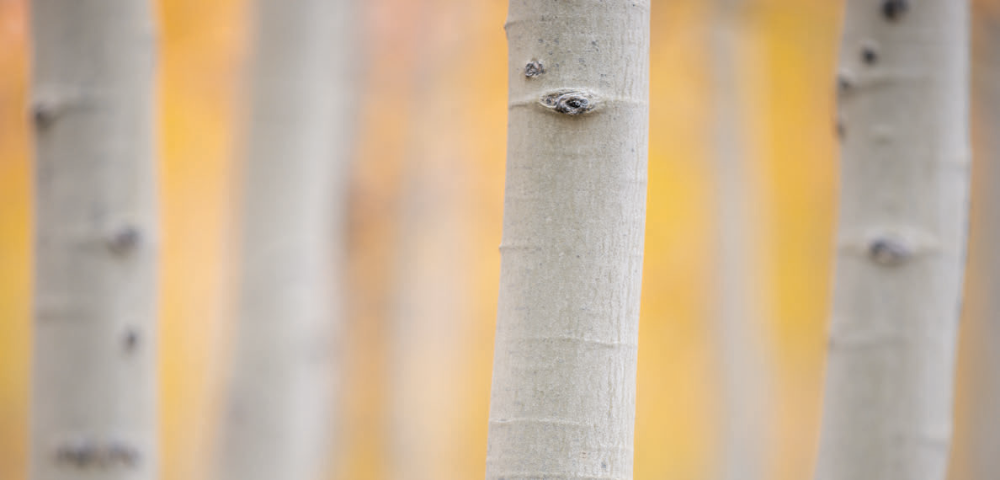
Rebecca Wilks
Kaibab National Forest
“This image was made along Forest Road 612 in the Kaibab National Forest,” Rebecca Wilks says, “in an area later devastated by the Dragon Bravo Fire. I was inspired by the light. I’d been camping nearby, waiting for friends to join me, wandering around with my camera. The late-afternoon sky was lightly overcast, just enough to create a soft glow on the autumn leaves behind these aspen trunks. I maximized the scene’s gentleness by making the image with a long focal length lens and a wide aperture to create a very shallow depth of field. That conveyed the dreamy look I saw, which contrasted with the insistent gaze of the tree knot on the one trunk that is in sharp focus. When I’m completely immersed in photography in the forest, I’m consciously aware of the things that are challenging to convey visually, like the rushing of foliage in a breeze and the unique aroma of fallen aspen leaves. Nevertheless, I hope that anyone seeing this will feel the soft charm of autumn in an aspen grove and the magical presence of the trees.”
CANON EOS R5, 1/30 SEC, F/2.8, ISO 200, 200 MM LENS
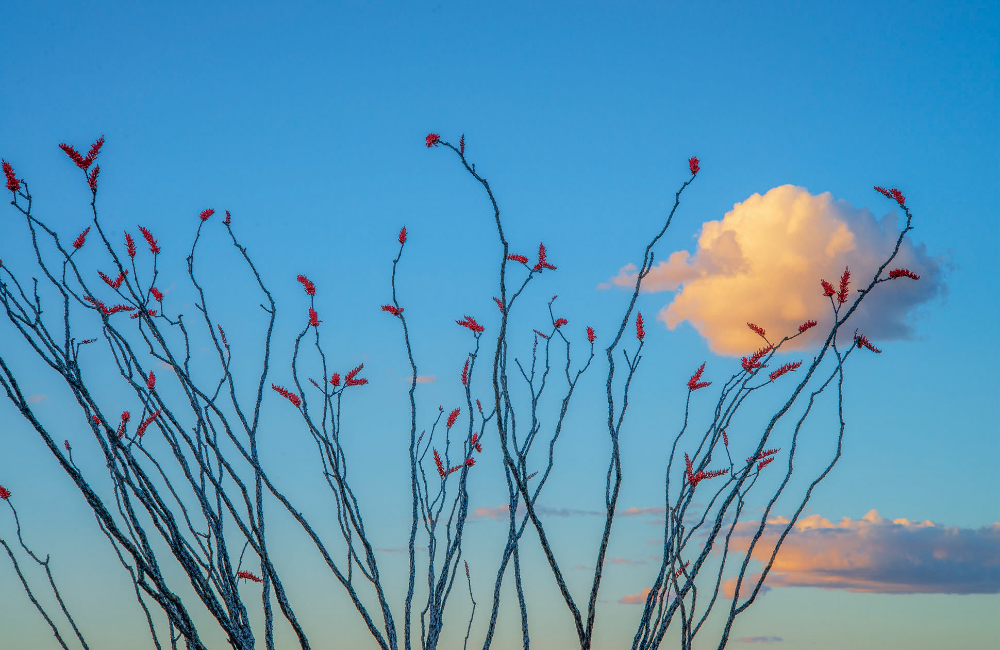
Norma Jean Gargasz
Tumacacori Mountains
“As I moseyed down a series of dirt roads west of Interstate 19 and Tubac, in the later part of the day, the alignment of the ocotillo and the cloud drew my attention very quickly,” Norma Jean Gargasz says. “The cloud was in the perfect place. I had to carefully maneuver myself around a bit of cactus and tall grass to get this shot. It wasn’t preconceived. I explore this area frequently and have noticed an abundance of ocotillos during my adventures. It just so happened that on that day the elements aligned perfectly — evening light, ocotillo in bloom and the gift of the cloud. My thinking was to create a playful image of the relationship between the ocotillo and the cloud, rather than a literal photographic landscape. Desert flora, especially ocotillos, can have a light-hearted nature to it. I like to think of these types of images as scenarios that one might notice at a glance along the way.”
NIKON D600, 1/80 SEC, F/14, ISO 250, 85 MM LENS