
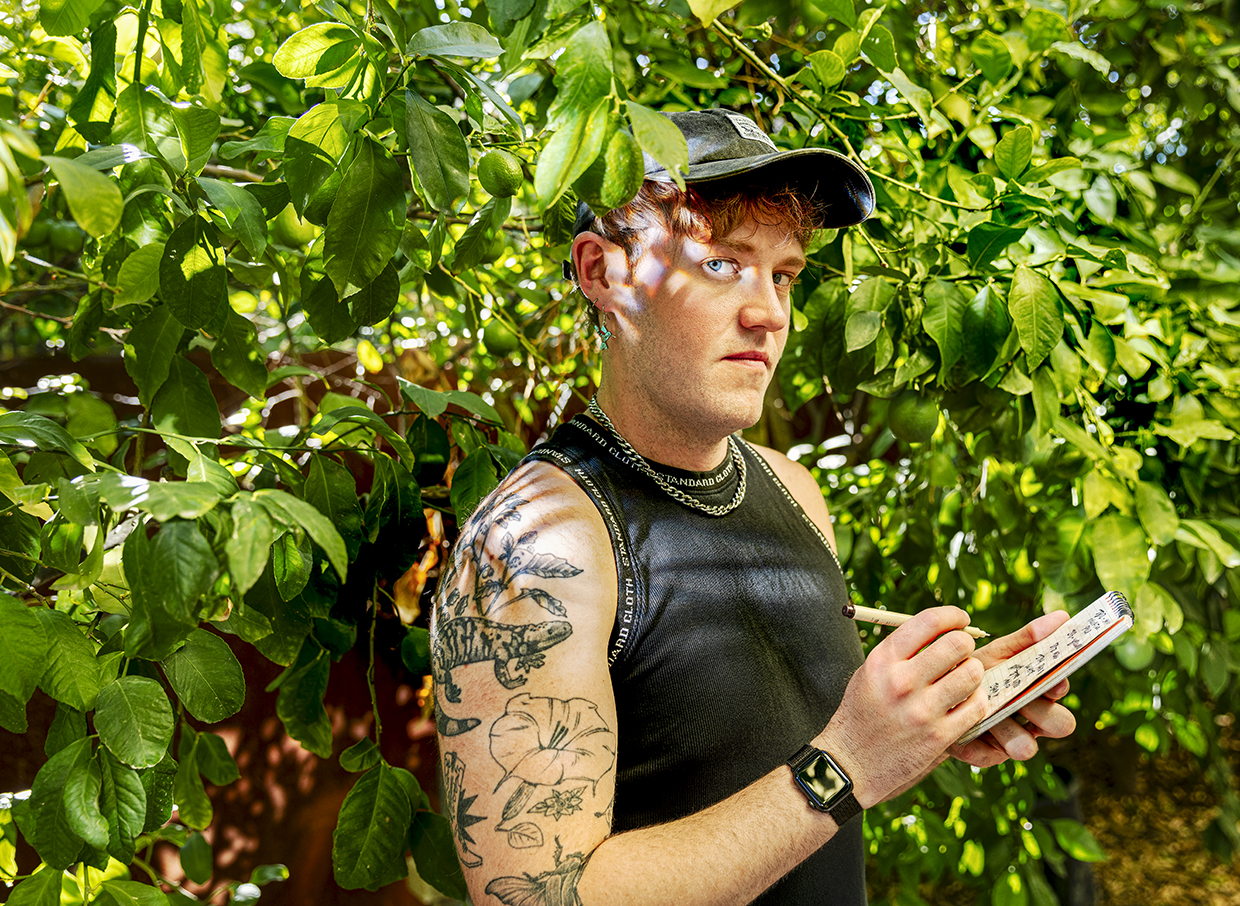
There are worlds that writers share with their readers — those they spin from imagination and experience. But there are others they keep to themselves — the magical, inspirational places that require protection. For Jonathan T. Bailey (pictured), one of those places is a hidden desert oasis in Southern Arizona, where waterfalls pour into shallow pools and cottonwoods cast shadows on sand. Where, one morning, he watched honeybees dance above his head. Where, one morning, he was inspired to write a poem, La Milagrosa, which included the line, “The sun has shifted as have I.”
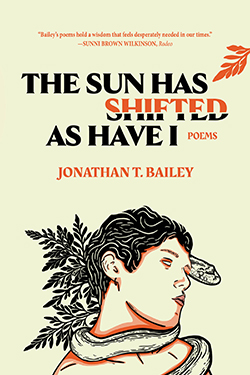
That line became the title of Bailey’s collection of poetry, which was published earlier this year by Torrey House Press. It contains more than 50 poems that explore the desert landscape, as well as themes of joy, discovery and longing. And even though La Milagrosa gave Bailey a title, it was a moment in the Pinaleño Mountains of Southern Arizona that sparked what would become his three-year-long endeavor to compile work for the book.
“There’s this one spot in that range for me where the silence isn’t like, ‘You can hear a pin drop,’ ” Bailey says. “It’s more like it’s where the sound has been vacuumed out. There are no insects. There are no birds. There’s just … nothing. But I was camping there, and a single hermit thrush flew in. If you’ve never heard one, they have a very haunting and unusual call.”
That call is self-harmonizing. Most birds have a syrinx, rather than a larynx, as their primary sound-producing organ, Bailey explains in his author’s note. The syrinx features muscles that enable the birds to control both sides of their bronchi. “By singing multiple notes simultaneously,” he says, “these birds have gained the ability to do something remarkable: harmonize with themselves.”
It would be a rare observation for an ordinary outdoorsman, but not for Bailey, who’s spent the better part of his 31 years exploring the landscapes of the desert Southwest.

As a queer kid growing up in rural Utah (hometown population 1,000), he frequently found himself at odds with the reality he found in society, compared with the joy he found in the natural world.
“When people ask me about my connection to nature, it’s a little bit strange for me to answer,” he says. “For me, it’s very similar to asking, ‘When did you connect with joy or happy?’ It was always there. But growing up in somewhat of a difficult environment and having nature so accessible ... from a very early age, I was connecting first to nature and learning from nature and spending, up until I was a legal adult, more time in nature than in society.”
At 17, Bailey survived a catastrophic climbing accident. But even when he was laid up — his quadriceps muscle almost decimated — Diane Orr of the Utah Rock Art Association reached out for his help with conservation work in the region he’d walked thousands of times. And even though he moved to Tucson at 23 with his boyfriend, who studies astrophysics at the University of Arizona, Bailey hasn’t stopped that work, that constant drive to understand the physical and spiritual world around him.
And he is self-taught. He dropped out of high school, but he is very far from being uneducated.
“I started just knowing something about life,” he says. “I just worked outward from there.”
There was a moment, he adds, when he realized what ecosystems were contributing to human existence and how things melded together. He studies scorpions. He studies fish. He has contributed to books about archaeology and art. He illustrates. He makes photographs. He writes. And writes. And writes.
He’s inspired by other naturalist poets and writers, like Mary Oliver and Ellen Meloy. And, in turn, maybe his own journey to healing, understanding and joy might inspire others:
“When we have a wound, we often treat it like we need to contain something, that we’re tensing our muscles to keep anything from flowing out in a way,” Bailey says. “It’s like a wound is also our interface with the world. It is a part of us that is interacting with systems that maybe we have grown up to ignore — or whatever it is — but so long as you allow that interface to connect, then you start seeing things in a different light.”
What’s frustrating, he adds, is that so many things we put into words sound like clichés. He’s perpetually reminded of the adage, “You can lead a horse to water, but you can’t make it drink.”
“In a way, our subjective experience of reality is put together by digesting information and turning it into something we don’t have to think about,” Bailey says. “You look to the mountains, but you don’t … you’re not actually seeing mountains. You’re seeing the concept of mountains.”
Regardless of how we see them, in the worlds that Bailey shares — and in the ones he keeps secret — those mountains are worth protecting.