
A week or two after the summer solstice, mirage-inducing heat across the desert Southwest creates a low-pressure vacuum. Winds, weighted with moisture, sweep in from the Pacific Ocean and the Gulf of California, signaling the start of the monsoon in Arizona. Clouds build in dynamic forms: altostratus, mammatus, cumulonimbus. Thunder echoes down dry canyons like belly laughs from hidden giants. And lightning, with its threat of sparking wildfire, searches for the path of least resistance.
There is no better place to witness this theater of meteorology than the veranda of the North Rim’s Grand Canyon Lodge. The view, dominated in the foreground by a trio of temples — Deva, Brahma, Zoroaster — continues south, past the chasm of the Grand Canyon, to where the Earth cracked open time after time, giving rise to hundreds of cinder cones and other ancient volcanoes along the Mogollon Rim.
Sitting on the lodge porch — perhaps in one of the worn Adirondack chairs, perhaps on the Kaibab Limestone wall laden with fossils — visitors from many corners of the world watch as the late-summer virga reaches down into the Canyon. Ridgelines and buttes appear and disappear behind the curtain of suspended moisture. Then, the rain! The colors of the Canyon deepen with each falling raindrop. The leaves of the Gambel oak reveal a truer green, the Hermit Shale a more daring shade of ocher.
Each inhale on that porch, mixed with cliffrose and wet earth, dissolves the division between us — as humans, as observers — and the surrounding scenery. We are invited in as characters in the scene, not simply as an audience.
This is the magic of the North Rim.
The first hints of magic are in the meadows of lupine and paintbrush, seen through the car window before even crossing the park boundary. Voles duck from circling hawks; dusty hooves pop up from bison wallows. Breath slows. Blood pressure drops. In a society where human-made rhythms overlay much of our lives, it is a gift to be welcomed into a landscape still dominated by the drumbeat of nature. And it is a spectacular nature that greets us: quaking aspen groves, stately ponderosa pines, subalpine meadows interspersed with mixed-conifer thickets. At certain times of year — such as the wildflower bloom at the height of summer, or early fall set ablaze with golden leaves — even the Canyon itself takes a back seat to the beauty of the plateau.
For those privileged to have called it home, the North Rim also means community. In its remoteness, residents draw strength and support from one another like the aspen roots outside their windows. My summer evenings on the North Rim were filled with volleyball games and potlucks, laughter and closeness. Doors were open, socially and professionally, and an outstretched hand was always there, day or night. The true spirit of the North Rim lies not only in its natural solitude, but also in the community built in its reflection.
But you do not need to have lived on the North Rim to form an intense connection to it. Anyone who experiences it — for 30 minutes, or 30 years — has the landscape indelibly imprinted in their bones, and a right to claim attachment.
We must not forget that people have been enjoying summers on the North Rim since time immemorial — spending winters down in the Canyon, at places such as the Unkar Delta, before returning to the rim to hunt, gather and escape the inner-Canyon heat. Evidence of this long connection, which continues to this day, is still seen in the Ancestral Puebloan sites along the Transept Trail, between the lodge and the campground.
I believe if we could all gather across time, from thousands of years ago to today, we, as “North Rimmers,” would bond over the magic of this singular landscape.
On July 3, 2025, I was guiding a group of youths on the Colorado River when a single bolt of lightning knifed through a ponderosa stand, sparking the Dragon Bravo Fire. The White Sage Fire, just to the north, had already filled the Canyon with its heavy, hazy smoke. In the mornings, I awoke strangely comforted by the thick air, which smelled of childhood campfires. I was unaware of what would come over the next few weeks.
I have been present for many fires at the Canyon. They are not unusual or necessarily unwanted. Nuisances, yes, because of smoke and closures, but I learned early on to respect them. In particular, the Warm Fire left a lasting impression on me when it ripped across the Kaibab Plateau in June 2006. I was living on the North Rim that season and working at Roaring Springs, a ranger station almost 4,000 feet below the rim. Ash, singed oak leaves and blackened ponderosa bark fell thick onto the quiet trails. Smoke settled into the Canyon for days on end, and in the low light of the evenings, the inner Canyon was washed with a copper film. Everything felt slow and cumbersome, as if life was moving though a time-faded Polaroid.
The landscape of the North Rim is well adapted to fire. Wildfires help with nutrient cycling, the clearing of underbrush, habitat rejuvenation and seed germination, among other benefits. Ponderosa forests evolved with a consistent fire regime. Tree ring data suggest that the forests burned naturally every two to 12 years, creating habitat for other specialized species, such as the tassel-eared Kaibab squirrel — endemic and adorable, and whose life cycle is dependent on mature ponderosa forests.
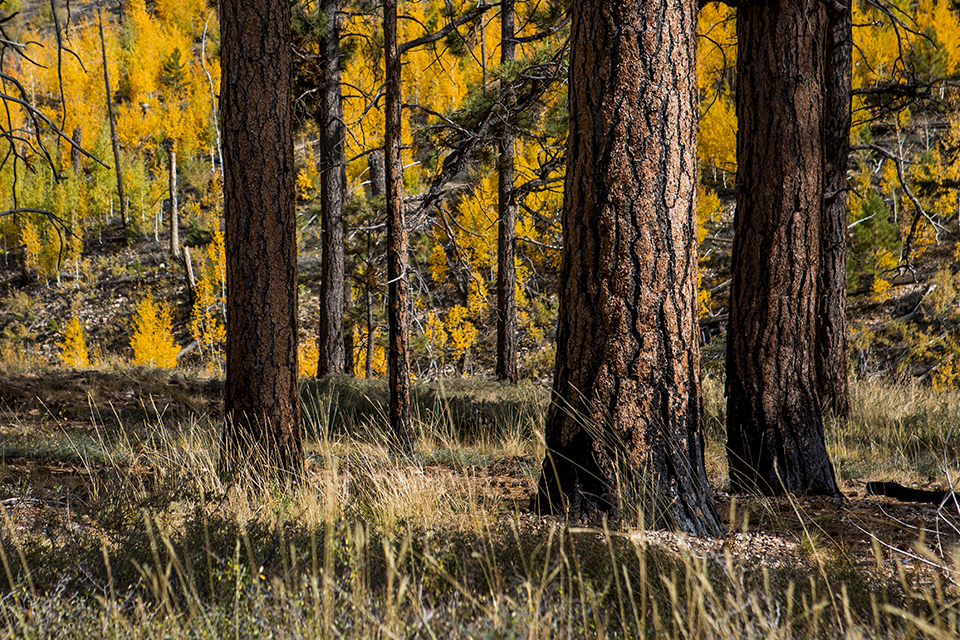
A stone’s throw from where the Dragon Bravo Fire started, this balance of fire resilience and dependence is on display along one of my favorite forested hikes, the Tiyo Point Trail. Tiyo — a young man who, in Hopi oral tradition, journeyed down the Colorado River in a gouged-out tree trunk — survived many adventures to ultimately bring the rain dance ceremony back to the Hopi mesas. As I follow mountain lion prints down the old two-track, the sun-warmed ponderosa bark fills the forest with its signature vanilla scent. I can’t help but think of Tiyo’s boat as I pass under the massive pines. Although his boat is said to have been made of cottonwood, I always imagine the sheer enormity of these particular ponderosas would make a vessel worthy of navigating the mighty Colorado.
These ponderosas, through their specialized adaptations — high crowns, thick bark, deep roots, fire-resistant needles — have survived many generations of fire. In fact, research suggests that ponderosas did not arrive in the region until the lightning of monsoon storms began triggering fires at the end of the Pleistocene. Yes, these trees evolved with fire and depend on it, but the high-intensity fires we have seen in recent decades exceed the conditions to which they adapted.
For too many years, our forests were managed by conservation principles guided by the myth of the American wilderness. This inaccurate ideology taught that pristine wilderness areas in the American West were devoid of people and fires and should be preserved without influence from either. This view neglects to consider the mutual connection between Indigenous peoples and the land, or the crucial role of wildfires across diverse landscapes. People were forced out, fires completely suppressed. We are currently playing a frightening catch-up game born from decades of fire management informed by these ideals. Fortunately, many of our current public land managers are dedicated to remedying the errors of the past.
Acknowledging the fire-adapted history of the North Rim is in no way minimizing the destruction from the Dragon Bravo Fire. The losses are profound to so many, in so many ways. Community has come together across the world to mourn the loss of trees, flowers, animals, buildings, history, lifestyles, livelihoods, connection. I still long for the veranda where I witnessed dear friends say, “I do”; the quiet meadows, with their skyrockets and penstemons; rubbing Brighty’s nose for good luck, every time.
Grief is a tricky emotion, with no real road map or timeline. When I confided in a dear friend about the heartbreak I felt upon learning the extent of the destruction, she wisely and gently reminded me that the Earth and these wild spaces do not belong to us; we belong to the Earth. What was lost, then, was not material to be owned, but something that was part of all of us. This marked a small but profound perspective shift for me.
Given the unpredictable climate and changing weather patterns, we are inevitably heading for more loss. It will be necessary to familiarize ourselves with grief and allow ourselves the space and time to process it, from denial to acceptance and every step in between. The Canyon, with its wild spaces and devoted community, guided me through the grief of losing my mother, and I must trust that some of its magic will help us through this most recent loss. Even in a time when she is wounded herself, the Canyon still has the power to heal others.
While the Dragon Bravo Fire still smoldered, I attended a talk in Flagstaff by Robin Wall Kimmerer, an Indigenous botanist, writer and mother. With warmth and humility, she invited us, as an audience, to reflect on our relationship with the land: “What does the Earth ask of us?” Through anecdotes and assertions, she urged us to shift our perspective from one of exploitation to one of kinship and reciprocity. We can do this, she said, by truly listening to the land.
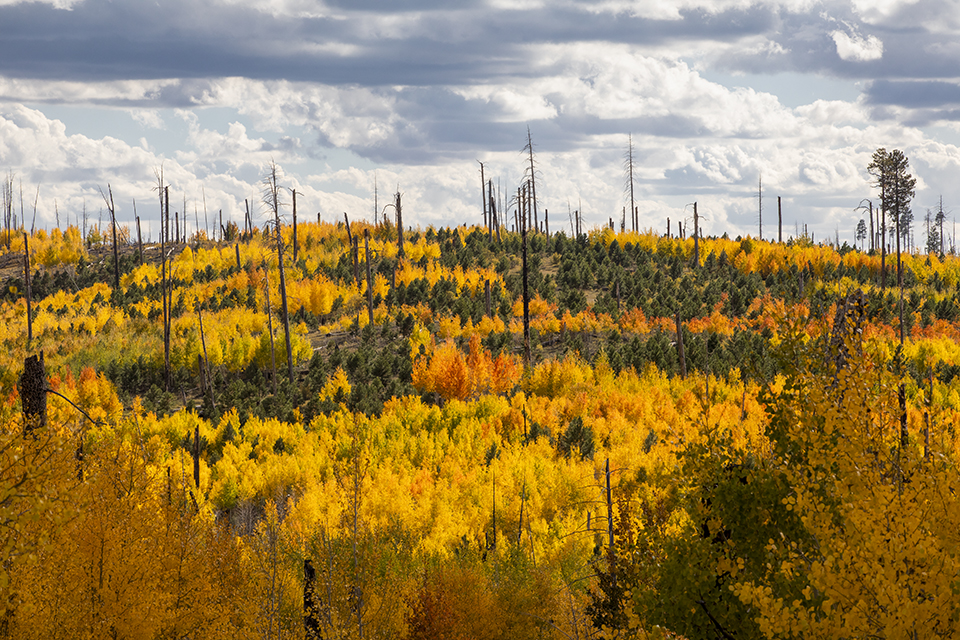
On September 28, the park announced full containment of the Dragon Bravo Fire, and on the 30th, I made the long drive up. I was unsettled, not knowing what to expect or how I would react to the effects of the burn. Cresting the ridge past Jacob Lake, though, I was immediately met by a different type of fire. Huge swaths of new aspen growth, where the Warm Fire had burned nearly
20 years earlier, glowed in their autumn dress like thousands of matchsticks lit all at once. If I squinted, the whole forest was aflame. It was beautiful and fierce, and a reminder that life springs from loss.
My first stop was at Kaibab Lodge, 5 miles from the park entrance, where I was greeted under a sign that read, “Welcome Dragon Slayers.” Robin Bies and her partner, Chad Sanders, were managing the lodge when the fire tore through. Robin pulled out her phone and swiped through photos of the unnerving smoke plumes she witnessed from the driveway of the lodge. She lingered longest on the photographs of the firefighters. Robin and the Kaibab Lodge crew fed 300 firefighters a day in the early weeks of the fire. “They were like family,” she said, tearing up. “Better than family.” This is the North Rim I know and love.
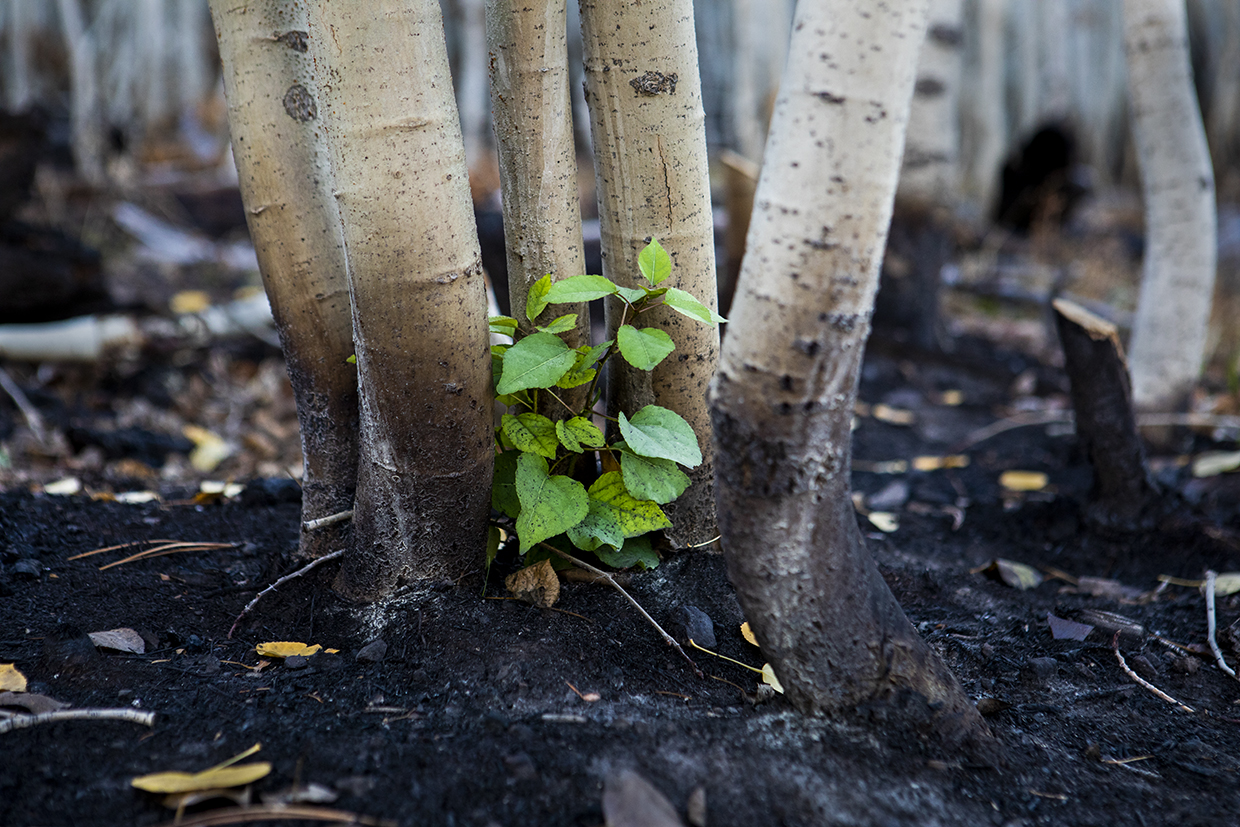
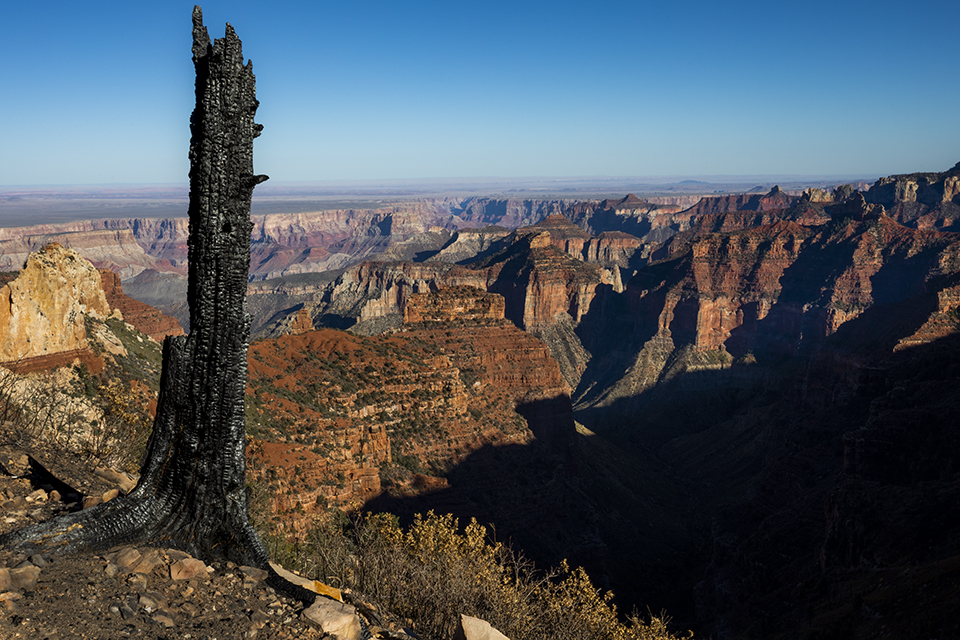
I took a deep breath and drove into the park. Once inside, I decided to walk the 6 miles round-trip between Point Imperial and Cape Royal Road along one of the only trails open, the Ken Patrick Trail. The forest along the trail had burned in a mosaic pattern — some areas looked healthy and familiar, and others felt like walking on the moon. The side canyons and drainages were hit the hardest, their dense vegetation and steep terrain fueling intense burns. I had to look away. But in the blackened soil, locusts and ferns were already sending up their green shoots. A goshawk searched for prey in the thermals at the rim of the Canyon; a shy deer peered through a manzanita thicket. The rhythm of the North Rim that has always welcomed and comforted me was still there. Fire and its aftermath are that same rhythm. Nature is in control, dynamic and determined — and it is a humbling thing to behold. We can fight against it, or we can join forces.

In the wake of the Dragon Bravo Fire, humanity, despite our differences, found common ground in its shared connection to the North Rim. This moment offers an opportunity for all of us, individually and collectively, to ask what actions we are willing to take to ensure the survival of our beloved landscapes. To start, we can support the efforts of those who dedicate their lives to the land — public servants, land managers, firefighters, Western and Indigenous scientists — who are working tirelessly to build resilience, even in the face of great adversity. On a more personal level, we can deepen our knowledge of the land by encouraging a mutual relationship with it. We can listen closely, as Robin Wall Kimmerer reminds us, and learn to love and understand the land as intimately as we know ourselves. This will serve us well, for our fates are bound together.
On the way back home, I stopped to thank the firefighters who were felling trees along the forest roads. Out of every tree in the forest, they told me, a pair of endangered California condors had chosen to roost in a burnt snag near their base camp. I thought of my drives past the Warm Fire scar over the years. Delicate mariposa lilies and purple deer vetch reclaimed the burnt soil, aspen shoots became healthy groves, and even ponderosa seedlings took hold in the once-ashen earth. The landscape changes, but it still holds the magic. If we put an ear to the ground, we might find ourselves falling in step with its heartbeat. Together as stewards, with the land as an ally, we can help nurture what rises from the ashes.