
Imagine most people who are headed for the Grand Canyon don't stop driving north on U.S. Highway 180 until they reach the South Rim and its stupendous views. But I'm on a quest for 24 hours of cozy seclusion — possibly a quixotic one so close to the bustling national park. My destination is just south of the park boundary: the Tusayan-Montane Campground on the Kaibab National Forest.
I've brought a friend, Ash, and we've made a vague plan: one sunset, one sunrise, and between the two, a campfire and a good night's sleep under the stars. We drive all five of the campground's loops in search of the perfect spot, and we're spoiled for choice. I'm told Tusayan-Montane usually has an open site unless it's an exceptionally busy weekend. I decided to come on a weekday to maximize the chances of solitude, and now, we have our pick.
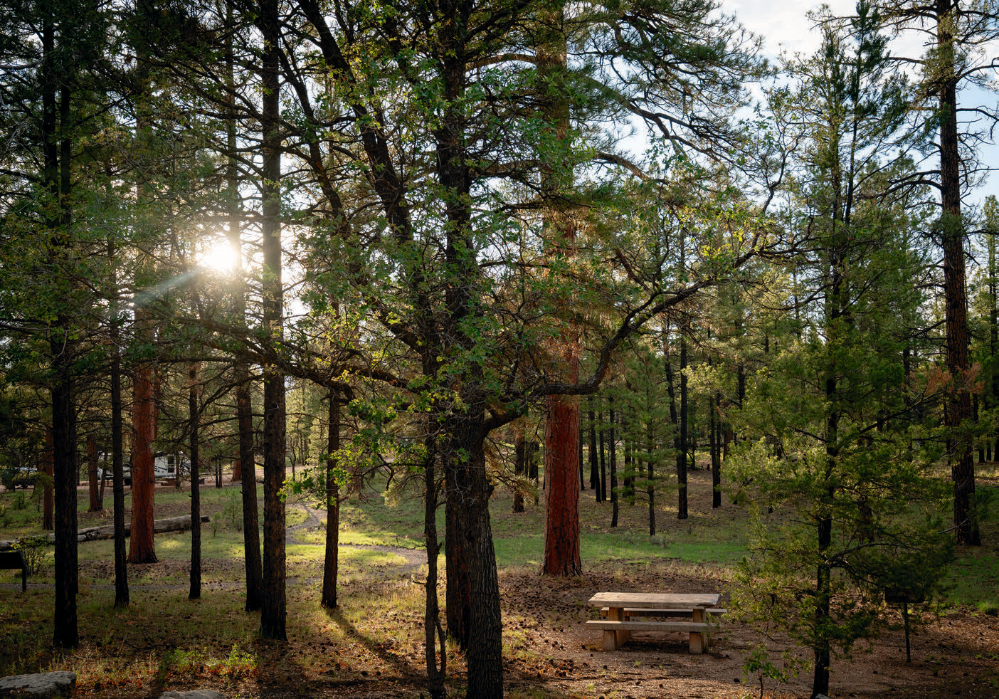
When three pronghorns lift their delicate heads and lope away from the car on the Black Bear Loop, we take it as a good sign and claim the nearest spot. It's spacious and screened by hammock-ready ponderosa pines, giving it the sense of seclusion I'm looking for — though at the moment, there's only one tourist in an RV and a rim-to-rim hiker sharing the loop with us.
I keep looking around as I pitch my tent, as if crowds of people have somehow concealed themselves behind the narrow pines. This place has the feel of a well-kept secret — and it's just a stone’s throw from one of the natural wonders of the world.
For the spontaneous traveler, nabbing a campsite on the South Rim during peak summer months is a lottery-worthy stroke of luck. Mather and Desert View campgrounds open for reservations six months in advance; only Mather offers a handful of first-come, first-served spots.
Tusayan-Montane, formerly called Ten-X, was constructed in the 1970s just south of the town of Tusayan, and it mostly served as overfill for the park campgrounds. But a remodel began in 2020, and it was expanded to 160 campsites with picnic tables and firepits, plus two ramada-covered spots for large groups — just in time for the COVID-19 pandemic and a downturn in international tourism.
It’s a restful location, which comes as a surprise only 4 miles from the park entrance. With tents pitched and sleeping bags unrolled, Ash and I go exploring. The first stop, of course, is the pit toilets, which are the cleanest I’ve ever seen. The faint trace of cinnamon air freshener makes me mildly ashamed of the state of my bathroom back home.
The campground has a central picnic area, from which springs a short nature trail paved with pea gravel. It’s an easy, level walk, marked with signs offering tidbits about the ecology of pines and suggesting some of the animals we might see: elk, porcupines, turkey vultures and the unmistakable Abert’s squirrels with their ridiculously long tasseled ears. We follow the trail toward the Elk Loop, which offers first-come, first-served sites. It looks to be about halfway filled. The hosts there point us toward a longer trail that loops the campground.
“It must get busier?” I ask before we set off.
“Nope,” one of them says.
The loop trail moves through open pines, varied with oak, juniper and patches of sweet-smelling sage. It’s overgrown — another sign of this area’s seclusion — and requires a bit of wayfinding. Robert Frost wouldn’t know which way to go, as all the paths here are less traveled by.
Ash points out an elk shinbone, white and bleached enough to please the producer of even the most clichéd Hollywood Western. A wire fence encircles the roughly 170-acre campground to keep out cows. Under such circumstances it’s hard to get lost, but the feeling of lostness, in the best sense, isn’t far off. On the southeast corner, we find a 1930s-era railroad bed once used to haul lumber. Tall pines poke up between railroad ties. We search the ground for treasures. All the artifacts here — railroad spikes and rusty bolts — are historic, so they must be left in place.
There are still a few hours until sunset, so I leave Ash ensconced in the hammock and go to meet the Black Bear Loop hosts. Mike and Linda Daley tell me it’s their fourth year here as caretakers, though they’ve been visiting Tusayan-Montane since the 1990s.
“Once people come here for the first time, they’re like, ‘Man, this is so much better than camping in the Canyon,’” Mike says.
The seclusion, so rare on the south side of the Canyon, comes with a number of benefits. The first, as I’ve already discovered, is a better-than-average chance of seeing spectacular wildlife. The Daleys tell me an elk herd usually traverses the area — one bull elk became such a fixture he earned a nickname, Scooter, although they didn’t see the animals last year.
“We miss them,” Mike says, but adds: “Better to keep them wild.”
It’s a compliment to the place that the Daleys keep returning, since they’ve camped in every U.S. state except Hawaii. (“You can’t drive there,” Linda explains.) They tell me Tusayan-Montane was always a favorite. Silence is another benefit. It’s an ideal launching point for rim-to-rim hikers or tourists who want a quiet base camp from which to explore the South Rim. The campground was remodeled with RV space in mind, but generators aren’t allowed after 8 p.m.
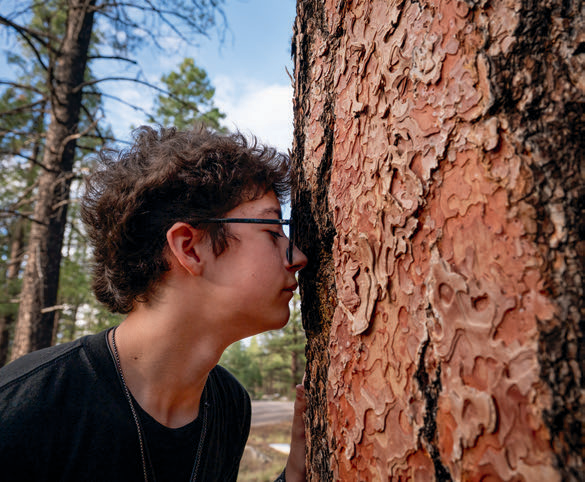
I ask for advice: Where’s the best spot to watch a Grand Canyon sunset?
The Daleys are noncommittal. “You’re not going to pick a bad spot,” Mike says.
With that in mind, I collect Ash and we head to the rim. It’s a 10-minute drive to the park entrance, and another 10 takes me to a parking spot near El Tovar. We decide to work up an appetite for dinner by walking westward along the Trail of Time in the direction of Hopi Point.
Down below, straggling hikers climb the Bright Angel switchbacks as the sun sinks in the sky, burnishing the Kaibab Limestone until it shines a pale gold. We watch the fading light until we're hungry, then head to the Harvey House Café for dinner.
When we return to Tusayan-Montane after dark, we startle a lone bull elk that was lingering just beyond our tents. He ghosts away from the headlights. Scooter — or one of his kids — lives on.
Stargazing is pretty good wherever you go in the Canyon country, and both Grand Canyon National Park and the town of Tusayan have made strides to keep artificial lighting to a minimum. Tusayan has a night-sky-friendly lighting ordinance in place, and Grand Canyon was named an International Dark Sky Park in 2019.
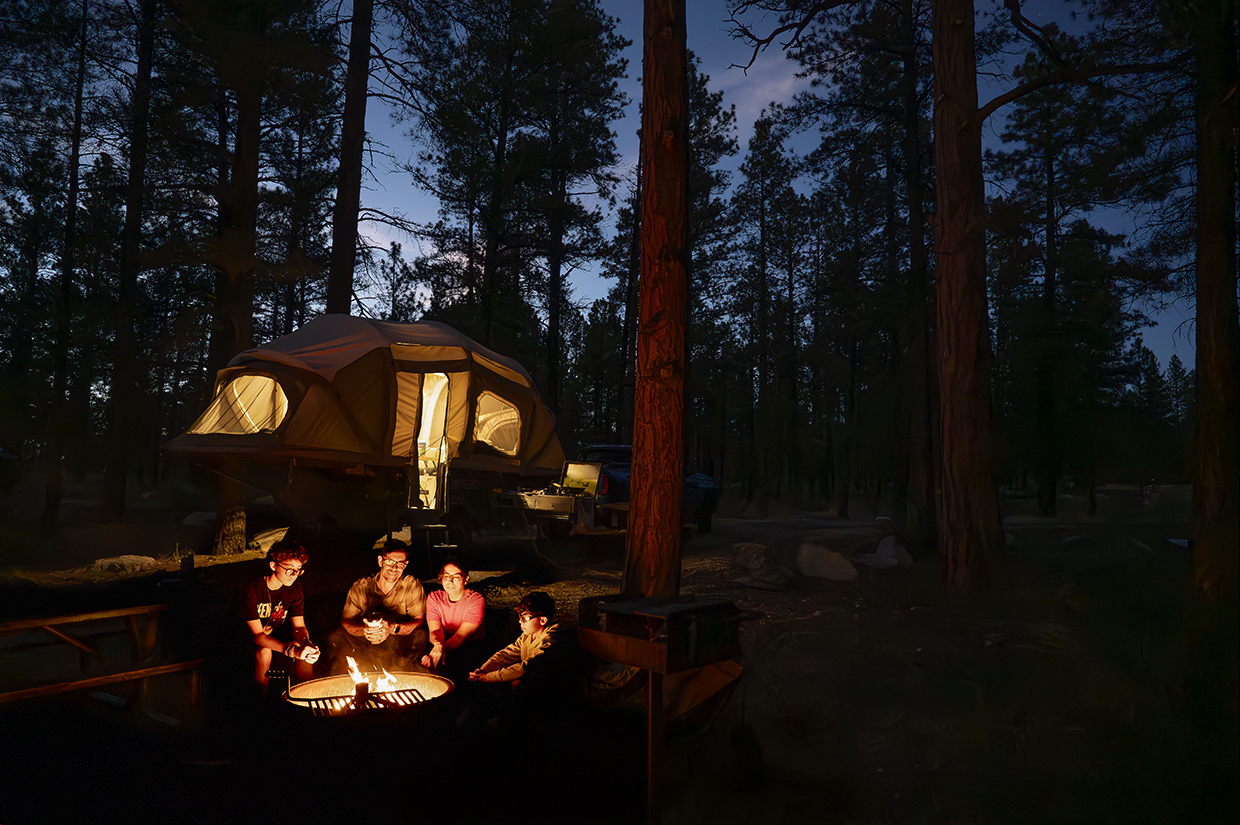
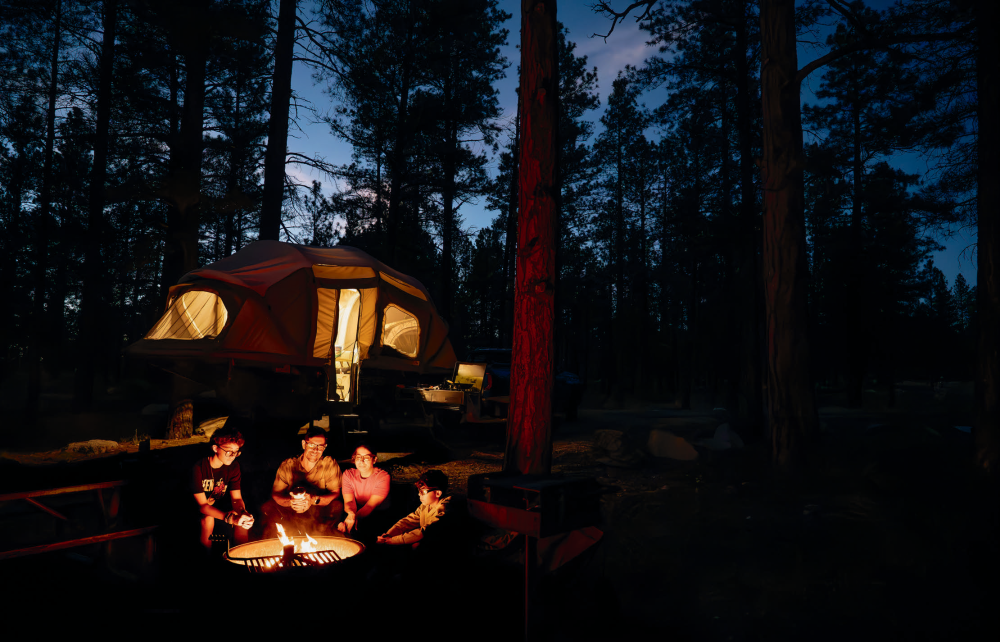
I can't discern any noticeable light pollution from our campsite, and the stars are irresistible. No moon has yet risen to wash out their colors. Since we're planning to see sunrise at the rim, it would be sensible to turn in early, but Ash and I linger over campfire stories and s'mores until past midnight.
A short four hours later, I claim the same parking spot near El Tovar. A handful of early risers lean on the stone wall, waiting for the show to start. This time, Ash and I walk east along the rim as the topmost layers of stone turn pink. We settle at an outcropping with another pair of sun-seekers, who are watching the spectacle the only sensible way: facing west, toward the shifting canvas of color on the Canyon walls, with their backs to the rising sun.
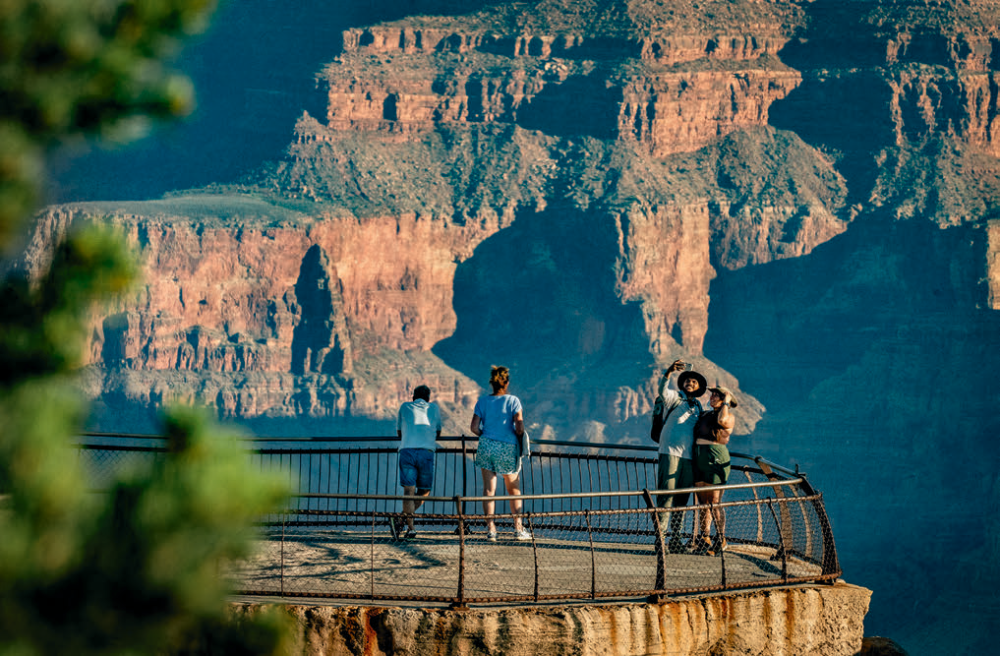
It's not my first Grand Canyon sunrise, though this isn't a view that dulls with repetition. The light plays over the stone, first highlighting a band of pink, then blazoning a cliff with gold. My mind — admittedly hazy with lack of sleep — wants to translate the shifting light into piano notes, played pianissimo and very slow. The whole performance is too complex to follow.
Gradually, other visitors join us at the Canyon's edge. One dad keeps a firm grip on the back of his teenage daughter's jacket while she makes a panoramic photo on her cellphone. The thin crescent moon, now risen clear of the horizon, vanishes by degrees into the brightening sky.
Though this trip was meant to be all about solitude, I'm oddly happy to be in human company for this moment. No one breaks the silence, yet there's a sense of something shared.
Afterward, Ash and I treat ourselves to breakfast at El Tovar — peach griddle cakes and iced coffee — and return to Tusayan-Montane to break camp. It strikes me that the Grand Canyon's bewildering views can sometimes feel almost as overwhelming as the peak-season crowds. Some experiences require a moment of respite before they're fully absorbed. Now I know just where to go to find it.
For reservations, visit recreation.gov.