

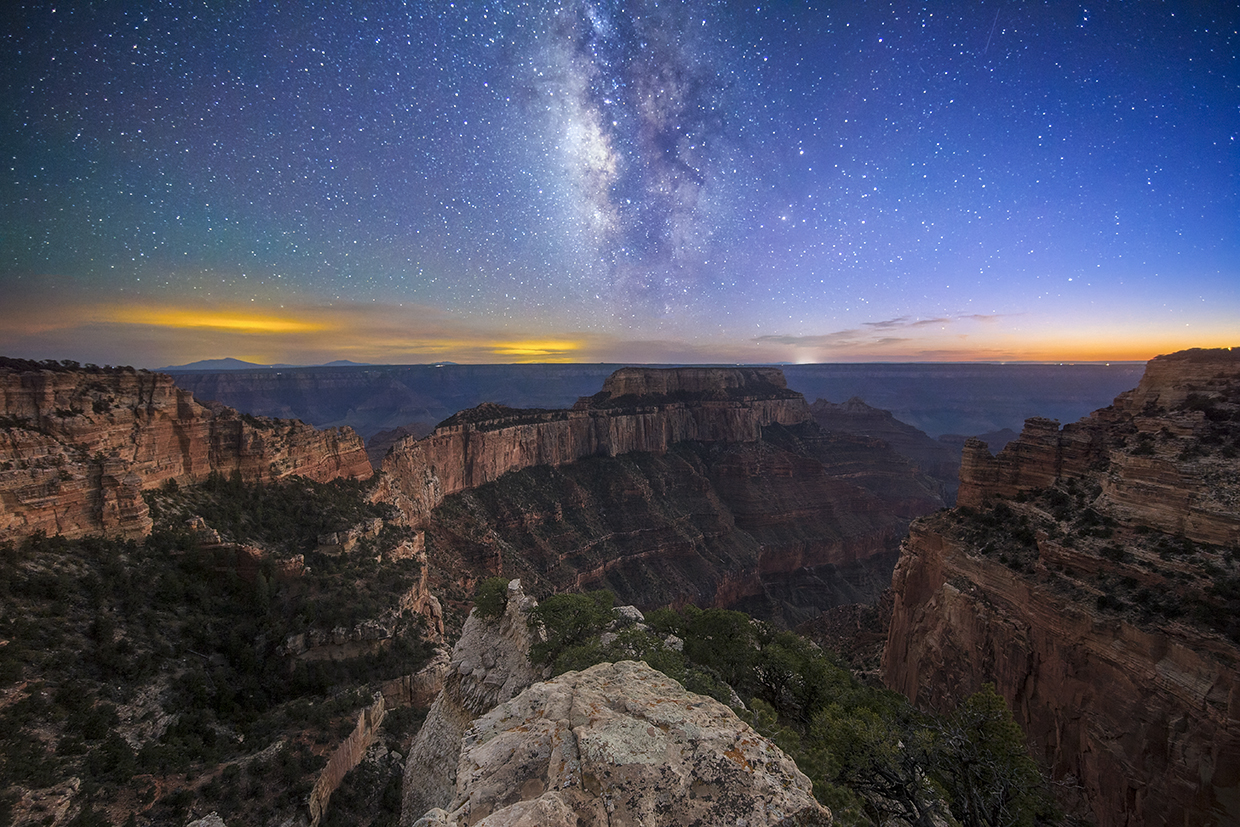
So, here I am, gazing more than 2 million light-years into the universe from a spot a mile deep and a billion years inside the Earth. I’m at the bottom of the Grand Canyon. It’s 26 years ago — not even a nanosecond by the timescale of either the Canyon or deep space, but a solid chunk of my own, ongoing saddle bronc ride in this great cosmic rodeo.
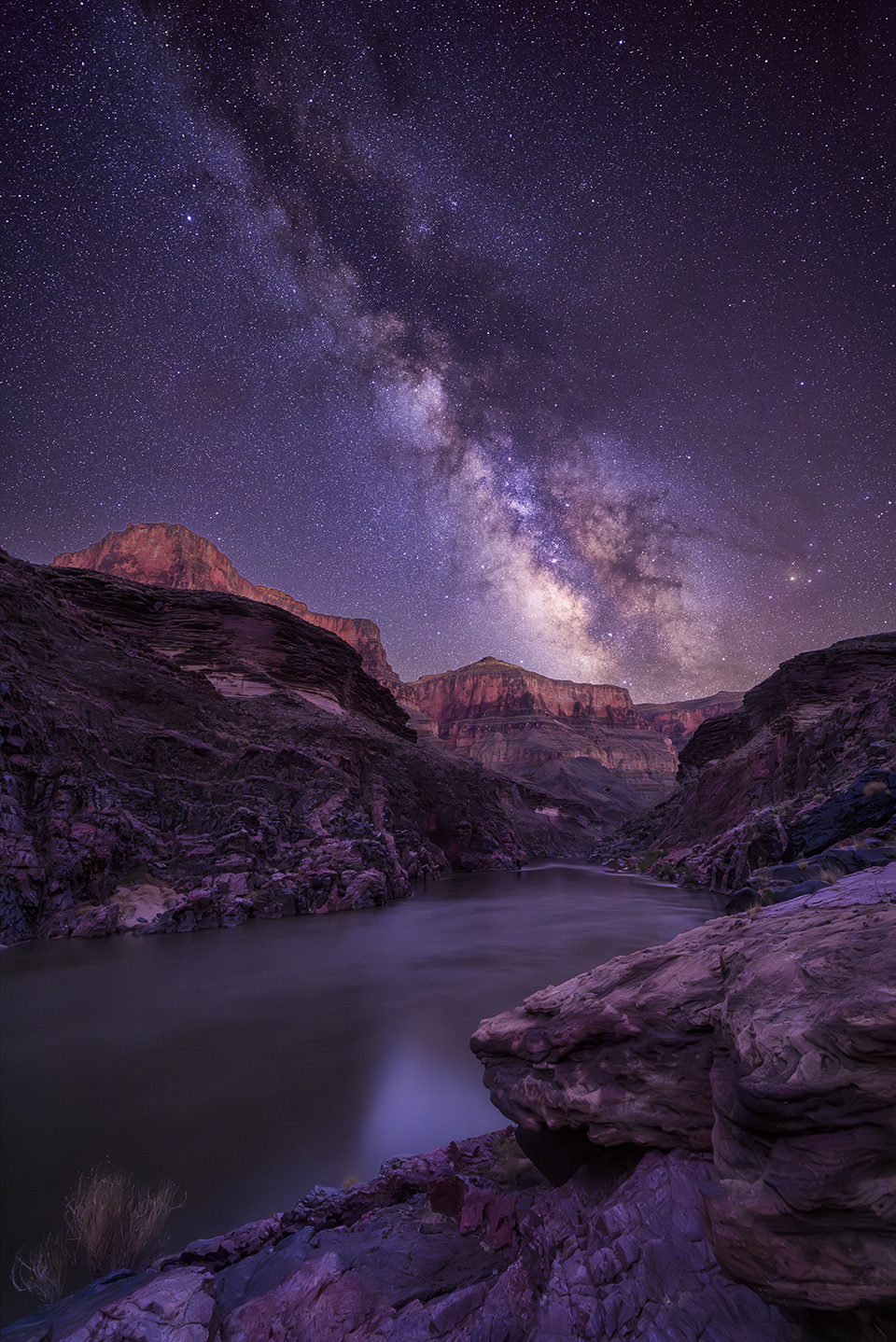
I’m working as a swamper on a rafting trip, and we’re a few days past Phantom Ranch, camping along the Colorado River. The late-summer night is warm, cloudless and as dark as dark gets, with the waning crescent moon already tucked behind the Canyon walls.
The cliffs frame the sky, making it easy to track the stars’ progress through the night. Then, at one point, everything looks different. I see the night sky not as some giant dome above the Earth, but as a three-dimensional expanse without end. There’s depth. Some stars look closer, others more distant, and I connect the dots, those pinpoints of light — tracking a course toward the infinite, earthbound and weightless at the same time.
Out of the darkness comes enlightenment. Because at the Grand Canyon, the boundaries blur as space becomes inseparable from Earth.
The Canyon after dark is transcendent. During the lunar eclipse in April 2014, I laid out a blanket and, with nearby elk munching on the spring growth, watched the moon turn blood red, suspended like a boulder over the Canyon. And on the darkest nights, the Milky Way paints the blackness with a swirling opalescence, like the inside of an abalone shell.
Grand Canyon National Park earned designation as an International Dark Sky Park in 2019. And since 2021, Grand Canyon Conservancy, the park’s official nonprofit partner, has sponsored an astronomer-in-residence program. The selected astronomer decamps for the historic Verkamp’s Visitor Center, where the top-floor apartment becomes a window on the Canyon and a base camp to work on projects and interact with visitors.
My wonder far outpaces my knowledge, and I’ve come to experience the Canyon and cosmos through the eyes of three of these experts, and in a new light. The fact is, I bear the scarlet letter of a “C” in college astronomy — and could use help figuring out how to feel at home in the Milky Way.
The crescent moon drops into the ponderosa pines, silhouetting the treetops before disappearing. It’s a moonset like any other. But tonight is also the culmination of an 18.6-year cycle when the moon reaches its extreme position along the horizon, an event known as the lunar standstill.
Laura-May Abron, the Canyon’s astronomer in residence at the time of my visit, tipped me off to the standstill, and we meet the following afternoon — an unlikely time for stargazing, unless the star you’re gazing at is the sun.
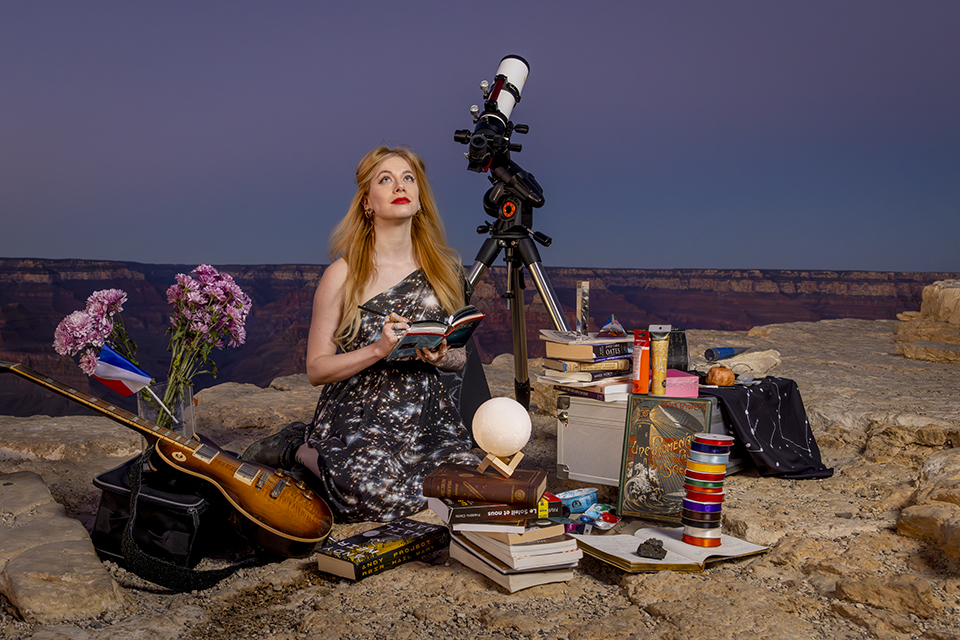
Wearing a print dress depicting the cosmos, and standing beside her solar telescope, Abron is hard to miss. Raised outside Paris, she has the kind of radiance that creates its own weather. Pair that with an absolutely top-shelf mind, and Abron’s charisma is best measured in lumens.
She is an artist, musician and former actor and model, and she works in public astronomy and other areas at Los Angeles’ Griffith Observatory. Abron researched asteroid 2024 YR4, once seen as threatening to strike Earth in 2032 (and now given as much as a 4 percent chance of crashing into the moon that year). She also worked on a project focused on comet 3I/ATLAS, the third known interstellar object to pass through our solar system.
Intrepid enough to chase tornadoes in the heartland and volcanic eruptions in Iceland, Abron even manages to get around LA without a car. And check out her website: She literally breathes fire.
With the sun still behind billowing clouds, Abron describes discovering visual astronomy in 1997, when her mother pointed out comet Hale-Bopp from the family’s balcony. The comet’s brightness and vividness were dazzling for Abron, for whom art and astronomy are closely tied. She cites the Japanese manga and anime series Sailor Moon as an early inspiration.
“I bought all of the books,” she recalls. “They included cosmological equations … and the characters had names of asteroids. I learned the asteroid names through Sailor Moon. People don’t believe me that this manga was just full of astronomy. Especially because astronomy wasn’t really geared to young women.”
Entranced by the stars, Abron “sort of borrowed for a little too long” a Carl Sagan book, filled with Hubble Space Telescope images, from her school library. “I was just desperate to get my hands on this stuff,” she says. “And especially, again, as a young girl, I had no idea how you would even get a telescope or have access to people with telescopes.”
She certainly has one now: a double-stacked, 80 mm Lunt Solar Systems Hydrogen-Alpha telescope bearing the Tucson-based company’s saguaro and sun logo. When the sun finally emerges, we take a look. My first reaction couldn’t be more prosaic: Yep, that’s the sun. And it sure looks hot. Then, Abron points out the visible features: sunspots, flares and prominences, which are physical manifestations of magnetic fields that might remain visible for a day or so. Abron fills sketchbooks with drawings of prominences. She likens it to cataloging clouds.
Working as a public scientist in the most public of places has its complexities. “I meet moon landing deniers every now and then, which floors me,” Abron says. “Because the moon landing is one of the greatest, perhaps the greatest, achievements of mankind. And certainly in this country.” But she says she seeks to find common ground, recalling when members of a church group discussed whether the big bang theory could be reconciled with the belief that the heavens, Earth and life were created in six days.
“It was actually such a nice exchange,” she says. “At the end, one of them finally asked, ‘Can I pray for something for you?’ And I said, ‘Well, could you pray for the NASA budget?’ And they said, ‘Yeah, absolutely.’ We have different views, and that’s fine. … I don’t want to destroy their belief system, because then they associate that negativity or dismissiveness with science.”
Before visiting the Canyon, I stop at the Flagstaff Star Party for a sunset recital by the Dark Sky Quartet, which performs astronomy-themed compositions in outdoor settings, including on Canyon rafting trips.
Playing viola is quartet founder Dr. David Koerner, emeritus associate professor of astronomy and planetary science at Northern Arizona University — and Canyon astronomer in residence in the fall of 2024. The quartet settles in under a gazebo, while behind them, the clearing sky turns a pale yellow-gold that wouldn’t be out of place during a nice day on Venus. Such days, Koerner explains, are in decidedly short supply: Introducing Venus, the Bringer of Peace, a movement from Gustav Holst’s The Planets, he disabuses the audience of Venus’ swoony, romantic reputation by describing the planet of love’s sulfuric acid clouds and 900-degree surface temperatures. The star Vega emerges, and the San Francisco Peaks glow with the day’s last light.
For Koerner, it’s all connected: sky, music and the Colorado Plateau. His Canyon introduction came through music: He grew up in a religious Ohio household, and his parents were classically trained music educators. He remembers, at age 7, staring at the album cover of Ferde Grofé’s Grand Canyon Suite and trying to figure out what was at the bottom of the gorge, which remained hidden in the image. He especially loved Cloudburst, the suite’s last movement, with its timpani thunder and piano glissandos standing in for lightning. He would take to the family’s grand piano and pound on the keys to re-create those glissandos. “I never forgot the thrill of trying to musically depict something from nature,” he says.
When his family moved to California, Koerner saw the Canyon for the first time and soon became “a nerdy Grand Canyon kid,” with a topo map on his bedroom wall and Canyon books on the shelves. He began making regular trips, first with his family and then on his own. “I think the Canyon had the same attraction for me as the cosmos: as a foil to the Sunday-school religious picture,” he says. “All that rock is hundreds of millions of years old. What is that? And how does it fit with all the other stuff that didn’t get taught?”
He pursued his musical career, then earned a master’s degree and a Ph.D. in planetary science from Caltech. His academic career took him to the University of Pennsylvania, but he never lost his fascination with the Colorado Plateau. “Dying to get back to this place,” he went to work at NAU in 2002; several years later, a friend asked him to play with a string quartet on a rafting trip. “I was floored — I didn’t even know they had such a thing,” he says. “I played on the river trip. It was 15 days, and we did eight concerts in side canyons. Hard chamber music. I really started back to music, in a big way, partly because of that.”
Now retired from his academic career, Koerner is composing astronomy-inspired pieces. During his residency, he performed outside at moonrise, at sunset and under dark skies. It was his attempt, he says, to integrate music, landscape and skyscape to give people “a deeper impression of the cosmos and their place in it.”
“One woman had never seen the Milky Way — never,” he says. “She asked, ‘How do you stay grounded when you see all of this?’ And my reaction was, ‘If you’re not grounded in the universe, are you really grounded at all?’ ”

We are disconnected from the universe. Looking at the stars is considered vaguely exotic, even eccentric — something apart from daily life. Dark skies have become a luxury, an amenity to be found only on a vacation, like an infinity pool or a sound bath.
Tempting as it is to blame ever-shortening attention spans and the distraction economy, dark skies are simply harder to find. Beneath a piñon pine outside of Verkamp’s, I sit down with Stephen Hummel, who served as astronomer in residence in the winter of 2025. He’s just arrived from Texas, where he works as dark skies initiative coordinator at the famed McDonald Observatory.
Hummel outlines a dire scenario: Between 2011 and 2022, North America’s night sky grew 10 percent brighter each year, on average. “That’s an incredible pace,” he says. “And it pains me to think that one day, people could just never see the night sky again. We’re close to that in a lot of North America already. Anywhere east of the Mississippi, there’s nowhere as dark as this.”
Hummel has returned to the Canyon to work on lighting projects outside the park to better preserve the night sky. During his residency, he replicated a light pollution study from a decade earlier to measure the changes; he found that despite such remedies as retrofitting more than 5,200 lights at the Canyon, light pollution outside the park is about twice as bright as it was 10 years ago.
Hummel, though, offers a bit of reassurance: The Canyon is still very dark, especially when you look directly overhead. The problem is that light domes on the horizon from the two largest nearby cities, Phoenix and Las Vegas, continue to get brighter. “With the endless horizons up here, you can see light sources hundreds of miles away,” Hummel says.
While no stranger to night skies, Hummel was profoundly moved by his Canyon experience. “Astronomers typically see the moon as kind of an annoying thing, because it gets in the way of the Milky Way,” he says. “But seeing the Canyon in the moonlight, with the moonlight reflected off the snow, was utterly breathtaking — something I didn’t know I would appreciate so much.”
Hummel had planned on going into international relations before he found his way into an astronomy career after volunteering at McDonald. He’s fluent in the statistics and specifics of night skies, but he also lyrically articulates what’s at stake.
“The night sky is a source of inspiration,” he says. “It’s culturally important, and important ecologically for all kinds of wildlife. They need dark environments to live, right? A frog needs a dark environment almost as much as it needs water. The night sky is a natural resource, a part of nature just like the trees around us are. It is not separate. The sky up there is not a separate entity that doesn’t affect things down here. It’s all one ecosystem.”
After sunset, I return to Verkamp’s. I’m forever amazed by how completely the South Rim empties at night. For a half-mile along the rim, I see only a few people before spotting Abron. As I approach, she says, “Matt, is that you? This feels like a drug deal.”
“Or a prisoner exchange in a spy movie,” I reply.
Abron looks the part. She’s wearing a long, belted coat that resembles a trench coat, light-colored to help people find her when she conducts nighttime observations. She uses a laser pointer to take me on a tour of the sky, and the beam dances like a blingless Tinkerbell across the constellations. She tells mythological stories of beautiful princesses, angry sea nymphs and horseback rescues, reflections of when people long ago projected human vanities and frailties onto stars and galaxies far more distant than even the gods of antiquity could imagine.
Although those gods claimed immortality, nothing lasts forever. Abron mentions that over time, the North Star changes — and in another 2,000 years, Polaris will surrender the title to Errai. “It should be a much better North Star, because it’s very bright,” she says. “The change happens because the Earth has a little bit of a wobble.”
Standing in the darkness, we discuss just how wobbly our planet can be — whether professionally, personally or politically. As those day-to-day realities begin to intrude on our immersion in deep time, I ask Abron about a bright star hanging above the North Rim. It’s Capella, she says — not one star, but a quadruple star system nearly 43 light-years away. That’s more than 250 trillion miles.
Abron then explains that the brightness of stars, as viewed from Earth, changes over time. It’s all about proximity: Some stars are moving closer, others farther away. “The stars that are brighter now will not necessarily be the brightest in a couple of thousand years,” she says. “It’s kind of nice.”
I reply, “I’d like to see that.”
“Right? Like, me too,” she says. “It’s just so humanly hard to understand. You know, we’re so young, and we live such short lives. Yet we’re faced with these things, whether up there or down here, that have such immensity, such a long length of time. Even the Grand Canyon is a baby compared to the universe.”