
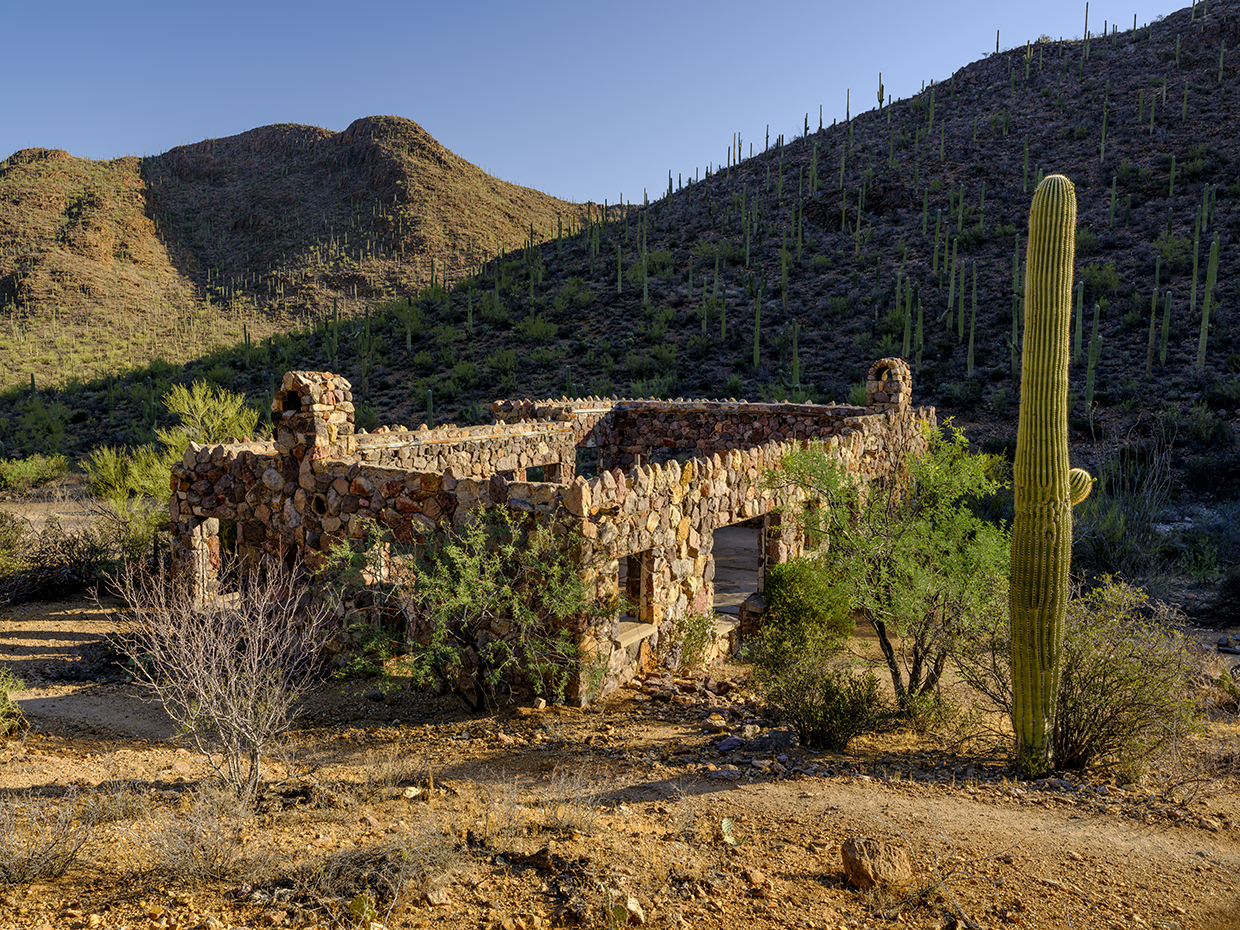
MORE THAN ONE TRAIL will take you to the old stone house in the hills west of Tucson. I like to begin at the Camino de Oeste Trailhead and follow the winding path of the arroyo. It’s a 2-mile hike to the roofless ruin made of sunset-colored stone — all that remains of the Bowen homestead.
Years ago, a slip of paper tucked into a plastic sleeve provided visitors the only available information about the origins of the house. On one hike, I found a tattered extra copy beneath a newly printed one, so I stole it. Rain-pocked and sun-faded, the piece of paper has lived in my file cabinet for more than a decade. Thus, my obsession with Ruby and Sherry Bowen began.
The Bowens moved from Illinois to Arizona in 1928, after a doctor prescribed a dry climate for Ruby’s heart condition. Sherry, a veteran of World War I, took a job as a city editor at the Arizona Daily Star. The transition wasn’t easy for the young couple.
“I thought of the desert with a feeling of deep aversion and dread,” Ruby admitted. “Here, of all places in the world, I did not expect to find beauty.”
But when the train reached Arizona, Ruby awoke in the Pullman car at dawn to a view that astonished her: giant saguaros, pastel-colored earth and distant mountains. “I looked out upon this unbelievable loveliness … captured by the mysticism, witchery and beauty of the desert,” she wrote in her diary.
The diary is long lost — I’ve never managed to track down a complete copy — but fragments of Ruby’s writings and photographs remain. They show that when faced with starting over in an unfamiliar place, Ruby decided to approach her new life in the Sonoran Desert like any other avocation.
“My friends busied themselves doing new, odd and very strange things and called it a hobby,” she wrote. “Why couldn’t I do the same with desert living?”
AS A CHILD growing up in Tucson, I thought the stone house was a place of irresistible romance. Any kid nurtured by Hatchet and The Boxcar Children daydreams about building a home in some out-of-the-way location. The Bowens chose a particularly beautiful spot that’s now part of Tucson Mountain Park. Situated alongside an arroyo in a tiny valley, the stone house blends so perfectly with the steep hills on either side that it nearly disappears into the landscape.
From the Camino de Oeste Trailhead, I follow the David Yetman Trail, which used to require a bit of wayfinding as it crisscrossed the wash. Now, it’s well-trodden and marked with signs. Mourning doves perch on the tops of saguaros, relaying messages to one another in a kind of melodious Morse code. Here, it’s clear the Bowens craved wildness and solitude: Even now, with the Tucson metro area’s population at more than a million, the sights and sounds of the city fade.
The Bowens claimed this land under the Homestead Act, which Ruby read about one morning in a newspaper advertisement. The act encouraged westward expansion by giving 640 acres to anyone who “proved up,” meaning they built a house, lived in it and grazed livestock.
In 1931, the Bowens moved from the city to the hills and made a temporary home in a one-room cabin. According to Ruby, the materials to construct the cabin were “carried up the mountain on the backs of men — stick by stick, bolt by bolt, every nail and tool and paint bucket.”
Meanwhile, Hispanic and Native laborers constructed a 1,400-square-foot house out of local stone. At first, the Bowens could reach the spot only on horseback, and their “livestock” consisted of three burros and a neighbor’s horses. Eventually, they used the arroyo as a kind of rough road, passable by car after a builder shifted the worst of the boulders.
It took four years for the Bowens to “prove up.” In 1935, President Franklin D. Roosevelt’s secretary signed over the deed to the land.
It must have been a difficult commute for Sherry, but Ruby loved the isolation. Once, a neighboring homesteader walked 2 miles to the house to say hello, only to be greeted by a shotgun blast. The neighbor never did meet Ruby; he wrote later that she “wanted no visitors, only seclusion — which indeed she had.”
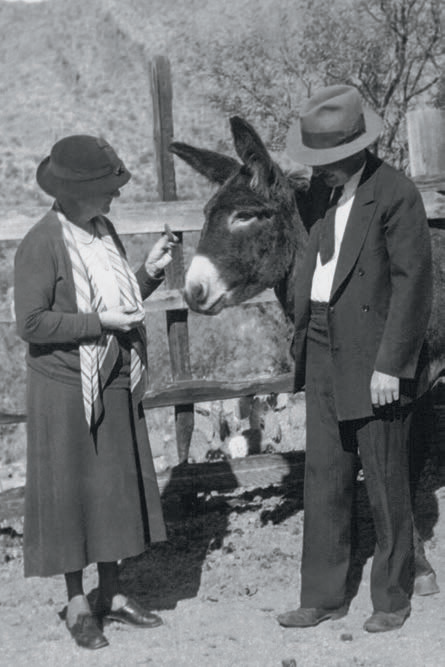
RUBY TACKLED her new hobby with enthusiasm. One magazine reported that she devoted her spare time to “cactus gardening, desert cookery, beekeeping, bird study and coyote taming.”
She kept a log of wildflower blooms from February to November and once recorded 16 species, including poppies, penstemons and hyacinths, in a 4-by-4-foot area. Today, a sign at the trailhead warns visitors not to feed wildlife, but Ruby had no such qualms. She befriended a jackrabbit with apple cores and constructed a watering hole for deer, javelinas and bighorn sheep. “It is surprising how soon the news of one’s hospitability gets about on the desert,” she wrote.
I find the watering hole, now dry, and the foundation of the outhouse. The Bowens’ well, dug some distance from the house, still reaches water, but no windmill remains to pump it. I drop a pebble through the grate and count, “One-Mississippi, two-Mississippi” before I hear the plop.
Inside the house, faint lines on the cement floor allow me to trace the shapes of the rooms and the zigzag hallway. Every wall has numerous wide windows looking over the desert. A mountain lion once tried to climb through one, tempted by the smells wafting from the kitchen.
The crumbled edges of a bathtub endure, as do the two fireplace chimneys darkened by soot. Coiled pipes inside a chimney provided heated water. Nothing remains of the roof except a few charred rafter stubs and a strip of old tin.
It’s easy to imagine the Bowens living here, even though the seclusion they sought is long gone. A steady stream of hikers, joggers and mountain bikers come up the trail. Many of them stop to explore the stone house; I tuck myself into a windowsill to watch people drift through the space. One visitor peers in the doorless entry and says to no one in particular, “Should I knock?”
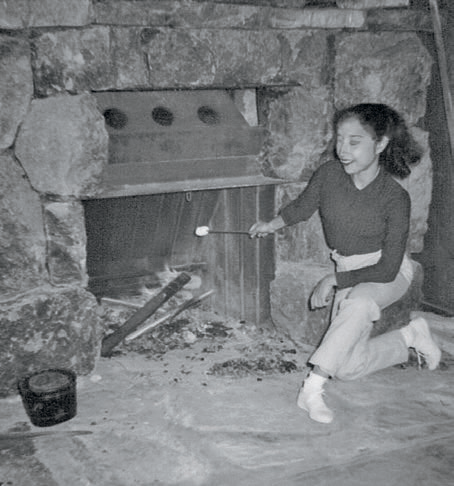
WHAT WAS HOBBY TO RUBY was livelihood to the land’s original inhabitants, and Ruby knew she lived on the homeland of the Tohono O’odham people. The Homestead Act’s foundation in land theft never seemed to trouble her, though she often wrote about Indigenous traditions.
Every summer, O’odham families arrived by wagon at the Bowen homestead to harvest saguaro fruit, using long poles to knock down the ripe berries and ollas to simmer syrups and jams. “A tantalizing aroma somewhat like that of ripening strawberries hangs in the air,” Ruby wrote of the harvest, a tradition that continues today at adjacent Saguaro National Park.
She wrote articles for the local paper about the O’odham harvest and the Pascua Yaqui Passion Play (a blend of Yaqui and Catholic traditions), but her favorite topic was cactuses. And she was an early champion for environmental protection: She urged readers to plant native flowers, raised concerns about “bootlegged cacti” and condemned the destruction of barrel cactuses for candy-making.
She also saw lessons for humanity in cactus life cycles. “Desert plants,” she wrote, “teach a patient adaptation to one’s environment, endurance, and a wise conservation — an abiding faith that desert rains will come if one will but wait long enough.”
In an article for The Desert Magazine, Ruby described the one-night-only spectacle of a night-blooming cereus (Peniocereus greggii), a Southwestern cactus that spends most of the year as unimpressive gray-green stems until it explodes with oversized white flowers. She explained the bloom usually happens around San Juan’s Day (June 24), and she kept an all-night vigil to photograph the pale, frilly flowers at their “fullest perfection” just before dawn.
Accompanied by Ruby’s photograph of an exquisite triple bloom, the article, Queen of the Desert Night, was her most popular. It was picked up by Reader’s Digest, and Arizona Highways printed an excerpt; the editor belatedly gave Ruby credit a few issues later.
Her language was — pardon the pun — flowery, but heartfelt. She wrote, “Those who live in an arid, sun-parched region the whole year through inevitably come to regard the exquisite flowering of this plant with something of the awe reserved for birth, death and other of Life’s mysteries.”
When Ruby’s daughter, Gloria, was born on San Juan’s Day in 1943, Ruby celebrated the occasion by planting night-blooming cereuses in her cactus garden.
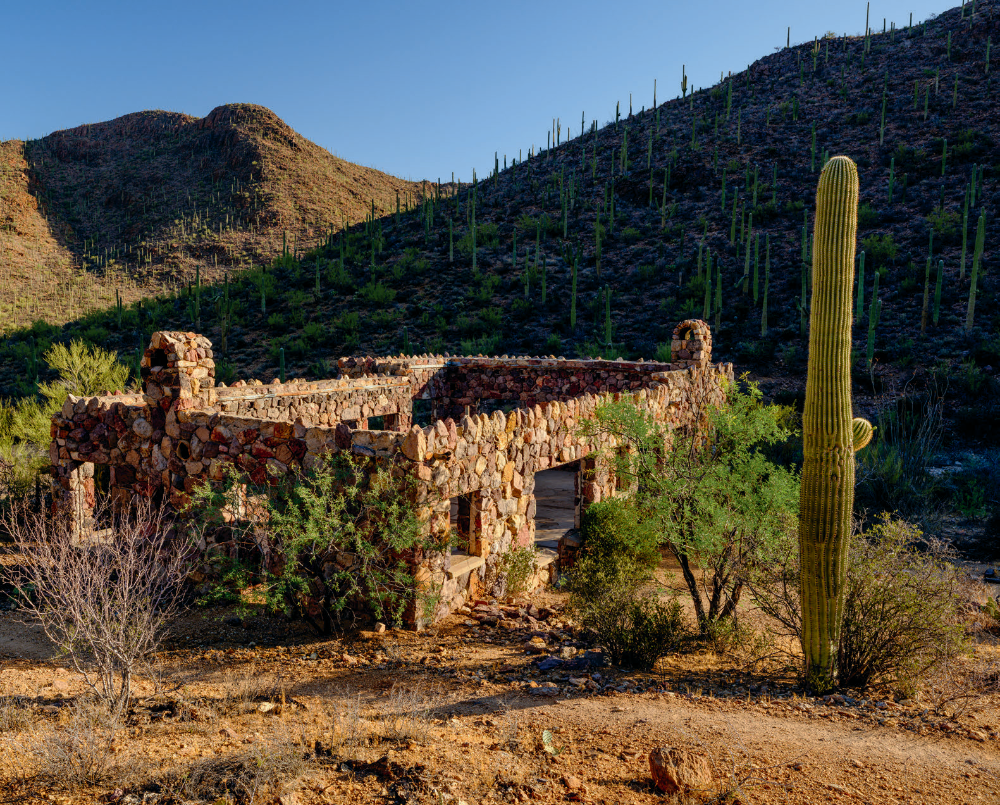
I CAN FIND NO TRACE of the cactus garden today, but admittedly, it’s like looking for a needle in a stack of needles. The most promising sign is a lone hedgehog cactus, which looks out of place among the teddy bear chollas and prickly pears. But if cereuses still flourish here, they elude me.
Gloria was a toddler in the stone house. Years later, she recalled how her father topped the Christmas tree with a star cut from a spare bit of roofing tin. But her birth and Ruby’s continued decline in health soon prompted a change. Sherry took a job as an Associated Press editor in New York City, and the family moved there in 1945.
The Bowens hoped to retire to their homestead in Arizona, which may explain why they left furniture and many other belongings behind. But they never returned. Sherry died in New York in 1956, and Ruby succumbed to rheumatic fever and heart damage in 1961. Gloria, who became a renowned ballerina, visited her childhood home in the desert the following year, but she never lived there. Not long after, a fire destroyed the roof and interior wooden walls.
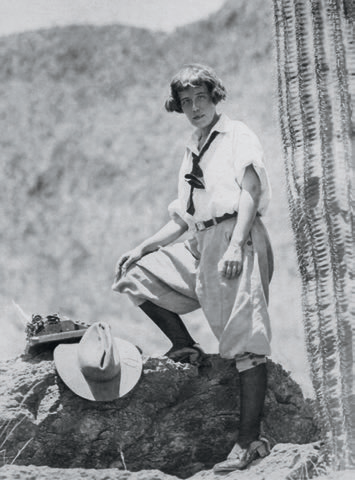
The homestead became part of Tucson Mountain Park in 1983. I’m pleased to see the plastic-sleeved slip of paper that once told the Bowens’ story has been replaced by an interpretive sign. It includes a photo of Ruby standing beside a saguaro, wide-brimmed hat and typewriter close at hand.
The 14 years Ruby spent in these mountains made an indelible mark on her — and what survives of her writing made a similar impression on me. “Desert living has given me something rare and precious,” she wrote, “a sense of human values and spiritual satisfactions perhaps seldom found in such abundance anywhere else on Earth.”
From the stone house, hikers can continue up the David Yetman Trail to Gates Pass or backtrack a little way and turn down a spur trail — which ends on the improbably green lawn of the JW Marriott Tucson Starr Pass Resort & Spa. There, an elegant sign points the way to “Bowen’s Trail.” I can’t help but wonder what Ruby Bowen, lover of seclusion, would have thought of all this fuss.