
It's easy to miss the old bed of Route 66 in Petrified Forest National Park, even though the Tawa Trail starting at the Painted Desert Visitor Center crosses directly over the top of it. The National Park Service hasn't yet put up an interpretive sign to draw attention to the flat, raised roadbed, abandoned since the 1960s and overgrown with yuccas and saltbush.
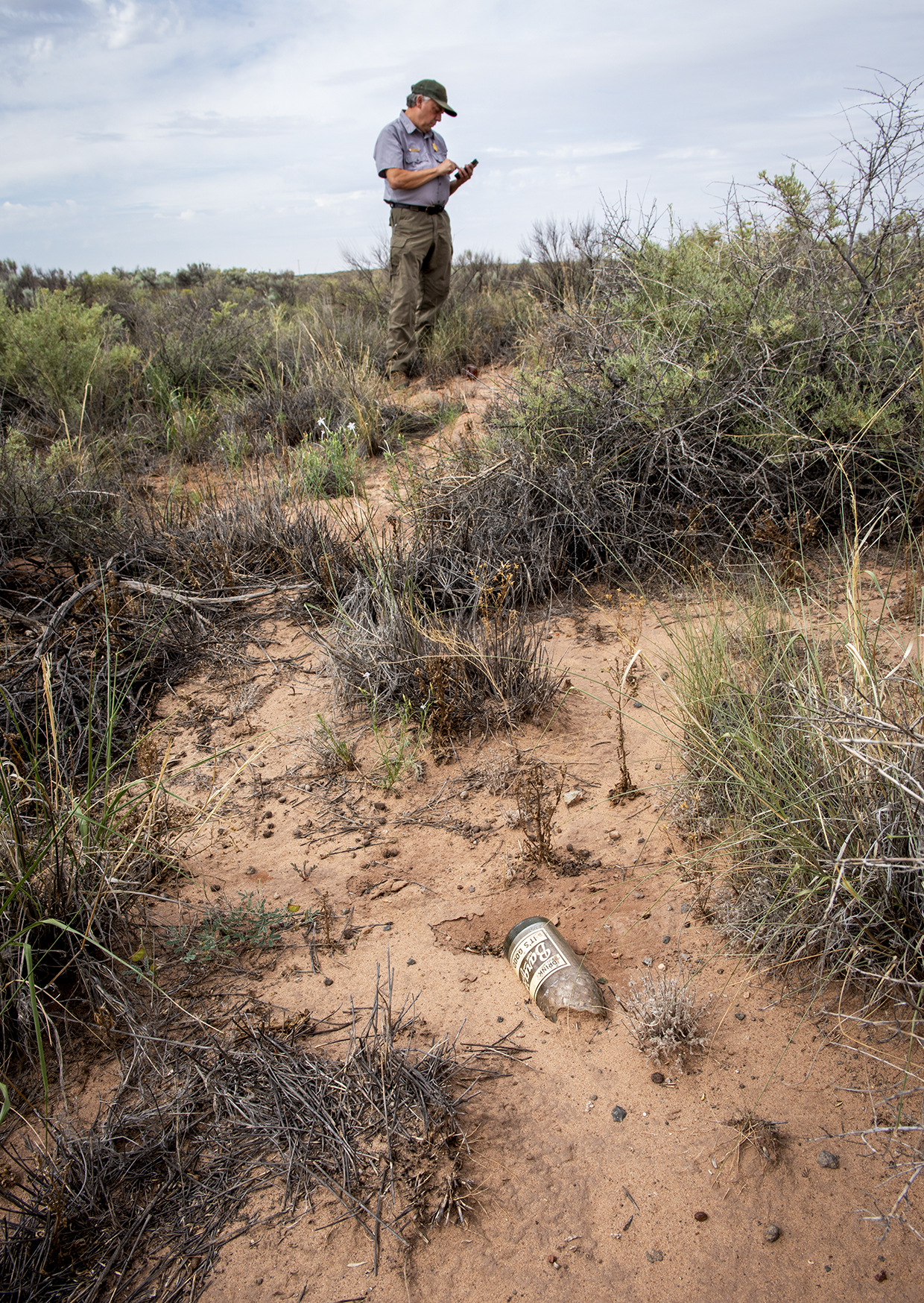
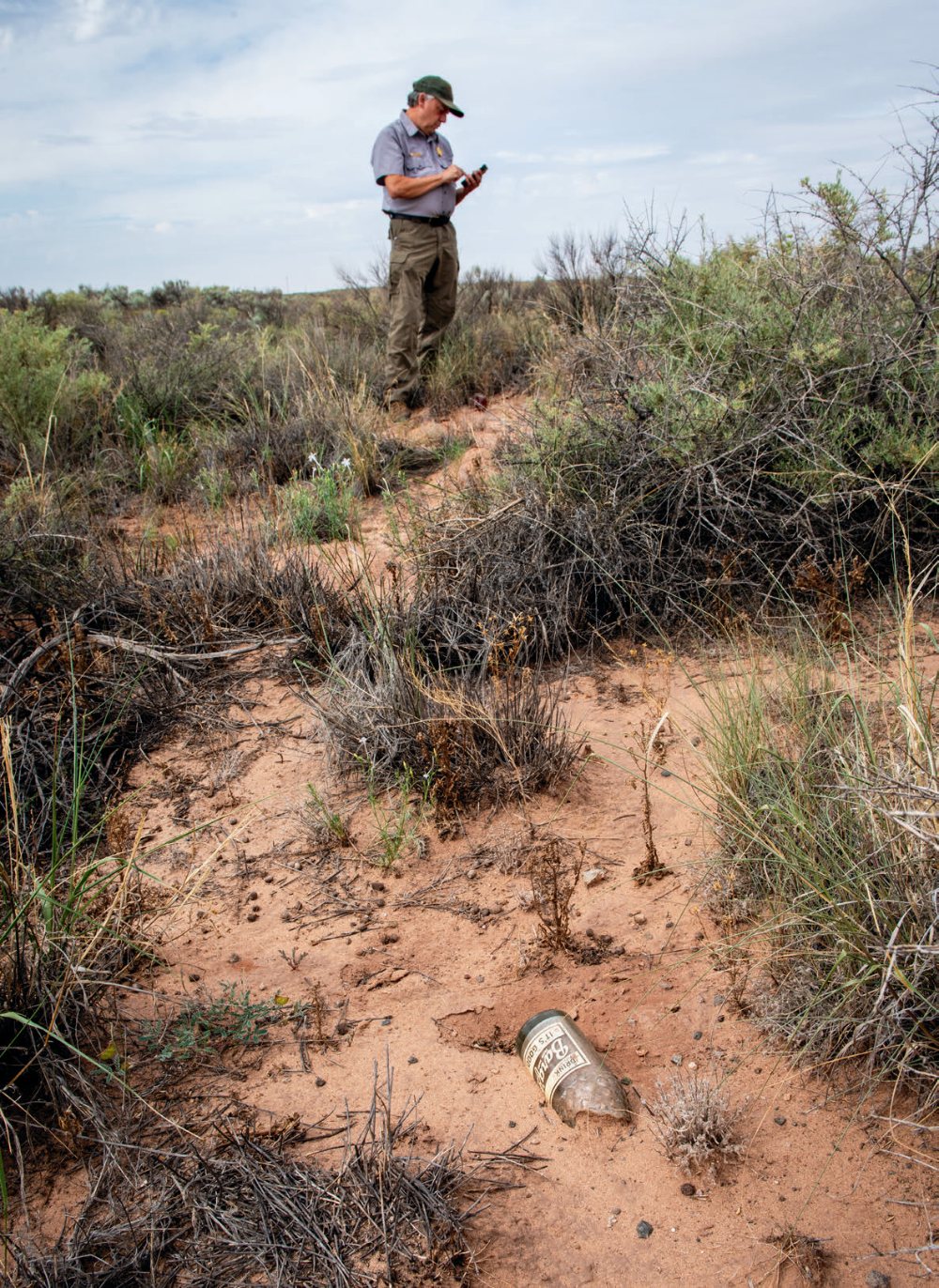
Bill Parker, the park's Chief of Resources and Science, points to a scatter of green glass shards: "I wonder how many people walk up that trail ... and see that pile of broken glass right there, and go, 'Why doesn't the national park ...?'" He trails off, leaving the obvious unsaid: Trash ought to be picked up, especially in a place with a reputation for scenic beauty.
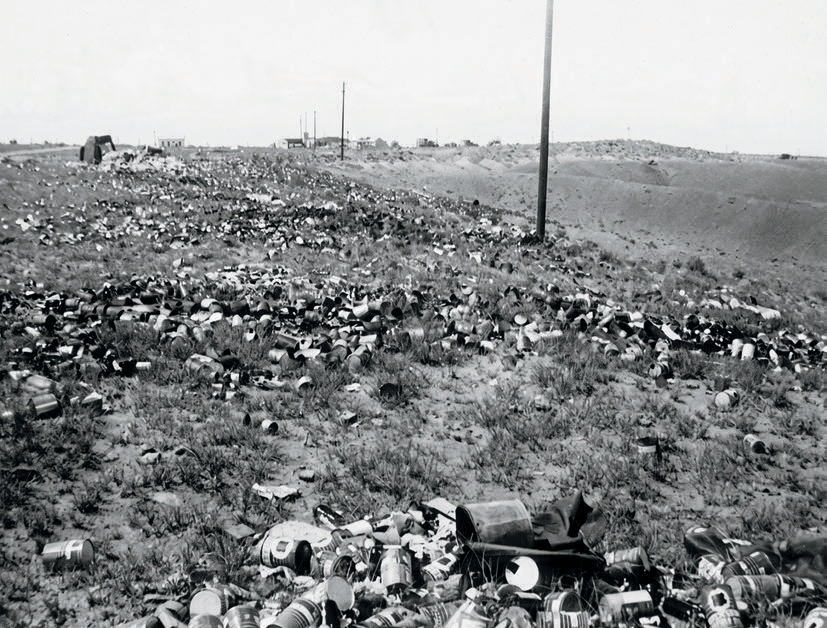
But this isn't trash — at least, not anymore. The shattered glass, along with every other discarded item strung along the ditches on either side of Route 66, is a historical artifact. Each one offers a treasure trove of insights about the fabled Mother Road.
Route 66, celebrating its centennial this month, was once a major thoroughfare connecting Chicago to Los Angeles. It was assembled piecemeal from existing roads, and in Arizona, it followed the path of the National Old Trails Road, which itself followed an old wagon road that cut through lands traversed by Navajo, Hopi and other Native peoples for generations.
The centennial also commemorates the start of the federal highway system, which changed the face of America. Parker says before that, “people tended to stay and live their entire lives in their neighborhoods or nearby. This really opened things up for them. That's why it's so symbolic.”
Today, the name “Route 66” evokes romantic visions of the open road. The 6-mile stretch in Petrified Forest is the only part of the highway (originally nearly 2,500 miles in length) that passes directly through a national park. In 2020, park staff decided to nominate the old roadbed for the National Register of Historic Places. The register usually honors significant places that are at least 50 years old, and the nomination process requires an archaeological survey.
The park partnered with the Museum of Northern Arizona for the task, and scientists set out in search of treasure. What they found strewn along Route 66's margins was trash. Lots and lots of trash.
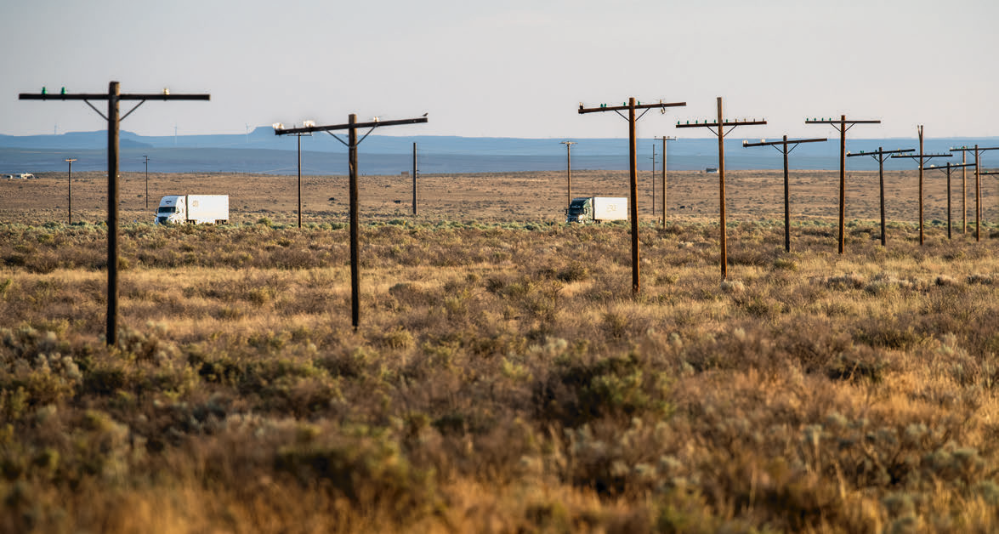
This section of Route 66 was paved in 1934 and bypassed in 1958, long before the environmental movement, highway beautification programs or anti-litter campaigns. That makes it a boon for archaeologists who study trash — though Parker argues practically all archaeology involves studying trash.
“It's just from different time periods,” he says. “In this case, they just happened to throw it out of a car window while they were doing 45 miles an hour down the road.”
Parker bends to pick up a rusted can and checks the bottom. It's Triton motor oil. “You didn't go anywhere without [extra] oil in your car,” Parker says. In those days, drivers stopped often to refill gas and check oil. Even so, engine failures were common. Dust Bowl migrants fleeing westward on Route 66 didn't have the means to maintain or repair their vehicles. The survey turned up one “breakdown camp,” where stranded motorists survived off their wits and whatever food they had in their car, stuck in the unforgiving desert for hours or perhaps days.
The archaeologists also found burned, twisted and broken car parts, mostly from the post-World War II era. During the war, Petrified Forest National Monument staff set the national record for how much metal scrap they collected to aid the war effort. After the war came the heady days of the American road trip, and the shattered remnants of crashes were left in place.
Route 66 was a dangerous road. Military vehicles had torn the pavement into potholes, no barrier separated the two-way traffic, and cars had no seat belts. Black travelers, in particular, risked accidents from fatigue because so many hotels refused to serve them. The survey turned up another reason for the numerous car crashes: alcohol.
David Purcell, MNA archaeologist and historian, says after Prohibition ended in 1933, “with the return to the sale of alcohol, can manufacturers and bottle manufacturers each came up with disposable bottles. Prior to that point, bottles were intended to be washed, refilled and reused.”
The result is scattered all along the historic highway. “In fact,” Purcell says, “there are horrific period advertisements that I’ve seen from magazines of a guy sitting in a boat fishing, hucking his beer can into the lake.” The convenience of littering was a marketing ploy.
Ultimately, MNA scientists cataloged more than 11,000 items along the Petrified Forest stretch, estimated to be just 15 percent of what’s out there. Almost half the bottles and cans had once contained alcohol. A high fatality rate — possibly combined with Arizona’s habit of paving roads with dark red cinders, Purcell speculates — gave the Mother Road another nickname: Bloody 66.
When Purcell began the survey, he imagined cataloging every item of trash. “[We] very quickly realized that we were going to be out there until I retired,” he says. “It gives you a sense of the scale of how much litter was deposited on American highways over just a few decades.”
Beer cans and soda bottles often include their place of manufacture, so they show the movement of travelers and their changing tastes, anything from classic Coca-Cola to locally produced Navajo sodas. Other items included medicine jars, perfume bottles, tins of sardines, cans of condensed milk, bullet shell cartridges and Polaroid camera film.
Children’s toys also turned up, though they probably weren’t left behind on purpose. “The question is always whether that was deliberately thrown out the window by, say, a sibling ... [or] by an irate parent who is tired of hearing whatever the argument is in the back seat,” Purcell says. “Or whether somebody is playing with a toy on the windowsill, they hit a pothole, and out it goes.”
Purcell says the oddest item uncovered was the partial set of dentures — or maybe the unbroken tennis bracelet. (No one tested it to see if it has real diamonds.)
The discarded items offer an unvarnished look at American travel. In the post-World War II years, kitschy roadside stands and tourist traps sprang up all along Route 66. The Painted Desert Tower promised a glimpse of sunset-colored cliffs to tourists who climbed to the top. Farther on, block letters on a roadside zoo advertised “MOUNTAIN LIONS,” while a rival menagerie offered rattlesnakes and Gila monsters. In Two Guns, huckster “Rimmy” Jim Giddings used to startle visitors by speaking out of a microphone system rigged beneath the two-hole privy.
Petrified Forest National Monument had to compete with all these roadside gimmicks. Rangers set up “checking stations” along Route 66 with a dual purpose: to direct travelers into the park, and to check them on the way out for stolen pieces of petrified wood.
“One of the things we found were places where people had been approaching a checking station, and, seeing that they were going to be inspected, they pulled over and they dumped what they had,” Purcell says, leaving little piles of petrified wood, Native American objects and fossils behind.
Signs of thievery and drunken driving probably aren’t what the travelers themselves would have chosen to leave for posterity. But that’s the gift of trash: It shows the truth. Poems, songs and stories celebrated Route 66 from its earliest days, but the romance doesn’t hold up under scrutiny. Some accounts tell of travelers stuck in bumper-to-bumper traffic the whole way.
Even so, the legend of the Mother Road still draws millions of tourists annually, many of them from overseas. Olivia Charest, a Flagstaff resident who studied Route 66 for her master’s thesis in anthropology, describes these trips as pilgrimages. “They’re looking for America,” she says, drawn to a nostalgic version of the past that may or may not have really existed.
Charest says modern tourists on the mythologized “Main Street of America” stop at shrines and meet wise sages — experiences that are authentic and full of meaning. Her own journey traveling Route 66 with her mother inspired conversations between them about her mother’s childhood. In short, Charest suggests it’s possible to know the road’s harsher realities without losing its enchantment.
Interstates began to replace Route 66 in the late ’50s, and in 1984, Williams, Arizona, became the last town to be bypassed. Other shifts occurred around the same time: Environmentalism rose to the forefront, Lady Bird Johnson began her highway beautification project, and Mothers Against Drunk Driving formed. For some, the loss of Route 66 — and its associated dangers — was nothing to mourn. Charest documented one state highway official saying, “Route 66 is like an old can of tuna — once you’ve used it up, you throw it away.”
But the Petrified Forest archaeology project proves that anything thrown away can revive into new life. The park’s abandoned stretch of Route 66 was added to the National Register of Historic Places as an “archaeological district” earlier this year, and almost all the artifacts still lie where they first fell. The exception is a few on display at the Museum of Northern Arizona in Flagstaff, in an exhibition called “Wagon Road to Mother Road” that will run through January 31.
Kristan Hutchison, MNA’s exhibitions manager, says the community came together to provide relics for the show, including a 1931 Ford Model A, a Phillips 66 gas pump and a slice of the road showing its many layers of dirt, gravel, asphalt and pavement.
Hutchison wanted the exhibit to tell the complete story of the famous road. She’s fascinated by the “dark underbelly” revealed by the trash.
“That’s a piece of the story we don’t think about,” she says. People remember the small-town diners, jukeboxes and alluring beauty of the high desert, but they tend to forget the drunken driving and rampant littering. A lot has changed since the heyday of Route 66, some of it for the better.
“It’s not that we shouldn’t be nostalgic,” Hutchison says. But she thinks it’s important, when dreaming of the past, to identify exactly what we’re yearning for.
The decision to invest in federal roads such as Route 66 a century ago led to the modern era of superhighways — an era that, for many, feels too fast. Hutchison says, “I think that we’re nostalgic for stopping along the way and slowing down, having authentic experiences in a small town.”
Those are experiences travelers on Arizona’s rural roads can still have, simply by turning off for a meal, a stroll or a scenic view.
“It doesn’t matter what road you’re on,” Hutchison adds. “It matters what road you get off.”