
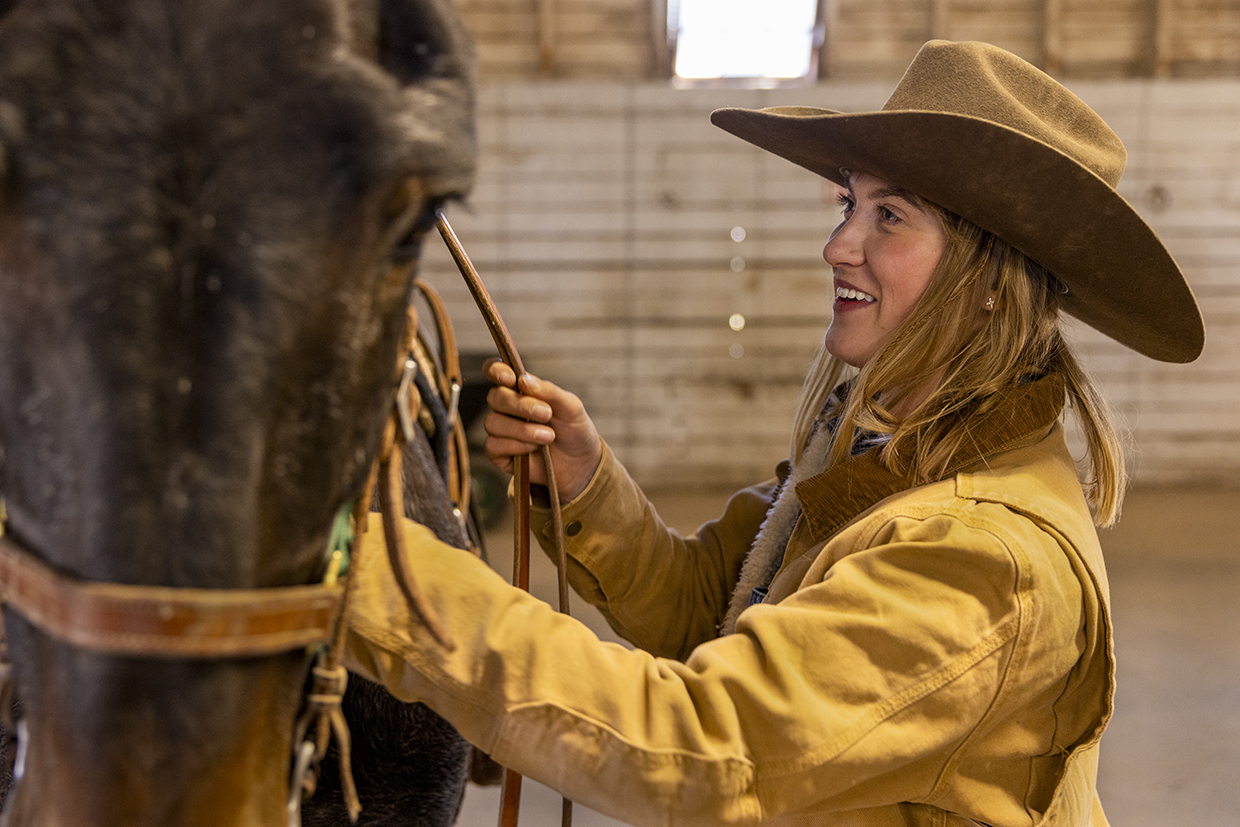
Remy Kelbel was 4 years old when she rode a horse for the first time. She didn’t come from a riding or ranching family; it was pure chance that her Aunt Vonna took her to a stable near her hometown of Colorado Springs, Colorado, one day. Something sparked. Among the animals, she felt like she belonged.
“Once the horse love is in you, for some of us, it never quits,” she says. “It’s always there.”
At Grand Canyon National Park, up to nine wranglers are employed by Xanterra Travel Collection, the descendant of the storied Fred Harvey company and the largest national park concessionaire in the country. Wrangling is a coveted job for anyone who loves equines, outdoor adventure and parks. Kelbel, who joined the tight-knit Mule Barn on the South Rim in the spring of 2025, has always had an affinity for all three. By the time she was 6, cowboys at Lost Valley Ranch, northwest of her hometown, were putting her on the lead horse for trail rides. By high school, she was show jumping. (“Tiny jumps,” she says.) Kelbel traveled with her family, too, climbing to Machu Picchu in Peru when she was a teenager and visiting Glacier and Yellowstone national parks.
But it wasn’t clear how she could turn her passion into a career. The most obvious path forward was veterinary school. “But I always struggled in school a lot,” she says, “with science, math, all those things.” She didn’t want to be a vet but loved storytelling, so she majored in broadcast journalism at Colorado State University and started a podcast called The Outdoor Equestrian, where she interviewed rodeo athletes, horse trainers and others who shared her obsession.
“All throughout my life, I tried as hard as I could to be into horses,” she says. “My family was not in that world at all.” Her father, however, helped her find a summer internship at WindWalkers Therapeutic Riding Center in Aspen. There, Kelbel helped teens with drug or alcohol addictions and children with disabilities learn how to approach, ride and care for a horse. Working with equines requires a calm and down-to-earth manner, she says. It’s a skill — or perhaps a way of life — that Kelbel has cultivated since childhood.
The internship at WindWalkers deepened her awareness of the healing power of equines. As she puts it: Animals never judge you. “Horses sync their heartbeats to ours, and that helps them learn about us,” she says. “They’re also herd animals. … They’re very observant; they’re very kind; they can tell if they like a person’s intentions within the first seconds of meeting them.” She says it takes a “kind heart” to win their trust.
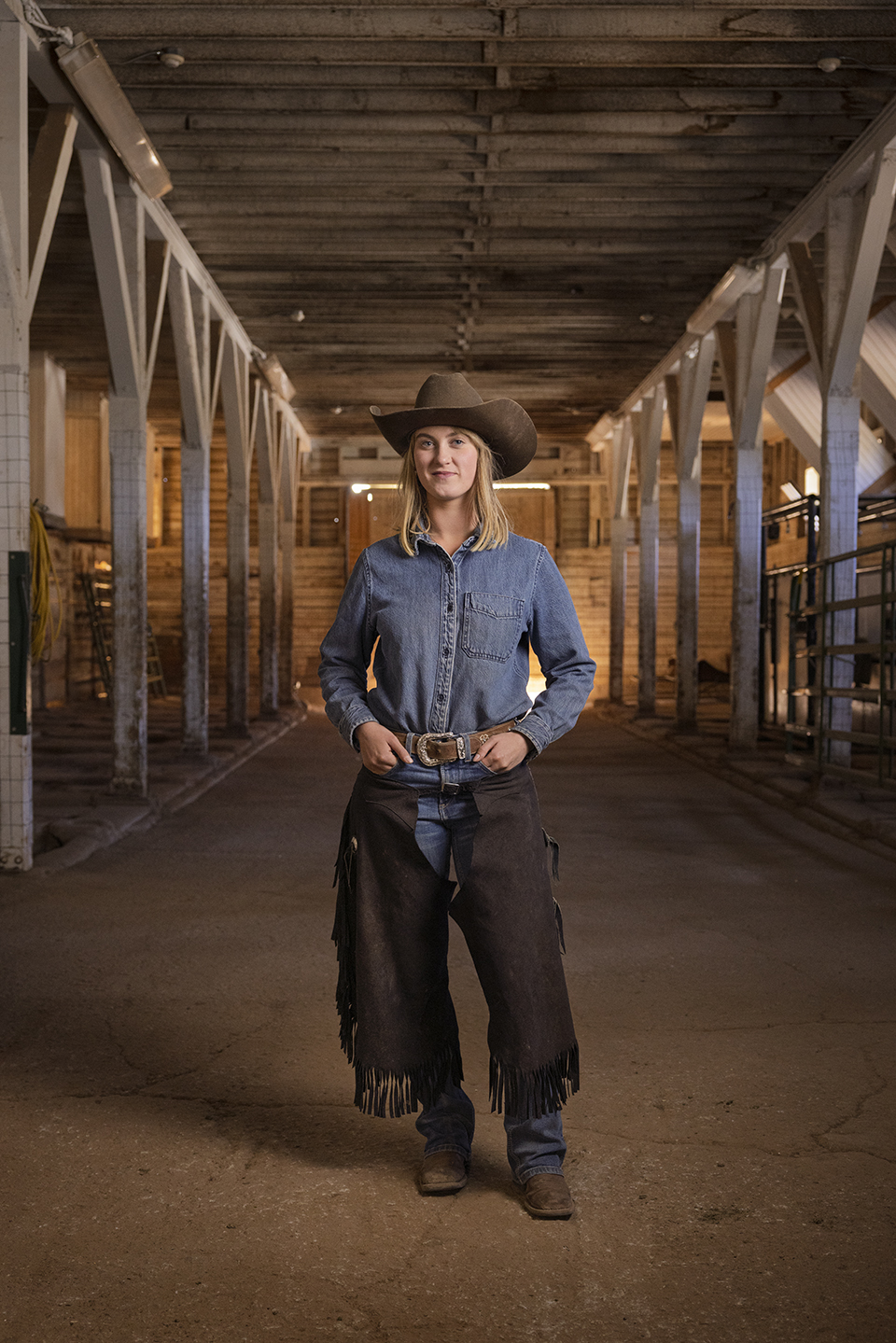
Kelbel’s dream, though, was to be a wrangler — a career so entrenched in the mythos of the American West that the word is used to brand Jeeps and blue jeans. She spent a summer wrangling at Colorado’s Garden of the Gods, where she always rode the same horse, Nemo. “I love that bonding experience with the animals,” she says. Just one problem: The job was seasonal, and she wanted to wrangle year-round. Grand Canyon National Park is one of the few places where that opportunity exists. So, when a position opened with Xanterra, she leapt at the chance.
“I always wanted to be a cowgirl … and now, thanks to the Grand Canyon, I finally am one,” she says. Making the move to Arizona to live year-round at the South Rim was a little scary, but she knew this was her moment. “I got the job, and I was amazed,” she says. “This is one of the best places in the world to wrangle. But it’s also one of the most dangerous.”
Canyon mule rides began in the 1880s, and today, up to 50 people ride mules along the rim or into the Canyon daily. The most coveted type of trip, an overnight stay at Phantom Ranch on the Canyon’s floor, involves a 10-mile zigzag down the Bright Angel Trail, which has more than 100 switchbacks. The steep trails and cliff edges are the most obvious hazards, and wranglers have to watch the mules (and their riders) closely on tight corners and sheer drop-offs.
Luckily, mules are surefooted creatures. They’re the offspring of a mare and a jack (a male donkey), so they’re related to horses, but with a different temperament. Kelbel says they’re not as friendly to people, but they’re steadier and less likely to spook. “They mean business,” she says with a smile. “You definitely want an animal like that in the Canyon, because the trails are so rugged and thin.”
Mules, like horses, are prey animals, and every part of their body is built for alertness: long ears that can swivel in any direction, a keen sense of smell and incredible eyesight. In fact, they have some of the largest eyes of any land mammal, set on either side of the head so they get nearly 360-degree vision. Mules can see all four of their feet and the rider on their back — essentially, everything but their own tail. Kelbel says that makes them hyperaware of the cliff edge and potential threats. She takes her cue from them: “If my mule is looking somewhere, I look where they’re looking,” and as long as there’s no danger, “I pet them and let them know, ‘You’re safe.’ ”
The Canyon’s rugged terrain aside, it’s a fierce environment for both people and animals, with extremes of heat and cold. Snow and ice coat the ground in winter; unrelenting sun is the norm in summer. Wranglers such as Kelbel have to prepare for emergencies involving the mule riders and the hikers who share the trail. Exhaustion, dehydration and altitude sickness are among the most common concerns, so Kelbel always carries extra water, electrolytes and a first aid kit.
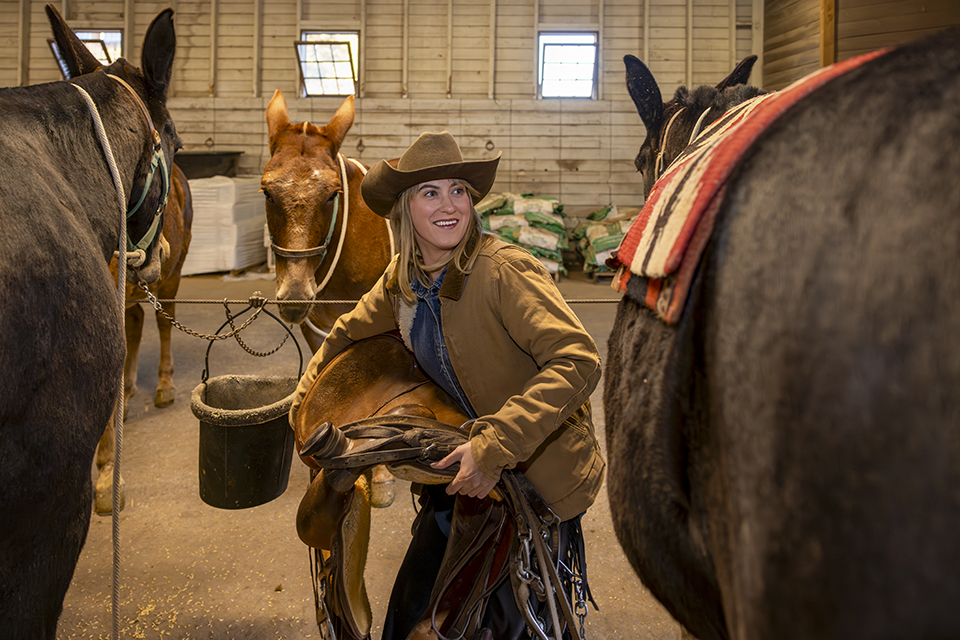
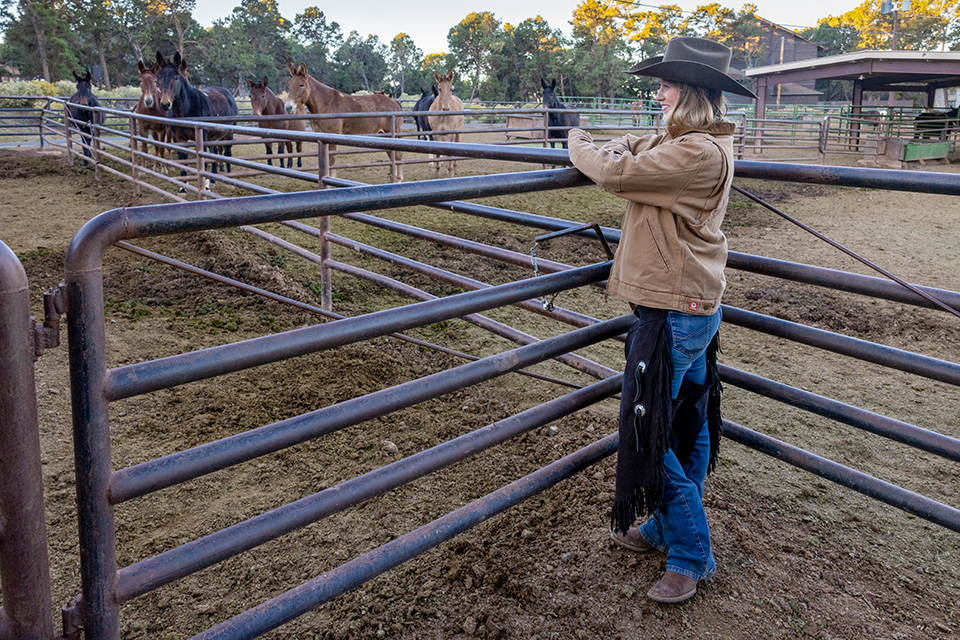
Kelbel’s calm, steady disposition is equally suited to working with equines and with humans in distress. But wrangling isn’t just about keeping the mules and their riders safe. It also requires the soul of an entertainer. “One of the best parts of wrangling is, we tell stories on the way,” Kelbel says. She talks about the history of the Canyon, about the 11 tribes that call it home and, of course, about mules. One spot, deep in the Canyon, is known as Echo Corner. Mule trains used to pause there so the tourists could yell, “Yeehaw!” and hear the echoes bounce back. The tradition ended when park officials complained the screams could be heard 3 miles away — and sounded like a distress call. Kelbel always pauses at Echo Corner to tell the story, which generally gets a big laugh.
“One of my favorites is sharing about the Kolb brothers, who were adventurer-filmmakers and photographers in the Canyon,” she goes on. “One of the main reasons the mule rides are so famous nowadays is because they took photos, in the early 1900s, of the mule rides.”
Kolb Studio, which dates to 1904, is still perched on the rim where the Bright Angel Trail begins, not far from the stone corral where tourists meet their mules. For decades, Emery and Ellsworth Kolb photographed the mule trains as they set off. Then, Emery ran halfway down the Canyon to a darkroom at present-day Havasupai Gardens, where he could develop the photos using the creek’s reliable supply of water. He jogged back to the top in time to sell the pictures to the tourists who were returning to the rim after a long trail ride. It was a 9-mile round-trip with a 3,000-foot change in elevation — and Emery sometimes made the run three times a day.
The Kolbs turned the Canyon’s mules into celebrities. Postcards sold at the park in the mid-20th century featured mules more often than any other animal; they outshone the half-tame deer, the majestic elk and the picturesque bighorn sheep. “The long mule trains lumbering up and down the Canyon trails,” scholar Yolonda Youngs writes, “provided a sense of scale and perspective to the Canyon’s immense size.”
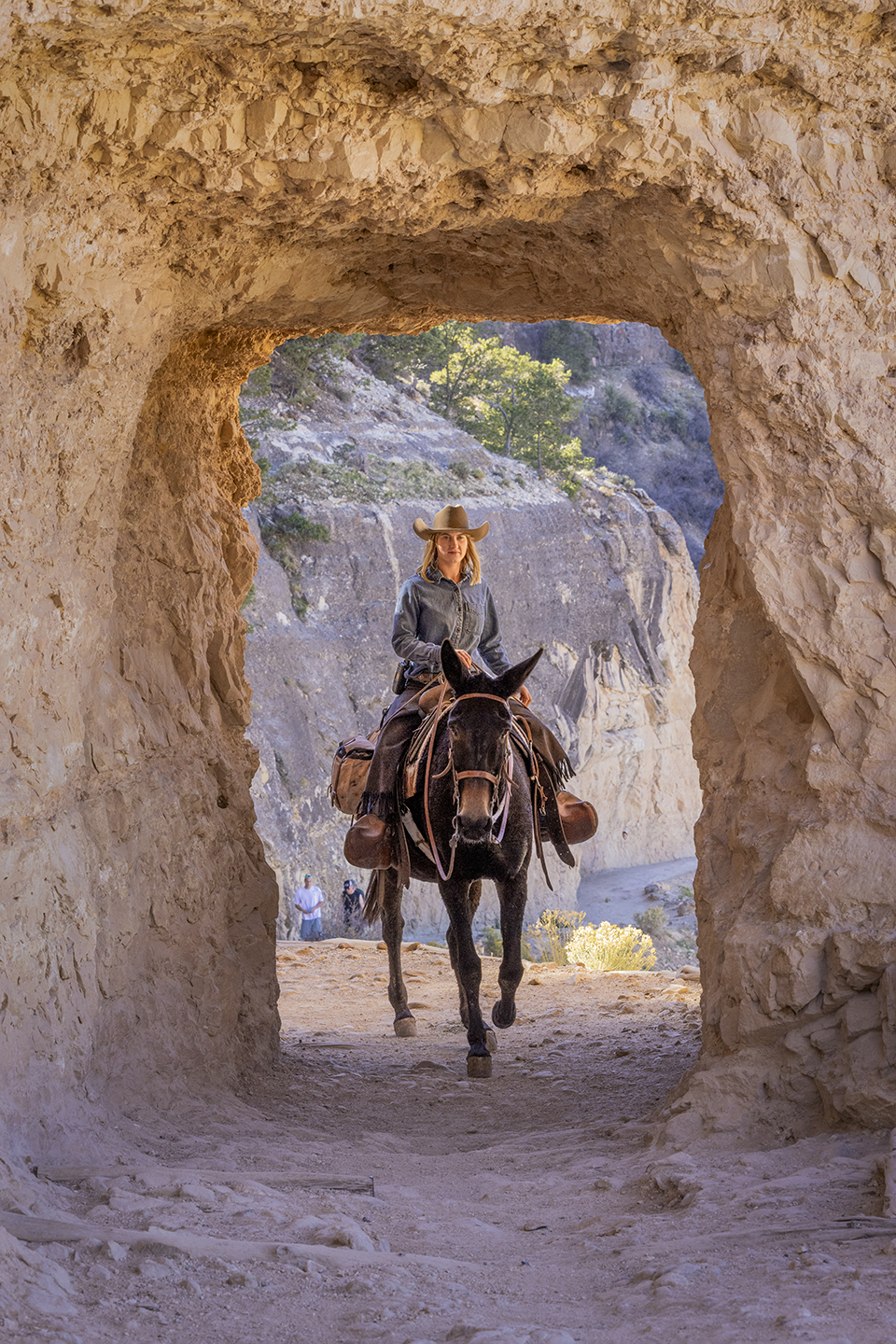
That popularity hasn’t waned. Today, Xanterra’s mule trips often sell out as soon as they open for reservations more than a year in advance. “People dream of this,” Kelbel says. “I’ve had guests be in tears in the Canyon because of what they’re seeing and how long they’ve waited to be out there. That’s an incredible gift I get to bestow on people — and have their journey be my journey, in a sense.” Every trek into the Canyon is a chance to see it anew, through a visitor’s eyes.
It’s a grueling schedule, though. Workdays start before dawn, when Kelbel and the other wranglers rise to saddle and bridle the mules. Of the roughly 130 mules employed by Xanterra for pack trips and trail rides, Kelbel says her favorite for rides below the rim is Marshall, but she also enjoys riding one named Arizona. “Arizona’s a really bumpy ride, because he will kind of hop on the steps going down, and it’s like, whoa!” she says with a laugh. “But he’s a good boy. I like him a lot.”
Occasionally, Kelbel takes a pack train into the Canyon to deliver supplies to Phantom Ranch on the waterless, staircase-steep South Kaibab Trail, but mostly, she works with guests. That gives her the chance not only to tell stories, but also to hear them. “Everyone has a different story,” she says. “You always meet amazing people.” Visitors come from all over the world — some in search of sublime beauty and adventure, others looking for solace and healing. “Being outside in nature,” Kelbel says, “it calms us down; it makes us more grounded. It lets us connect with something other than ourselves — kind of step out of whatever we’re dealing with.” She pauses, searching for the right words. “I think that’s what the mule rides do, is it gives you something to … step out of yourself and realize the world is so much bigger than you are.”
Kelbel says she never takes the job, or the beauty of the Canyon, for granted — “I count my blessings every day” — but she also looks forward to her days off. “I’m not gonna lie: I love getting to sleep in,” she says, or to relax with a movie or a book about adventure. She doesn’t yet know what the future holds, but as long as it involves equines, she’ll be content.
“Learning to wrangle here really sets you up for great success moving forward, wherever you go,” Kelbel says. “By doing this, I could really go anywhere within the horse industry. It opens so many doors.”
For now, it’s the fulfillment of a long-held dream — one that means she gets to introduce herself as a Grand Canyon wrangler whenever she meets new people. “Usually, people gasp,” she says. “They’re like, ‘That’s the coolest job ever!’ And I have to agree.”