
The scene at D.A. Ranch in Cornville on this late-October afternoon couldn’t be more bucolic. The pastoral grounds of the vineyard feature a mirror-like pond that reflects weeping willows draped in emerald-green leaves and set against a sapphire-blue sky. Horses casually graze behind white split-rail fences. And a log-cabin-style house with a big front porch invites visitors to relax in wooden rocking chairs.
Positioned around the water’s edge and at other picture-perfect spots are 23 artists putting paint to canvas as they participate in the 2025 Sedona Plein Air Festival. Some hold a brush in one hand and a glass of wine in the other. All are immersed in capturing the serenity and natural beauty of the moment. But there’s also a tension as palpable as the cricket songs rising from the pond. These professionals, from across the United States, know the clock is ticking.
“I am under a lot of pressure,” says Nic Fischer, who keeps working as he talks. “This is rapid-fire painting.” Fischer’s portable, telescoping easel is set up under a willow next to the pond as he tries to capture the reflection on his canvas. Back home in Bozeman, Montana, Fischer takes all the time he needs — weeks, or even months — to paint an evocative wilderness scene that meets his approval. But he likes to attend this festival, he says, to challenge himself and “fall in love with the red rocks.”
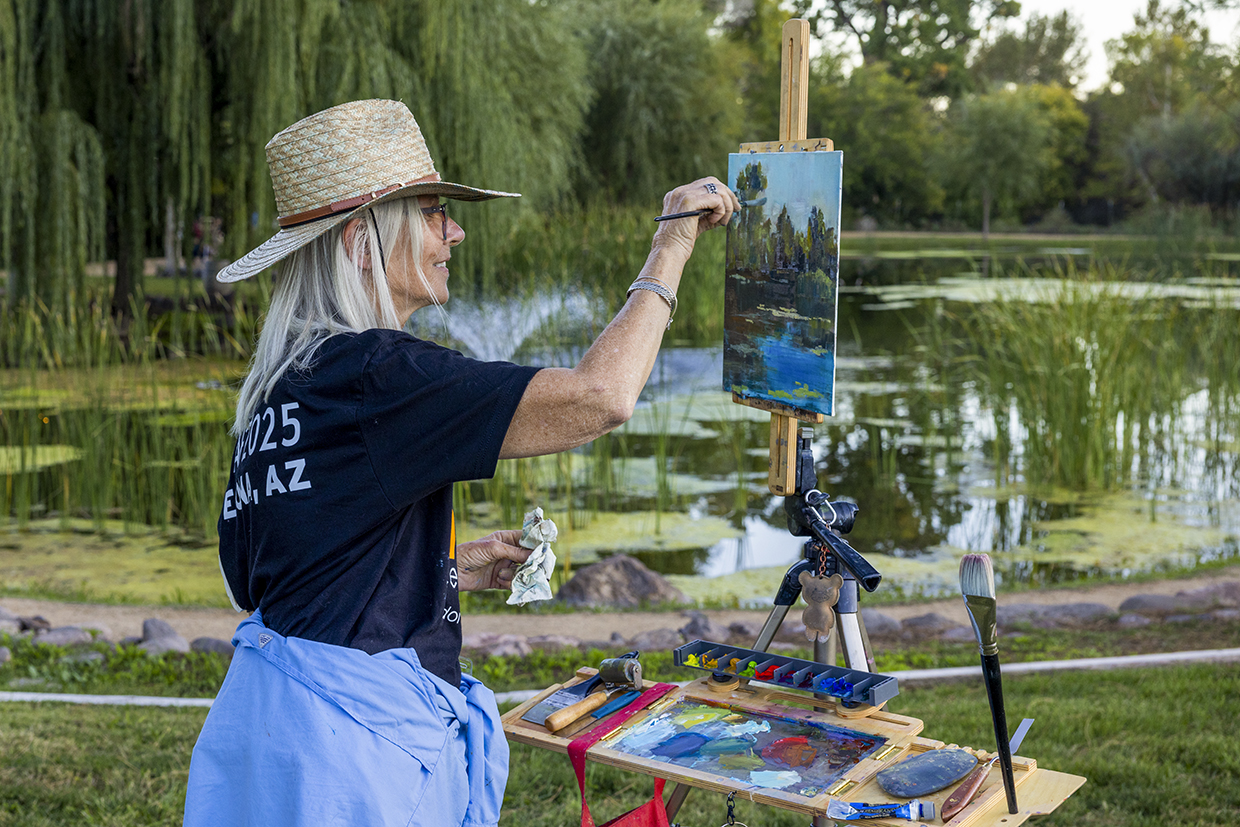
Sponsored by the nonprofit Sedona Arts Center, the Sedona Plein Air Festival is celebrating its 22nd year this month. Artists, like Barbara Mulleneaux (pictured), spend a week roaming Red Rock Country with their easels and paints, looking for scenes that captivate them — anything from an old tractor in a field to towering sandstone buttes at sunset. The D.A. Ranch event interrupts the artists’ creative solitude with a competitive “paint-out” for which they must produce a piece of art in just a few hours. The works are judged, and winners announced, later in the evening; meanwhile, curious members of the public and art collectors wander the grounds, looking over the artists’ shoulders to observe plein air painting in real time.
While landscape painting became popular in Europe much earlier, it wasn’t until the mid-1800s that technological advances in equipment made it possible to paint en plein air, or “in the open air.” Rather than committing scenes to memory and trying to replicate them in a studio, artists began traipsing across the countryside with portable easels and newly invented premixed oil paints in lightweight tin tubes.
The field-based ritual has changed little over the centuries, and it still attracts artists obsessed with authenticity. But they also often seek to communicate a sense of awe through their interpretation of a scene. The challenge during the competition at D.A. Ranch is to not only paint quickly, but also capture subtle details at a specific moment: the neon green of islands of algae on the pond, the shadows cast by cattails, the golden autumn light seeping into an old barn.
What observers may not be aware of is the lengths to which these artists go in making their art. “It is not for everyone,” says Florida-based artist and festival participant Manon Sander. “You have to be able to drag your stuff around and stand out in the heat and cold and wind.” Later in the week, Sander will paint a wetland while fighting off clouds of mosquitoes, scrape red dirt from her wet canvas during wind gusts, and encounter a tarantula en route to a painting spot. “Studio work can feel stale, because everything is so predictable,” she says. “When you paint outside, there are big surprises.”
At D.A. Ranch, Sander focuses on the rustic log house where people are gathering on the front porch. Painting as quickly as possible, she aims to replicate magical shadows, cast by ancient cottonwoods, that dapple the building’s roof. The dance between light and dark likely eludes those enjoying the generous shade from the trees on this unseasonably warm afternoon.
Many of the artists at the festival participate in what they call “the circuit,” traveling to annual plein air events across the country. There’s a camaraderie among the group, as well as a bit of friendly competitiveness. But Sedona holds a special draw. Just as famed French impressionist Claude Monet popularized his hometown of Giverny for the local landscapes he painted, Sedona is a plein air artist’s paradise.
After the D.A. Ranch gathering, Fischer spends several days at a solitary spot along Oak Creek beneath Midgley Bridge, becoming entranced by autumn colors and flowing water while creating a painting that shows two golden cottonwood leaves sailing past a towering burgundy cliff. “I was able to paint for six hours straight,” he says of the experience. “I loved the solitude. All I heard was the creek and the sound of leaves hitting the ground.”
By the end of the festival, more than 100 paintings fill the walls of the Sedona Arts Center. Sander wins first place in the D.A. Ranch competition, and Fischer is awarded third place in the festival’s final show for his painting of falling leaves. But the true reward for Sander and Fischer, like for many plein air artists, comes from being outdoors and studying the nuances of nature’s beauty.
“Once you start paying attention,” Sander says, “life becomes so much richer.”
The 2026 Sedona Plein Air Festival is scheduled for October 16–24. For more information, visit sedonaartscenter.org.