

It seemed like the perfect strategy for hiking Sedona’s scenic trails while avoiding the crowds and parking hassles. I planned my visit for mid-December, during the off-season, and rented an Airbnb that was walking distance from the Carroll Canyon Trailhead in west Sedona. The trailhead had only three parking spaces, which significantly cut down on visitors but offered access to an extensive network of premium hiking paths.
My yellow Lab, Trudy, and I had spent two full days roaming across Red Rock Country, reaching a high perch above the sandstone temple of Cathedral Rock and taking a circuitous backdoor route to the popular Airport Mesa. In the late afternoons, the golden winter light electrified the buttes and saturated the greens and blues of earth and sky. Distant coyotes howled and barked, as if to applaud the beauty — or so my romanticized notions about Arizona’s most ubiquitous large carnivore led me to imagine.
But it also occurred to me that perhaps something else was going on to rally the predators in broad daylight.
On the third day of my Sedona retreat, Trudy and I set out from the trailhead for an 8-mile ramble on the network’s least-used paths. We trekked along a wash that bordered a housing development, then skirted some salmon-colored cliffs before scrambling atop a mesa with 100-mile views. The coyotes were still singing, and this time, they were closer. And it was only 2 p.m.
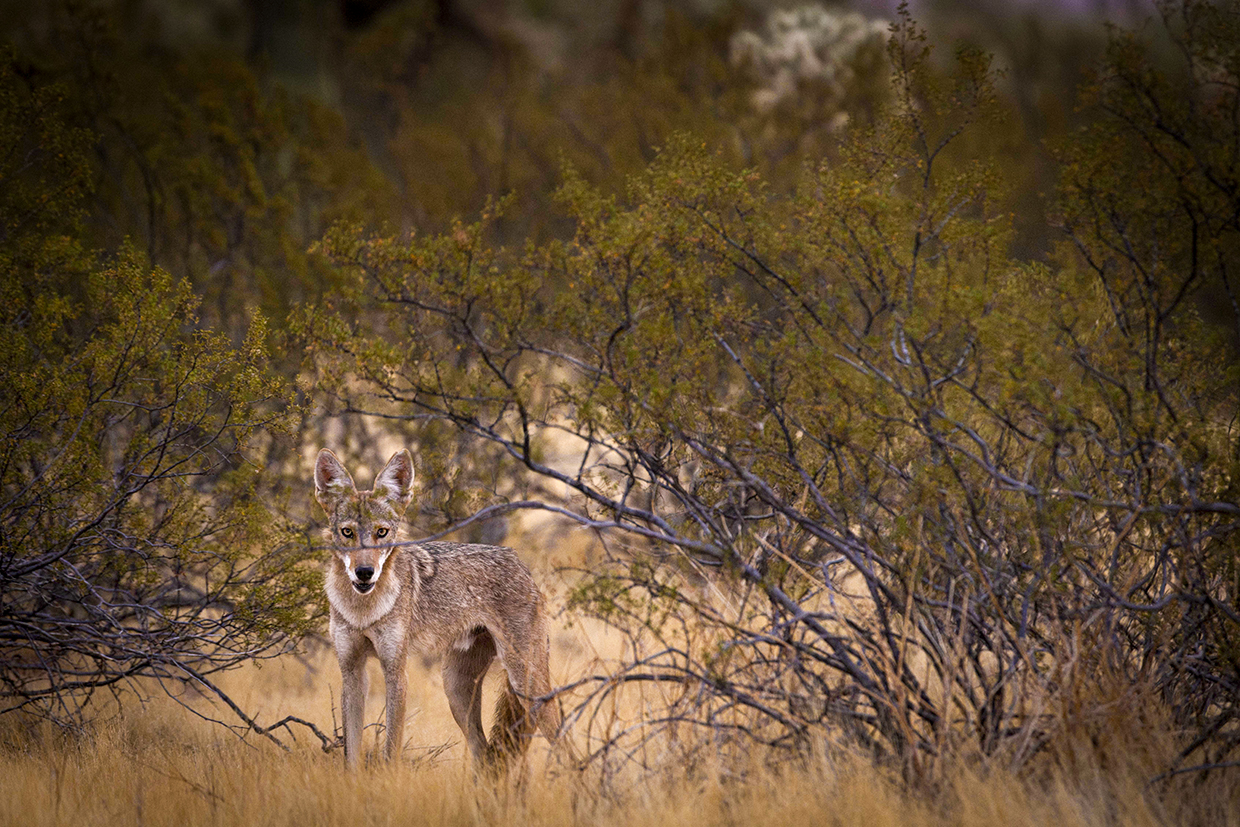
On our way back to the trailhead, Trudy trotted off-leash through the wash while I hiked about 15 feet above her, on a path that traced the edge of the ravine. A coyote with brown and gray fur and a bushy tail abruptly materialized from the manzanita bushes. It followed about 50 feet behind Trudy, matching her pace. I guessed the animal was just curious. Trudy weighed an athletic 75 pounds and was in excellent shape, despite her weakness for Frosty Paws ice cream cups. Meanwhile, the lanky coyote weighed maybe 35 pounds. But before I could convince myself that the animal didn’t pose a threat, four or five more coyotes appeared in the wash. Trudy picked up her pace, and so did the pack. They were running alongside her and behind her, and one was racing to seemingly move in front.
Just seconds earlier, I’d been on an easy, peaceful hike. Now, I shuddered with adrenaline as I realized I was about to watch coyotes tear apart my dog. They’d likely been tracking us for miles and waited for Trudy to get far enough away from me before making their move.
I yelled for Trudy in my most freaked-out tone. Trudy and the coyotes looked up at me. “Come!” I yelled again.
Trudy bolted up the wash’s steep embankment. She seemed to realize she was in danger, especially when two of the coyotes continued to follow her. I leashed Trudy and pulled her close with one hand while I threw baseball-size rocks at the coyotes’ feet with the other. They stared at me with yellow eyes and eventually backed off, disappearing into the manzanitas.
In the days that followed, I mulled the close call. On the one hand, how dare the coyotes go after my dog? On the other, their bravado and sneaky, synchronized attack, which had almost gotten the best of me and Trudy, was impressive. I resolved to learn more about an animal I’d mistakenly thought I knew well from hiking for decades on Arizona’s coyote-filled public lands. What was the creature that American Indians call “the trickster” trying to teach me?
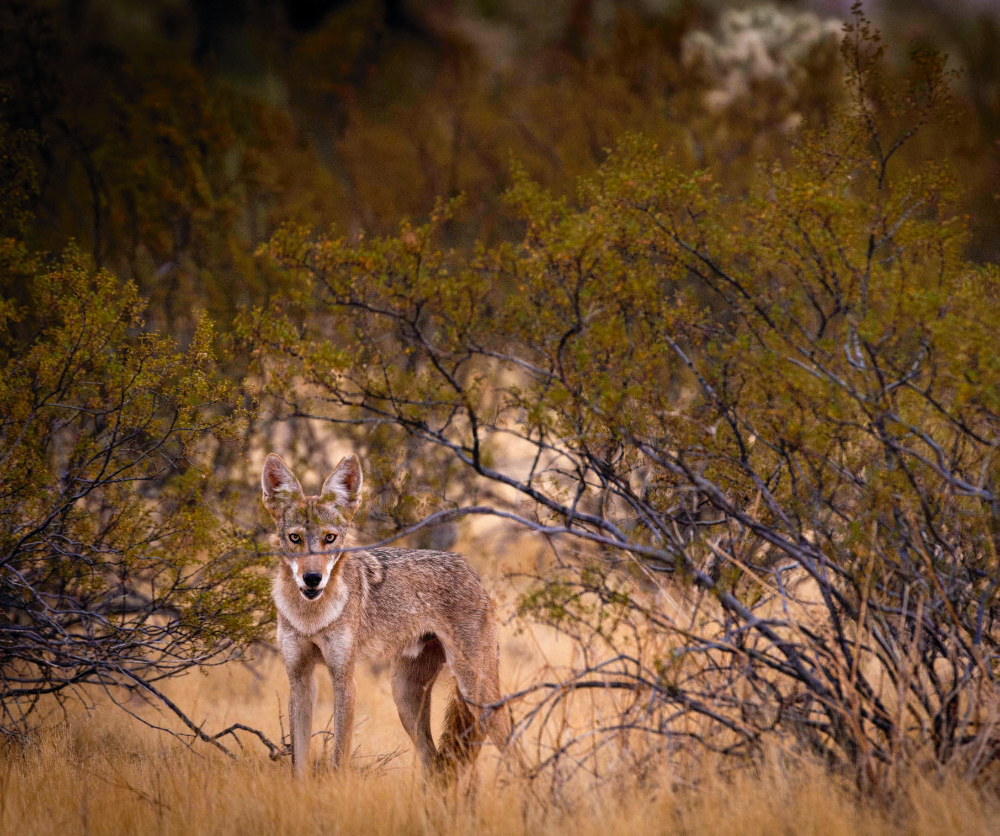
In Navajo stories, Coyote is often a very good-looking man,” says Jason Nez, who grew up on the Navajo Nation’s Coal Mine Mesa and now works as a fire archaeologist for Grand Canyon National Park. “He is a sweet talker; he can lie and trick people.”
Coyotes occupy an elevated status, culturally and spiritually, for the Navajo people and many other tribes. Beyond the animals themselves, most Southwestern and Great Plains cultures have a long oral history that revolves around a supernatural half-man, half-canine being named Coyote. And the separation between the flesh-and-blood animals roaming the land and this mythical character is often somewhat porous.
“Coyote is someone who thrives on chaos,” Nez says. “Coyote personified would be a man who yells ‘fire’ in a crowded room. He causes panic, and that is what makes him strong. He is both a nuisance and a teacher. He does things out of impatience and impulsiveness, to show us how not to live.”
Even though Nez describes Coyote as a “lecherous person who cheats at games,” he says he is, at the same time, “a very sacred being.” Navajo stories credit Coyote with many aspects of creating the Earth and stars. One story describes how a deity carefully placed crystals in the sky to form the constellations, but impatient Coyote grabbed the bag of crystals and haphazardly tossed them into the heavens, making the Milky Way.
Unlike wolves, which evolved in different places around the world, the coyote’s roots are unique to North America’s deserts and plains. The species likely was present when the first humans arrived in the region, which perhaps helps explain the animal’s continuing reputation among tribes who’ve been sharing the same homeland for a very long time.
“Stories about Coyote are the oldest preserved human stories from North America,” writes Dan Flores in his book Coyote America. “By the time of the Clovis people, who spread across the grasslands of interior America more than 13,000 years ago, continental coyotes were familiar creatures, and something about them resonated. ... No other native deity in America came anywhere close to inspiring such a vast body of oral literature. Wild coyotes captured the imaginations of Indigenous peoples as creatures endowed with special abilities.”
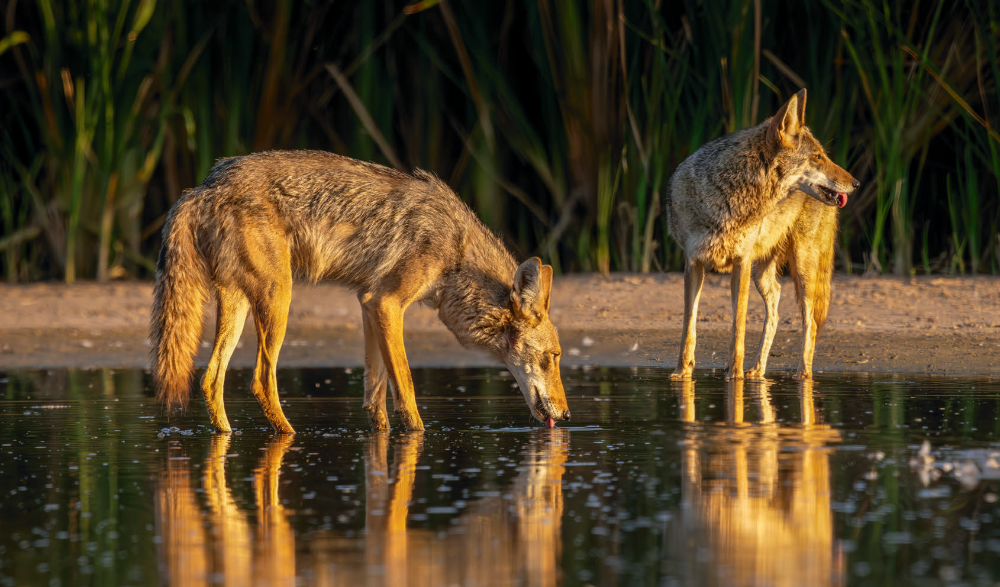
In the book, Flores contemplates why North America’s earliest humans seemed to revere the lowly coyote more than larger mammals of the late Pleistocene, such as the dire wolf, mammoth and saber-toothed cat. He speculates it’s because as the planet warmed, the big animals went extinct while the coyote developed evolutionary strategies to survive. These adaptations included shrinking in size (from about 80 to 120 pounds to the current 24 to 45 pounds) so it no longer competed with wolves for food and could sustain itself on smaller game. And, unlike wolves, coyotes adopted what zoologists call a “fission-fusion” social structure: They sometimes hunt in packs to kill large game, such as deer, but also hunt alone for rodents and rabbits. Plus, there’s the coyote’s capacity for speed, which is unmatched among canine species: It can run up to 40 miles per hour in bursts.
Members of the 1804 Lewis and Clark expedition were among the first European-Americans to encounter the coyote, which Meriwether Lewis initially described in his journal as a “prairie wolf.” Scientists would eventually determine the animal was not a small wolf but a separate canid species, Canis latrans, which translates to “barking dog.” The common name, “coyote,” is a variation of coyotl, a word from the Aztec people’s Nahuatl language.
However, as European-Americans settled in the West during the 19th century, they deemed the coyote, along with other large carnivores, a threat to livestock, rather than a divine being. For the next two centuries, federal and state government programs attempted to eliminate coyotes and wolves from the western United States through poisoning, trapping, shooting from helicopters and sponsored killing contests.
Wolves, the primary predator of coyotes, were driven to near-extinction in Arizona and the rest of the Southwest. Other predators of the coyote, such as the grizzly bear and jaguar, were also eliminated from the wild. But the ever-adaptable coyote evolved once again to survive. Scientists have discovered that when large numbers of coyotes are killed, the litters of surviving females double in size, growing from an average of six pups to 12 or even 19 offspring. The females also go into estrus at a younger age when a local population is under pressure.
Without predators to keep their numbers in check, and having outsmarted human efforts to eliminate them, coyotes significantly expanded their range over the last century; they can now be found throughout North America, from Alaska to Panama. They continue to thrive in the wild but have also adapted to living in many urban areas, including Chicago and New York City’s Central Park. This creates challenges for both the coyotes and the humans who find themselves unwittingly sharing their playgrounds, golf courses and backyards with the trickster.
“From a traditional Navajo perspective, it is a bad sign when wild animals are living among humans,” Nez says. “Humans are not supposed to attract coyotes into their neighborhoods; they should not be walking the streets. It brings chaos.”
Nowhere is that chaos more evident than in the suburban wildland interface of Arizona’s cities.
There are more than 4.5 million people in the Phoenix metro area, and I feel like I have talked to half of them about coyotes,” says Darren Julian, a biologist and urban wildlife specialist for the Arizona Game and Fish Department. During his two decades on the job, no other animal has come close to the trickster in terms of prompting citizen complaints, causing Julian to respond to an endless stream of human-coyote conflicts.
But Julian is quick to point out that it’s not the coyotes’ fault. “Most of the issues are caused by people feeding them, either intentionally or unintentionally,” he says. Rather than rodents, rabbits and wild fruit, today’s urban coyote diet is composed of anything they can get their jaws around, including birdseed, backyard fruit, pet food, garbage and, sadly, unsupervised cats and small dogs.
Coyote conflicts in Sedona are a constant problem, according to Janie Agyagos, who worked as a biologist for the Coconino National Forest’s Red Rock Ranger District for 31 years until her recent retirement. “Coyotes are very opportunistic,” she says. “People need to understand that coyotes are just making a living. They will view pets the same as a rabbit or any other prey.”
Julian tells residents in neighborhoods where coyotes roam to remove anything from their backyards that might attract the animals. And he says people should “haze” coyotes by making loud noises to scare them away.
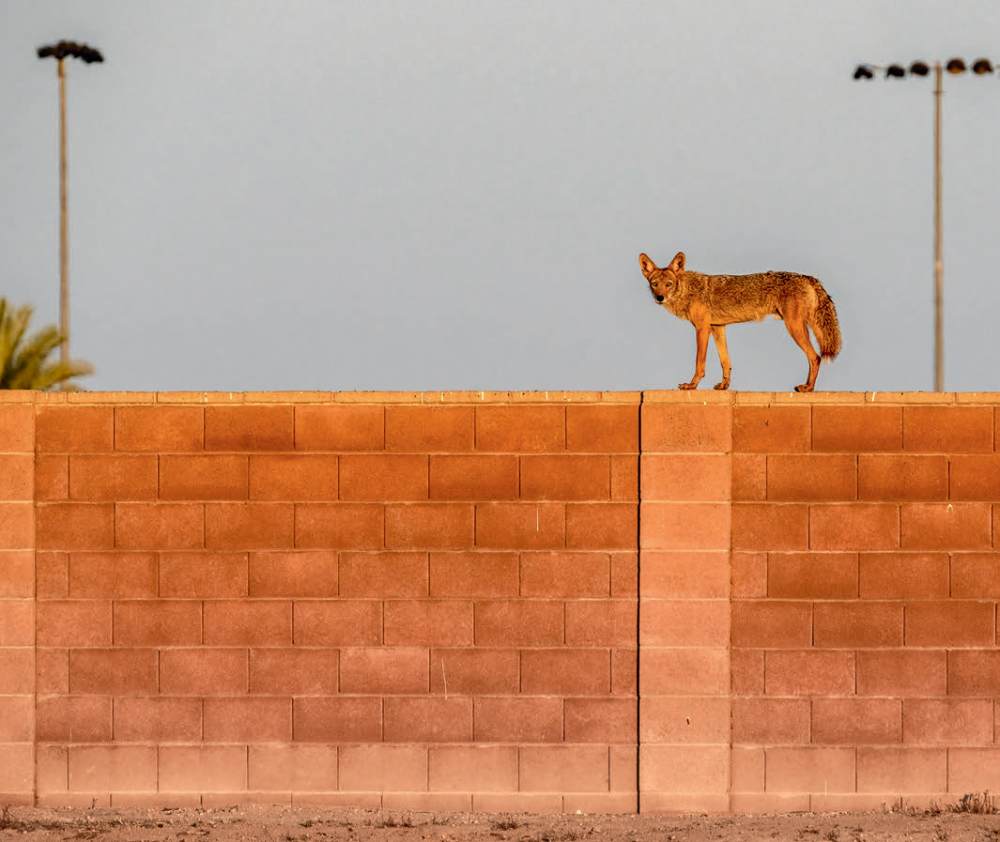
“Coyotes are amazing for how they can adapt to different environments,” he says. “I am not surprised anymore by anything people tell me about unusual coyote behavior.” One call he responded to involved a coyote that had jumped an 8-foot fence to get at cat food in a backyard. Another time, coyotes were seen walking the tops of 6-foot cinder block walls to scout for prey.
As for my close call in Sedona, Julian suspects the coyotes not only had been getting food in the nearby neighborhoods and become habituated to humans; likely, he says, there also were environmental problems in their traditional hunting grounds. “During times of stress, coyotes will come together in family units and hunt as a pack,” he says. “The wild prey population may have been way down. Maybe there were no rabbits.”
Climate change is presenting a new survival challenge for coyotes, just as it is for many other animals in the Southwest. And in December 2023, when I visited Sedona’s Carroll Canyon trails, Arizona had just experienced the driest monsoon and highest summer temperatures on record.
Armed with more knowledge and a resolve to not be tricked twice, I returned to Sedona in February 2026 for a hike on the trail where Trudy was nearly attacked. This time, I kept Trudy on a leash and held it tight as we traversed the edge of the wash. I listened for coyote sounds and scanned the brush for any signs of movement. All was quiet. But now, I knew better than to assume the trickster wasn’t there.
And I thought about what Jason Nez had told me: “The coyote evolved here. It is our job to learn how to live with them.”
Editor’s Note: The rules about pets and leashes vary from jurisdiction to jurisdiction. In national parks, pets must be on-leash at all times. In national forests (and also lands administered by the Bureau of Land Management), pets must be kept on a leash no longer than 6 feet in developed recreation sites, including campgrounds, picnic areas and trailheads. Most areas in the backcountry do not require a leash, but pets should be kept under control at all times.