
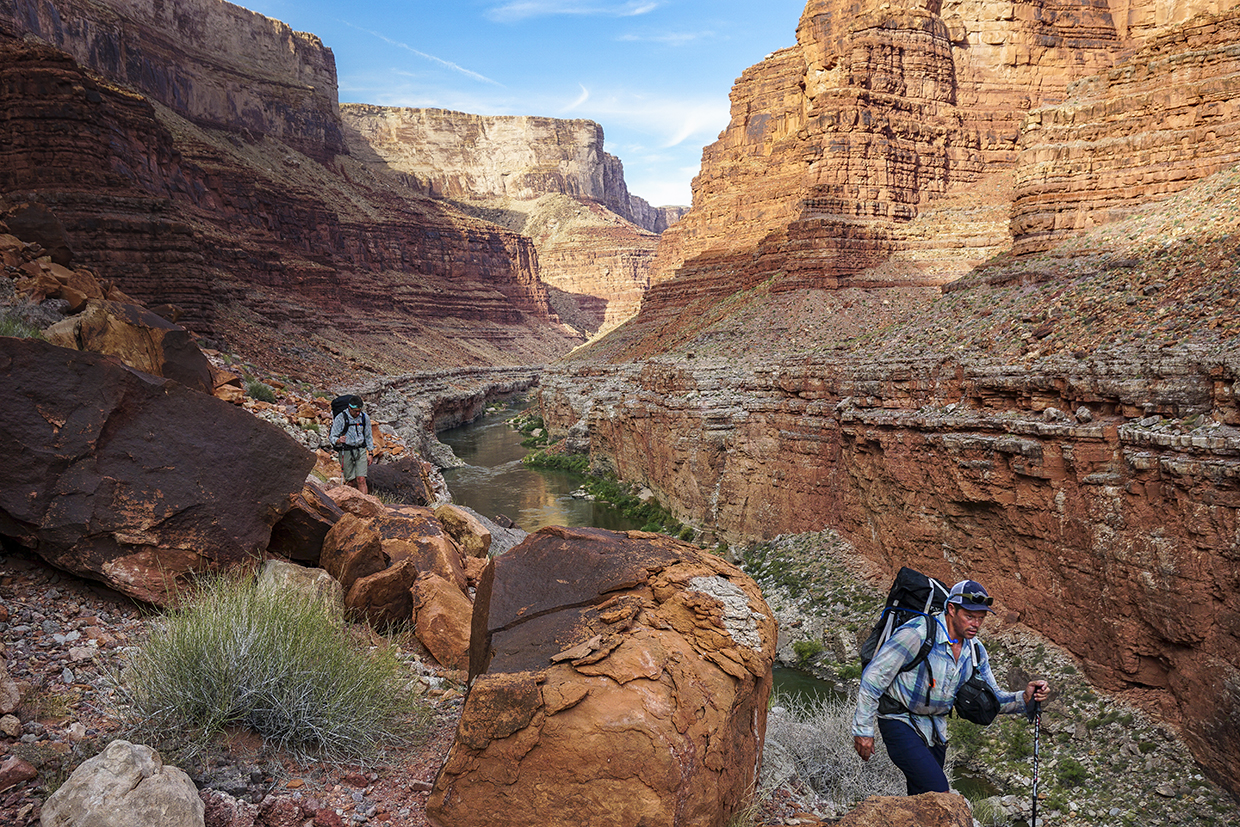
In September 2015, Flagstaff writer Kevin Fedarko and his best friend, photographer Pete McBride, set off from Lees Ferry in a quixotic quest to walk the length of the Grand Canyon — something only two dozen people had accomplished, according to historical records. The pair, on assignment for National Geographic, were chasing a story that sought to celebrate the 100th anniversary of the national parks system with a feat of derring-do inside one of America’s crown jewels.
Fedarko had worked for six years as a Canyon baggage boatman and was the author of the bestselling book The Emerald Mile, about the fastest run down the Colorado River. He would later confess that he’d assumed his river experience had made him a Canyon “expert” and ready for the challenge of trekking through the chasm on foot. Meanwhile, McBride was a globe-trotting adventure photographer who figured he and his buddy could tick off the National Geographic assignment in no time.
But by the end of the first day of their expedition, both Fedarko and McBride realized how wrong they’d been. Their packs were far too heavy with things they didn’t need, and the two were sorely lacking in lifesaving essentials, especially knowledge about bushwhacking in the Canyon. They would learn the hard way that one of the world’s most spectacular, yet inhospitable, landscapes has a way of squashing hubris-driven hikers like ants under a lug-sole boot. The 750-mile trek, which Fedarko and McBride had figured would take only a couple of months, ended up taking 14 — over eight separate trips.
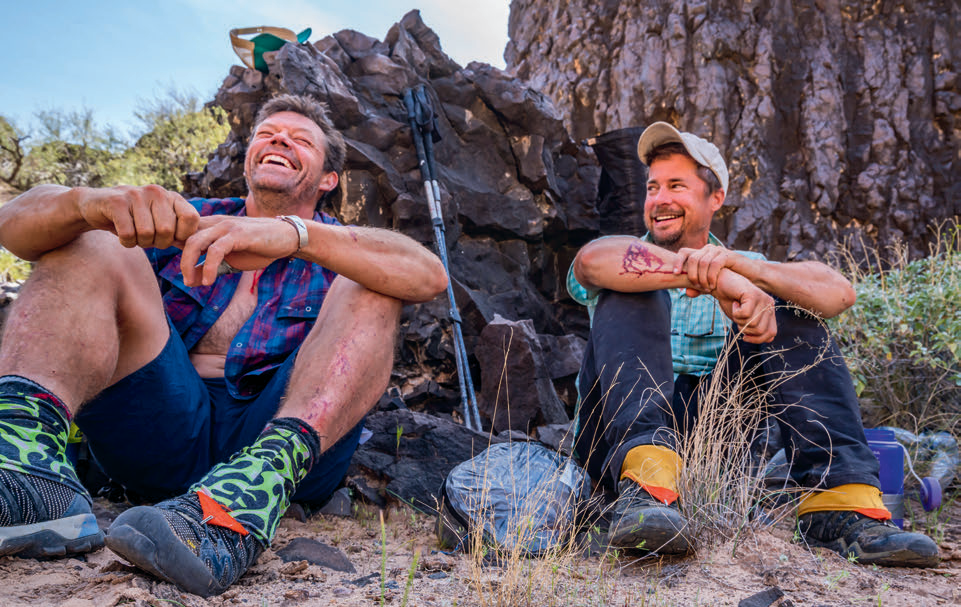
For Fedarko, the hike wasn’t even the hardest part. He’d signed on to write a book about his experience and promised his publisher he could crank out a manuscript in 18 months. But it consumed six years of his life as he wrestled with weaving an engaging narrative that encompassed not only the story of his journey, but also the Canyon’s geology, Indigenous cultures, development threats, flora, fauna, and a “who’s who” of other crazed Canyon hikers. The first draft delivered to his editor, he says, was a “Mount Everest of pages” that eventually was whittled down by two-thirds.
Although it may not have seemed worth it when Fedarko was falling onto a barrel cactus in the Canyon or spending countless late nights at his computer, the book quickly became a classic. A Walk in the Park hit The New York Times’ bestseller list shortly after the hardcover version was released in 2024, and it won the National Outdoor Book Award and the Andrew Carnegie Medal for Excellence in Nonfiction. The paperback edition, released earlier this year, also rose to the top of the Times’ bestseller rankings. In a cover endorsement, author Hampton Sides called Fedarko “the Grand Canyon’s most eloquent bard.”
While Fedarko is pleasantly surprised by how people have embraced a story about two guys toiling across the roughest country, the book’s popularity is also a testament to how beloved the Canyon is — even if some experience it only vicariously, through the words of a talented writer. I recently sat down with Fedarko to discuss the life-changing journey that became A Walk in the Park and the lessons learned during that journey. Here’s an edited version of that conversation.
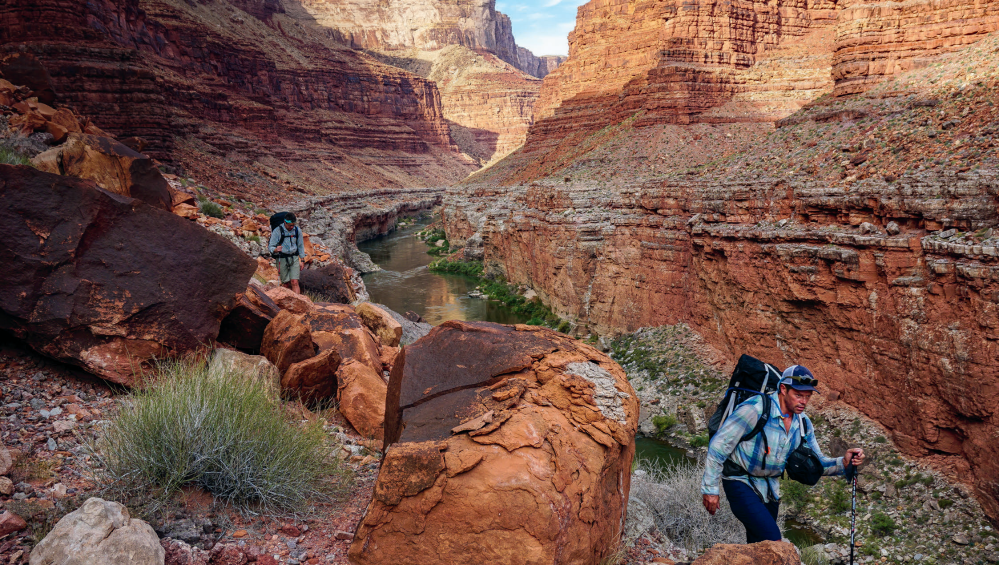
Annette McGivney: When we first met in Flagstaff, at a mutual friend’s dinner party in the fall of 2015, you’d recently returned home after failing to complete the first leg of your planned thru-hike. The bottoms of your feet were so badly blistered that you could barely walk — it was as if, according to your book description, they’d been “marinated in battery acid” — and your spirits seemed to have hit rock bottom as well. Was that initiation into off-trail Grand Canyon backpacking the lowest point of what would become a 14-month suffer-fest? Or were there other times during your expedition that were even more miserable?
Kevin Fedarko: There were multiple low points — multiple nadirs. Certainly, one of them was that first week after leaving Lees Ferry. We covered less than half the distance of what we thought would be our first section of the thru-hike and retreated in failure, expecting we’d have to abandon the National Geographic assignment. That was physically, professionally and emotionally a low point. But later on, we had to posthole through deep snow in a record-setting winter storm on Great Thumb Mesa. And our hiking partner, Amy Martin, dislocated her kneecap, which was very scary. Then, the relentless summer heat in the western Grand Canyon was so miserable, it forced us to retreat a second time and resume our journey in the fall.
AM: I have to admit, reading about your string of painful mishaps is entertaining and educational. But you also had several moments of wonder and joy, which you describe beautifully in the book. Is there one awe-inspiring experience that stands out as something you’ll remember for the rest of your life?
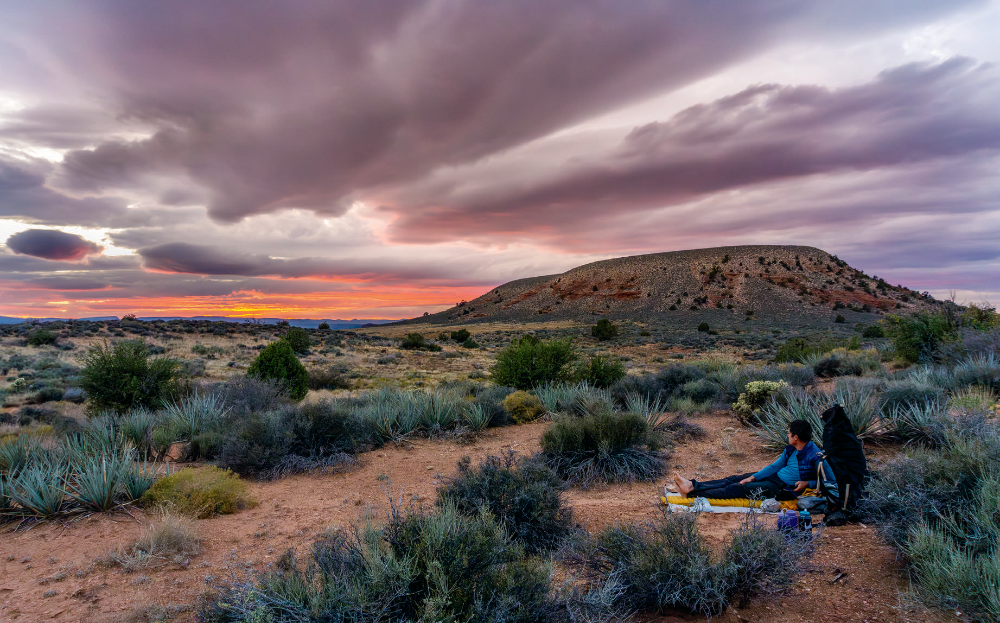
KF: I definitely wouldn’t say the high point was at the end of the journey. I didn’t experience a sense of euphoria upon completion, nor did I experience a sense that we had mastered the Canyon. We emerged slightly more competent than when we went in, but that isn’t saying much. Often, the joy was interlaced with the misery. There wasn’t a sunset Pete and I sat and watched where my muscles weren’t hurting and my feet weren’t aching. There were so many exquisite days and nights out there, especially on a section of the Esplanade that hikers call the Godscape. One night, Pete and I were camped on a promontory, listening to bighorn sheep far below us somewhere in the Redwall. Their bleating sounds were emanating up from the depths of the Canyon. We were talking about a pictograph panel we’d viewed earlier that day. It was an exquisite night of starlight, silence and hearing animals communicate with one another. We also felt connected in some way to the ancient people of the Canyon and sensed that maybe we were experiencing the Canyon the same way they did thousands of years ago. The moment was kind of spiritual, and I don’t use that word often or lightly.
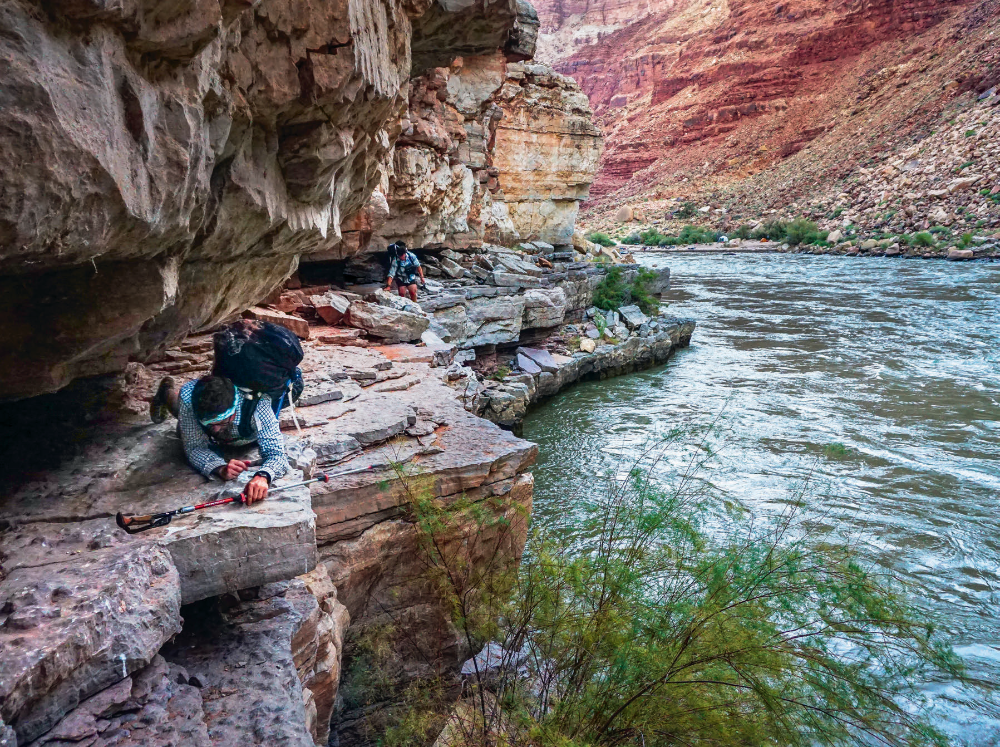
AM: Looking back now that the book has been outfor a few years, would you say researching and writing A Walk in the Park fundamentally changed you? Are you a different person now than you were before you took on this book?
KF: Oh, yeah. I was learning so many new things. After writing The Emerald Mile, I came away thinking I was kind of an expert on the Canyon, as embarrassed as I am to say that now. But from the first step of the first section of our hike in the Canyon, I was confronting the fact that I was the opposite of an expert. The Emerald Mile was a portrait of the river world, a subculture that believes the river is the essence of the Canyon. A Walk in the Park is a portrait of a world that I was only dimly aware of on the river. It’s a much harsher and brutal world: a world of rock. And when you get up there, you begin to discover that the river is not the essence of the Canyon. The 2 million acres that make up Grand Canyon National Park are mostly rock, defined by geology and a lack of water. That is where the truest and purest wilderness is: where you’re most on your own. It’s where you confront, in the most visceral way, that every action you take has consequences, and you’ll have to pay for or deal with those consequences of bad decisions, and poorly placed feet, and weather that you can’t control.
And then I learned about the 11 different tribes that are indigenous to the Canyon. Each tribe has its own history and a unique relationship with the Canyon. You can’t just write about one tribe and extrapolate and generalize. Their connections to and knowledge of the Canyon — encoded in their culture, language and ethos as a people — run deeper than anybody who looks like me can begin to imagine. And the United States government evicted those people when it created the national parks system that Pete and I were commemorating through the National Geographic story.
So, at the center of this thing that we all celebrate is a theft. I don’t think it negates the wonder of the parks or the importance of preserving the landscape, but it adds another incredibly important layer of understanding to it all. It’s amazing that I got to the age of 50 before beginning my education about the Native presence in the Canyon and the preponderance of the terrain itself. On the one hand, it’s an embarrassing travesty that it takes somebody like me that long to get to the starting gate. But another way of looking at it is as a privilege. What a privilege it is that my job requires me to not only keep learning, but relearning, over and over again. That’s why I can’t go beyond writing about this one landscape, this one park — because there are so many different layers to it. There is always more to be learned. And with each new layer of learning, the landscape itself becomes deeper and richer for me, and therefore, more satisfying for me to engage with.
AM: As you travel across the country, doing events to promote A Walk in the Park, you’re likely speaking to people who will never strap on a pack and hike into the Canyon, and certainly not venture off-trail. What do you think it is about the book that draws people in?
KF: The fact that so many people connect with the book is surprising to me. But what I hear with some consistency when I go to bookstores and give lectures is that people seem to appreciate the tribal element of the story. People also appreciate how a landscape like the Canyon has all kinds of things to teach us in terms of insight and growth. For me, the biggest lesson I share through the book is humility. In the Canyon, you learn how small you are in the face of larger forces that shape the Earth and the cosmos. This is something Indigenous people have long understood. Finding out that people connect with my story about humility — a tale of two guys who are pretty honest about how incompetent they are — makes me smile.
AM: What’s next? Are you planning another epic expedition into unknown territory?
KF: The Grand Canyon hike was the biggest and hardest journey of my life. It was ludicrous then, and now, at age 60, it’s fundamentally unthinkable. I don’t have any big treks planned, but what I do dream of is returning to some of the most magical places Pete and I visited 10 years ago. For me, one of the greatest pleasures of going into the wilderness is returning to locations I’ve already been to and adding new layers of depth and understanding. I’m not checking off a bucket list — there are so many places I have never been and probably will never go — but I want to return to the magical places in the Canyon. I will return as a different person, one who’s older and hopefully a little bit wiser, to see what the places have to say to me.
The paperback version of A Walk in the Park is now available at Barnes & Noble and your favorite independent bookstores everywhere, including Bright Side Bookshop, 18 N. San Francisco Street, Flagstaff, 928-440-5041, brightsidebookshop.com.