

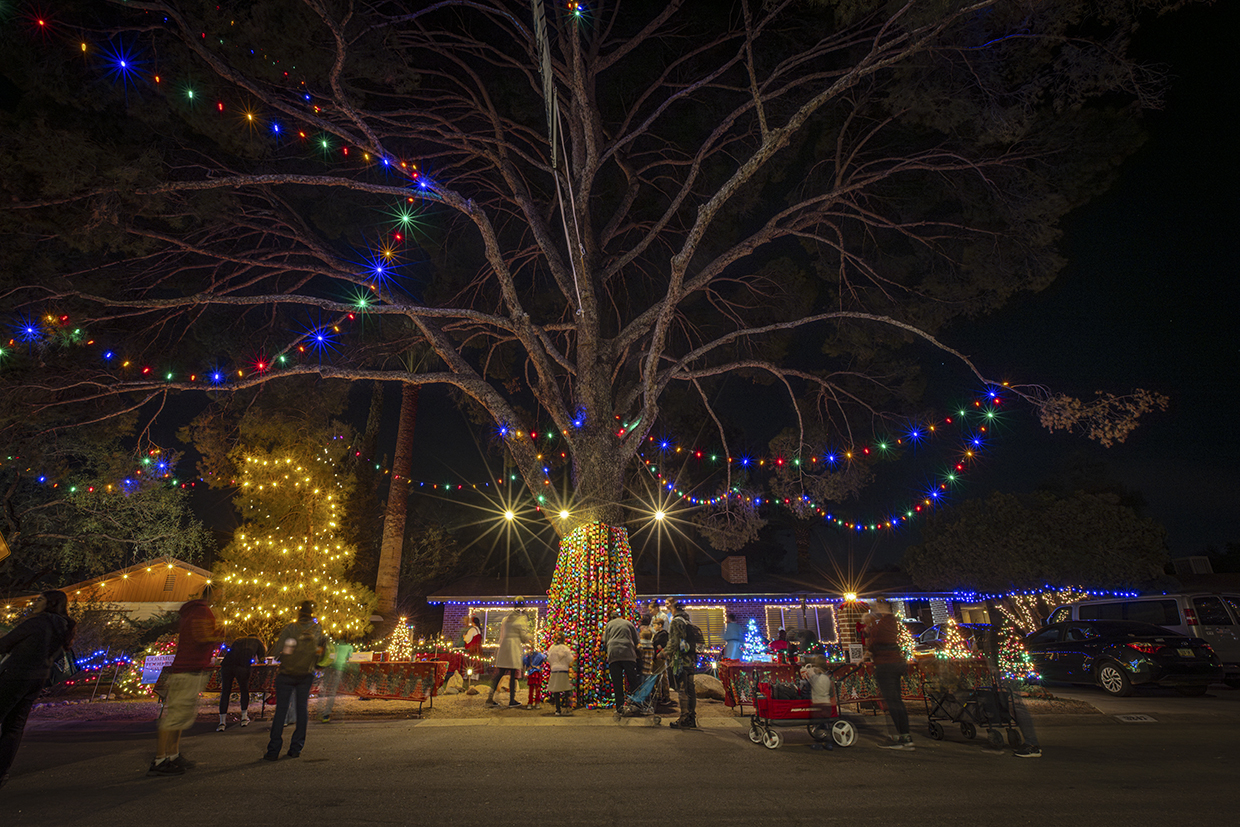
Anyone searching for holiday cheer in Tucson can’t do better than Winterhaven, a midtown neighborhood that lures throngs of people to its Festival of Lights each December. Bundled-up families wander the luminous streets to marvel at handcrafted displays adorning the houses, yards and even the occasional fire hydrant. My first stop is always the Wishing Tree.
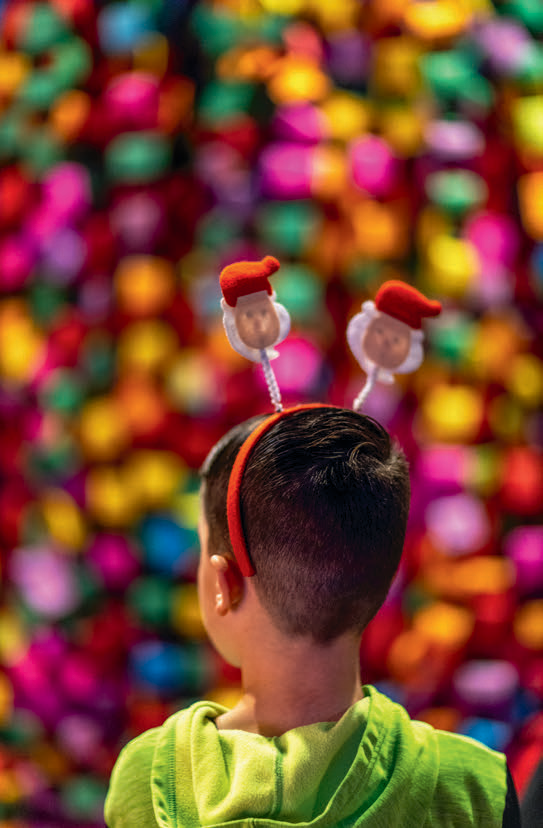
The venerable Aleppo pine is covered in so many layers of colorful construction-paper chains, I can’t touch the trunk without burying my arm to the shoulder. Every link bears a wish. Now in its 27th year, the Wishing Tree has a nightly queue of people waiting their turn for the stapler.
For some, the tree is a beloved holiday tradition. One visitor, Kenzie Culver, tells me she’s made a wish every December since she was 2 years old and some of them have come true. “I wished for health for my uncle,” she says, and there’s a smile on her face when she shares that his cancer is now in remission.
Ashlynn Carrig and Kaiden Conroy are also among the crowd. Carrig is hoping veterinary school works out. Conroy declines to share what he’s written. “Mine’s very secret,” he says with a grin.
I met the Wishing Tree’s creator, Liz Bowman,at the Southern Arizona Regional Science and Engineering Fair (SARSEF) in 2001, just after the tree’s inaugural year. We were both nervous teenagers who had won spots in a national science competition. We shared a flight from Tucson to Washington, D.C., just a month after the 9/11 terrorist attacks. Vividly, I remember the airport shuttle bringing us directly past the half-destroyed Pentagon.
It was an unsettling time to travel to the nation’s capital, but no one had wanted to cancel the trip. I confess I don’t remember any of the other science projects (mine was about arroyo hydrology) except for Bowman’s, which would unexpectedly live on for a quarter of a century.
Bowman’s question was pertinent to the times. New reports had been buzzing about the rise of American consumerism and materialism, predicting the new millennium would be an era of selfishness. Was that true?
“The best way to test it, in my mind, was seeing what people wished for,” Bowman recalls.
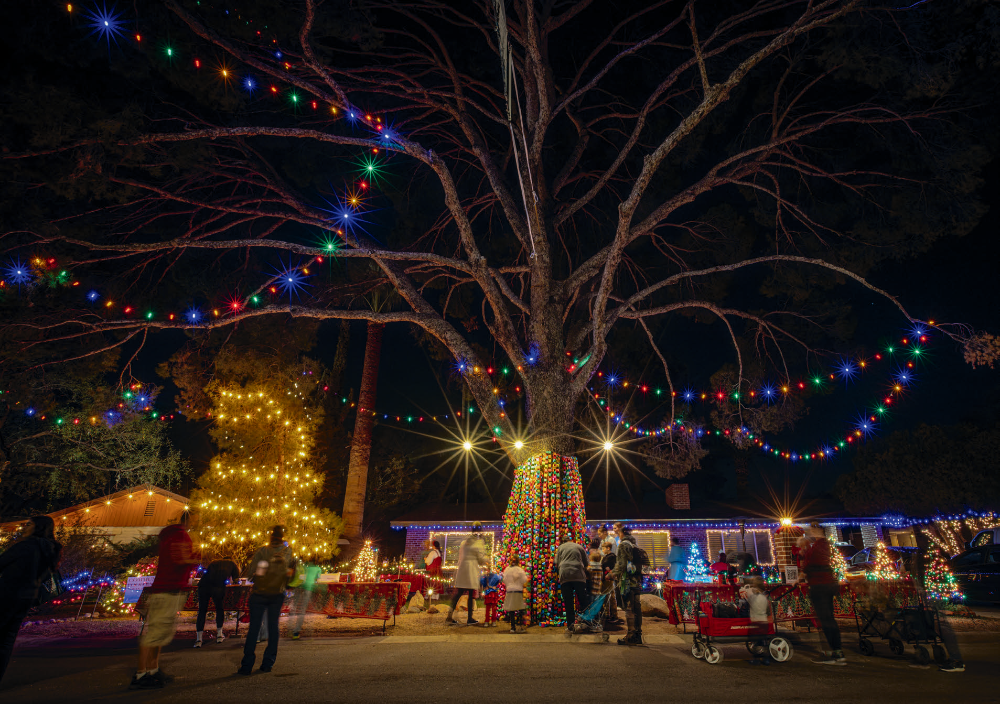
Wishing trees are an old idea. In Ireland and Scotland, generations of wish-seekers have left coins or tied ribbons on certain trees. But Bowman says she wasn’t aware of those traditions in 2000. (She points out that the concept of an Internet search engine was extremely new.) The pine growing in front of her Winterhaven home was just a convenient spot to stage the experiment, and the two-week Festival of Lights gave her a steady stream of strangers to recruit, more or less at random.
Everyone who scribbled a wish that first December was unwittingly part of a social experiment. Bowman categorized each wish as materialistic or non-materialistic. She can still recite the results by heart: Out of 2,775 wishes, 73 percent asked for something that couldn’t be wrapped in a box.
The top four wishes? Love, health, happiness and peace.
In a year otherwise crammed with dismal news and division, Bowman’s findings offered hope. She took it as a reminder that we’re all human, all sharing the same basic need for connection. People made wishes for others more often than for themselves. Kindness won out over self-absorption.
Bowman confirmed the uplifting results with six years’ worth of wishes for her senior year science fair project, then headed to college to become an evolutionary psychologist. The rest of the family — her parents, Kathleen and Bill Bethel, and younger sister, Meagan — took charge of the Wishing Tree.
“Our family’s grown up with the tree,” Kathleen Bethel says. Last year her granddaughter, Violet, just a toddler, added a paper ring to the tree without any prompting.
“It was like it was born in her blood or something,” Bethel chuckles. “She went right up to the table, got her paper, wrote her wish, got the stapler and went to the tree.”
“There’s no way she remembers from last year,” Bowman adds in a wondering tone. “She knew exactly what to do.”
By tradition, someone in the family writes the first wish. When I ask if the wishes ever come true, the answer is unanimous: Absolutely. Bethel points out that writing down a wish can crystallize what’s important and encourage people to work toward a goal. The act of wishing itself is a kind of magic.
Over the years, wishers have knocked on the door to share their stories. The most memorable of those was the boyfriend who snuck a look at his girlfriend’s wish over her shoulder. He came back later that night and spent hours hunting for it in the dark so he could wrap the paper slip around an engagement ring and make the wish come true. (The Bethels got an invite to the wedding.)
Wishes have appeared in a dozen different languages. Before Google Translate, the family used to recruit University of Arizona professors from various departments to read them. Bethel jokes it’s like eating potato chips: Once you read one wish, you want more.
That’s a sentiment shared by many Winterhaven festival-goers, who linger at the tree to peek at the words on the ever-growing paper chains. Mentions of material objects do appear, of course. Certain toys, such as dinosaurs, dolls and Lego sets, remain evergreen, but other wishes show the changing times, from the advent of Nintendo Wii to the rise and fall of Furby.
Some wishes are whimsical or weird. Bowman recalls plucking a paper slip off the tree that read, “I WiS for CHeeeSe” in blocky letters. “It was definitely a kid’s handwriting,” she says. “It was just beautiful.”
Other wishers express yearnings for change: babies, new jobs, reconciled relationships. “Find me a man,” reads one link in the chain. “For my loved ones to be safe,” says another. Some of the messages hint at heartbreak: “I wish for my mom to pick me up from school.” “That my parents stay healthy.” “That my uncle gets therapy.” Lately, “To be a better version of myself” pops up often.
But plenty of people simply scribble, “Have a merry Christmas” to whomever might read the message — a wish meant for the strangers drawn together by the tree.
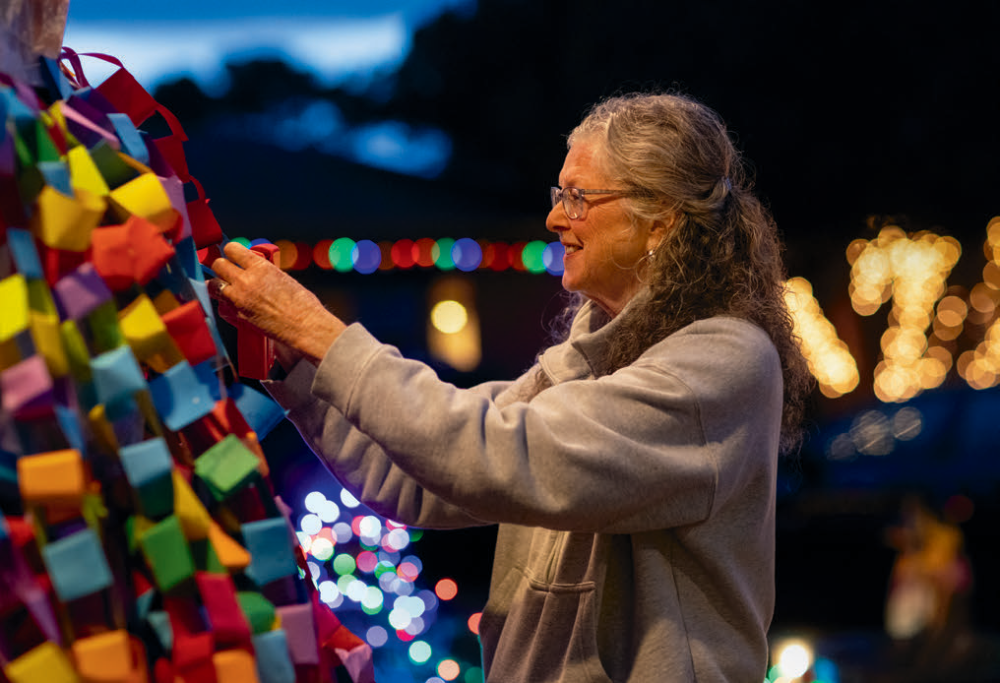
Behind the magic is an awful lot of work — dealing with unexpected rainstorms, for example, and hoisting the paper chains higher each night to make room for new wishes.
In 2020, at the height of the COVID-19 pandemic, the Festival of Lights was canceled for the first time in 70 years. Meagan, who had taken over for her older sister, worried that people would miss the tradition at a time when wishing was needed more than ever. She posted a QR code on the tree and collected wishes via social media. Unsurprisingly, wishes for health rose that year.
Although wishers sometimes express dueling values or differing politics, Bethel points out everyone is standing next to one another, “helping each other unjam the stapler or find a place to push through the crowd to get their wish up on the tree.” The tree shelters a small place of unity.
The family has no plans to end the tradition. They’re hoping the third generation, Violet, takes over one day. “I think if we ever stopped doing it, people would just staple receipts to the tree, or find some way to keep doing it,” Meagan says.
They used to keep every single wish, until the over-stuffed carport and attic prompted a reckoning. Bethel says now they “release them to the universe” via a bonfire. “Mind you, our shed is still full,” she adds. “The closet still has wishes in it. We had to save last year’s, because... ”
“The data!” Bowman chimes in with a laugh.
I’ve always felt a special connection to the Wishing Tree as someone who got to witness its origins in that long-ago science fair. But I’m not alone in feeling that the tree holds a certain magic. It’s become a gathering-place, cultural tradition and local landmark. The original 2,775 wishes have bloomed into significantly more than 30,000 a year — too many to count with accuracy.
Bowman recently moved back to Winterhaven. She’s now the chief operating officer of SARSEF, helping other kids find their passions at the science fair. Meagan is a wildlife biologist, and Bethel, a retired educator, is writing a book titled The Wishing Tree. She sums up the tree’s message this way: “People are good. Don’t give up. We can do better, and I think there’s hope that we will.”
Despite all the changes of the past quarter-century, Bowman’s first conclusion holds true: Material items never dominate the wishes. Instead, the same four rise to the top every year: love, health, happiness and peace. Love has never dropped below the No. 1 spot.
“There’s more that unites us than divides us,” Bowman says. “That’s my big takeaway.”