

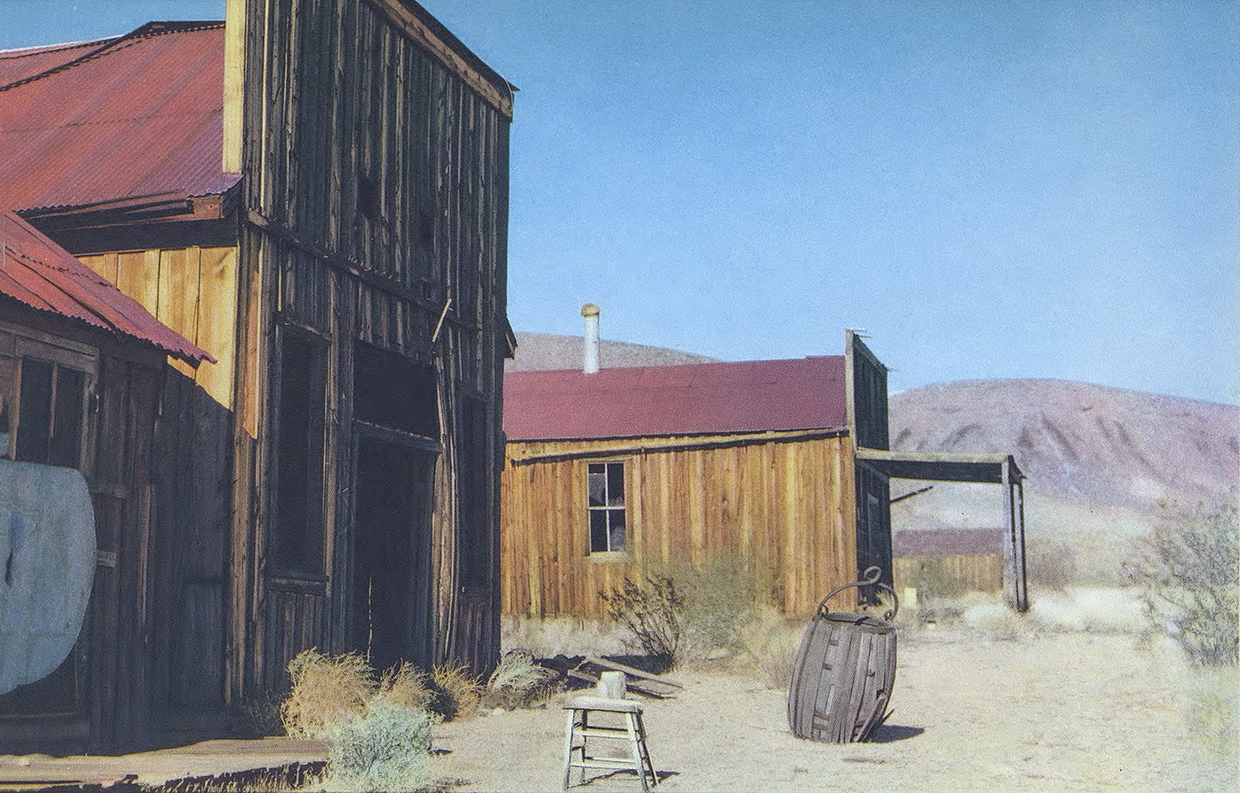
As a kid, Carlos Elmer, a photographer enshrined in the Arizona Highways Hall of Fame, liked to explore the ruins of White Hills, a small ghost town about 35 miles southeast of Hoover Dam. “I still enjoy returning to White Hills,” he said in 1960. “It was the subject of some of my first contributions to Arizona Highways, more than 20 years ago.”
By the time he started poking around, the old ghost town was decades into its disrepair, but in its heyday, it was a boomtown — a stereotype that got its start in the early 1890s. Like so many origin stories in the Old West, the emergence of White Hills is rooted in exploitation. According to the March 16, 1894, issue of The Arizona Republican, it got its start when a man known as “Hualapai Jeff” found a good-sized piece of silver while looking for minerals to use in making paint. “He said nothing at the time,” the paper reported, “but a short time afterward, Judge Henry Shaeffer asked Jeff if he knew of any good mines. Jeff answered, ‘maybe so,’ and brought him the fine specimen of horn silver.”
The judge offered Jeff $200 if he’d divulge where he’d found the silver. Jeff agreed, giving up his rights and thus setting in motion the evolution of a mining town that would become home to 1,500 people who built houses, schools, stores and a dozen saloons — seven were lined up in a row on Main Street. Mrs. M.A. Gillespie ran a boarding house, Noah Morgan operated a lunch counter, Dr. H.B. Bessac performed surgeries, and W.R. Boddy was the local barber.
The town was booming — it ultimately netted more than $12 million in silver and gold — but only for a few years. By 1898, it was on its way out. “No one is left,” Arizona Highways editor Raymond Carlson wrote many years later. “No stores, or filling stations, or corner drug stores serving Cokes. No old codgers sitting around spinning their yarns. No chamber of commerce representatives to show you around and point out proudly how thus-and-so happened here and so-and-so was shot there. White Hills is dead. It is the most ghostly kind of ghost town you could stumble upon anywhere.”
Today, all that’s left is a collection of unmarked graves being swallowed up by the Mojave Desert.