

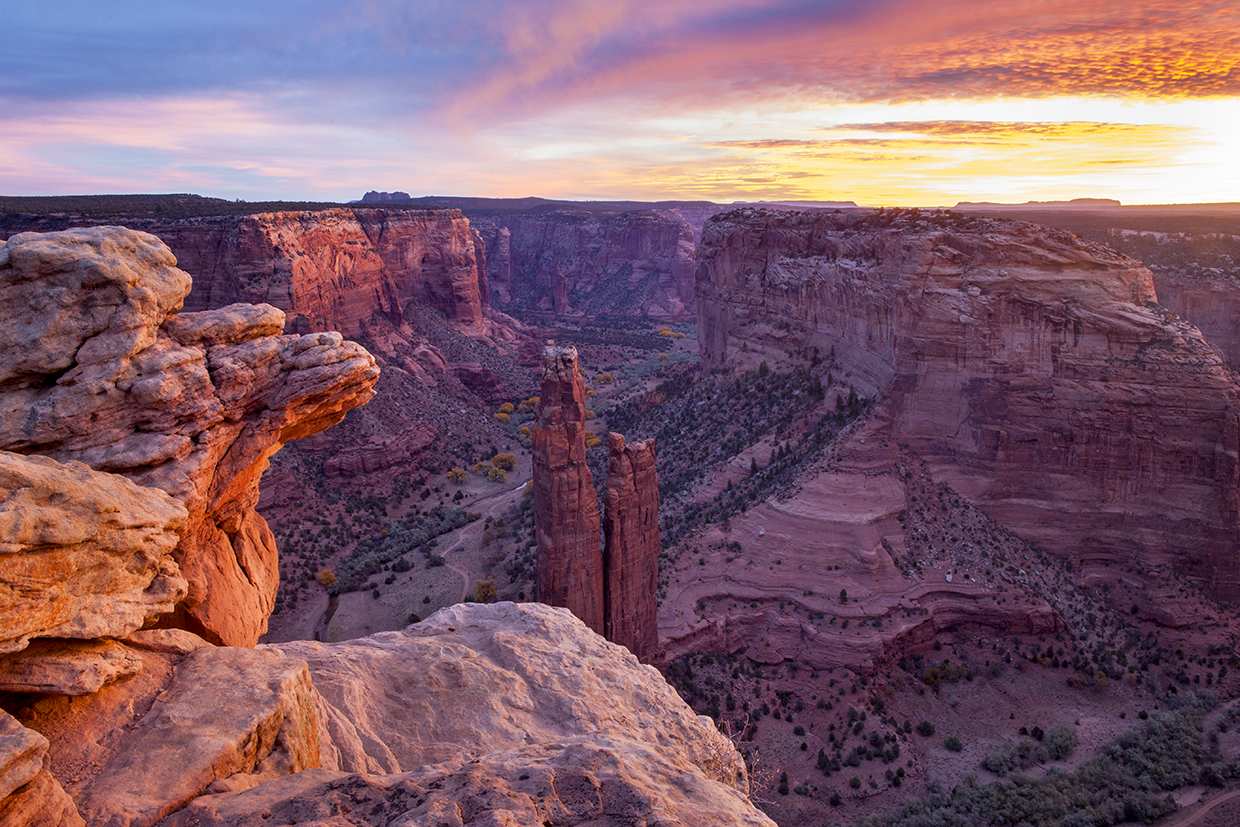
Sophie Shorty spent her childhood mornings cradled by cedar posts and hand-carved rock slabs deep within Canyon de Chelly. As the sun rose, warm light seeped into her hogan, slowly waking her from sleep. Brisk morning air crept across the sheepskin on which she slept. “There was no sense of time,” recalls Shorty, now 55. Then, her great-grandmother opened the door, letting in more light and signaling the start of a new day in a canyon that had always been home.
During summer breaks, Shorty returned to the canyon to help her great-grandmother. Her days were spent outdoors, surrounded by towering canyon walls that formed what felt like a sandstone maze. She cared for the family’s livestock, including sheep and cows; her family wove rugs from the sheep’s wool. Slivers of clouds high above the canyon walls mirrored the moving herds below. Shorty spent long days herding sheep, guided not by clocks but by the sun and the shadows cast on the canyon walls. “You know it’s lunch when the shadow is creeping back up a certain part,” she says. “You know it’s time to get back to the house.”
The footsteps Shorty once took through the canyon exist in the past, present and future. They are the same paths her relatives walked in 1864 during the Long Walk, when Navajo people were forced from the canyon and marched 397 miles to Bosque Redondo, in present-day New Mexico, and subjected to forced assimilation. “While intended to be a reservation, Bosque Redondo functioned as an internment camp,” according to the National Museum of the American Indian. “The U.S. stationed soldiers there to make sure that the Navajo, or Diné, could not leave.”
Shorty notes, “My granddaughter is the eighth generation of the return” from Bosque Redondo. And 95 years ago this month, on April 1, 1931, Shorty’s childhood home became Canyon de Chelly National Monument — a decision that stemmed from growing worries about damage to the canyon. “There was concern about pothunting and artifact hunting and people going into the canyon and disturbing residents,” says Lyn Carranza, the monument’s superintendent. Those residents include Shorty and 70 other families who still live at Canyon de Chelly.
Within the broader national parks system, the canyon is distinct not only for its landscape, but also for the people who continue to call it home. “Canyon de Chelly is unique because it is entirely Navajo trust land and [because] there is a community of people living in and around the canyon,” Carranza says.
In 1931, the Navajo Nation had not yet formed its Parks and Recreation Department, leaving archaeological features without formal protection. “The National Park Service got approval from the tribal council to establish a park and protect resources,” Carranza says. Today, Canyon de Chelly is cooperatively managed by the Navajo Nation and the Park Service.
“This partnership is still an ongoing learning process,” says park ranger Ravis Henry, who is Diné. And part of that process involves working closely with canyon residents, including Shorty. “They are the eyes and ears of the canyon and many times assist indirectly with preservation,” Henry says.
Amid changes in tourism, technology and land management, Navajo history and traditional customs help guide the work. Henry says adaptation has always been key to the tribe’s survival. “The people adapt to changes and influences from outside cultures,” he says. “Sometimes, the influence is so great, it takes a toll on culture, practices, traditions and language. But organizations like the National Park Service create space for our people to reconnect and strengthen those connections.”
Today, Shorty still walks the canyon paths shaped by centuries of Diné footsteps, now shared with visitors from around the world. The shadows still mark time as they move across the sandstone walls, just as they did when Shorty learned to measure the day by the sun, instead of a clock. “To us, Canyon de Chelly is our home,” she says. “She didn’t begin 95 years ago.” For her, the canyon is not a monument frozen in time, but a living place shaped by memory, labor and survival.
“There is no question that the Four Corners area’s archaeology is world class, and people from all over the world visit and learn from this place,” Carranza says. “Canyon de Chelly also offers the opportunity to learn about a living Diné culture, to meet the people and hear their stories.”
Although the canyon is now protected by policy and partnership, its deepest preservation comes from those who remain rooted in it. For the Diné, protection is not written solely in law, but carried through memory, prayer and responsibility passed down across generations. “Canyon de Chelly is our ancestral home — our mother and protector,” Shorty says. “It holds the prayers and tears of our ancestors, and we are responsible for keeping this homestead for our children. Our language and culture live within its stories.”
As morning light continues to spill into hogans along the canyon floor, time is still marked not by schedules or signage, but by shadows, stories and the people who call the canyon home.
NAVAJO NATION Canyon de Chelly National Monument, 928-674-5500, nps.gov/cach