

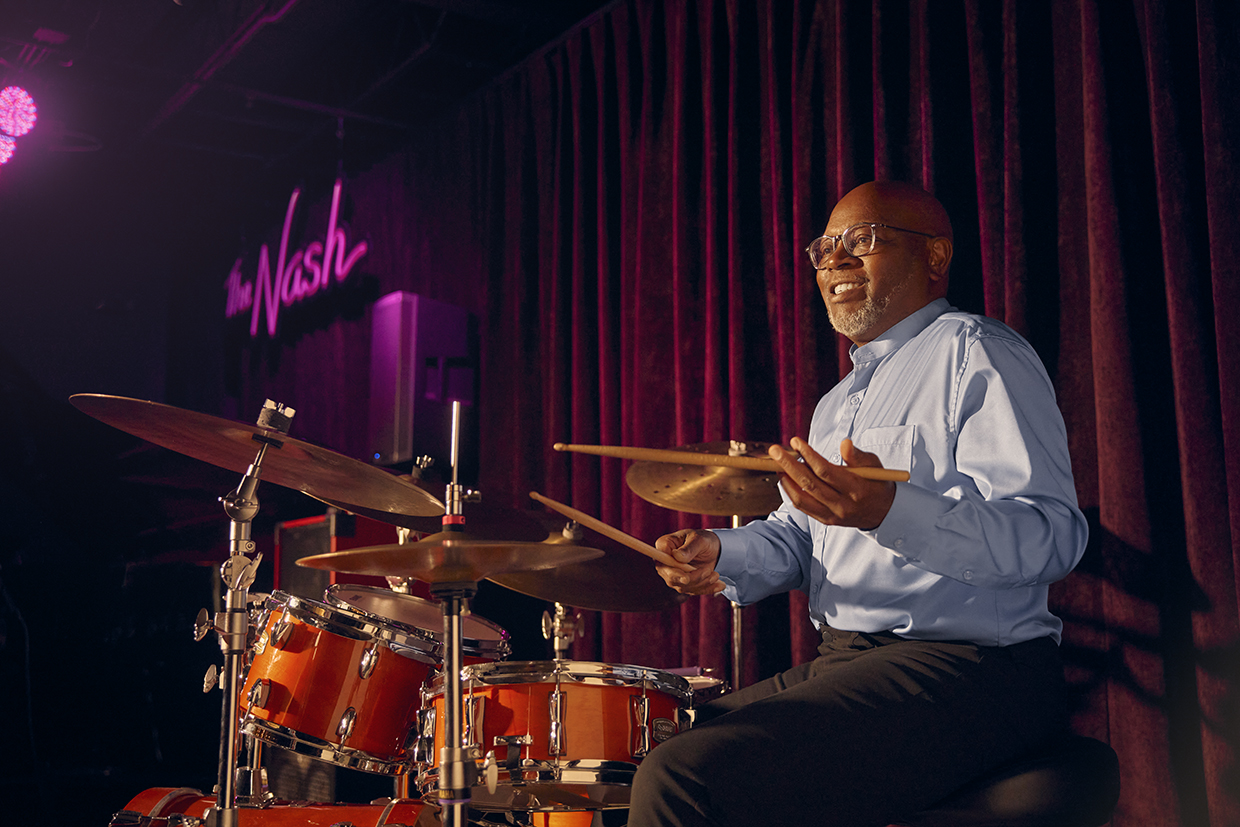
To call Lewis Nash a natural-born drummer isn’t to ignore the decades this Phoenix native has dedicated to his music. Or to downplay the deep knowledge he assimilated, first on the local scene and later while performing with the giants of the jazz world.
But long before Nash appeared on 10 Grammy-winning records and accompanied everyone from Oscar Peterson to Willie Nelson, he was a kid who just wanted to bang on the drums. And bang Lewis Nash did.
“I would go into the kitchen and surround myself with pots and pans from my mom’s cabinets, and get two knives or spoons or whatever — those would be my drumsticks,” he recalls. “Or I would go outside and find cardboard boxes and tin cans, and create a makeshift drum set around me. Use sticks from wherever I could get them. From a tree branch or somewhere.”
Watching Nash during a photo shoot at The Nash, the Roosevelt Row jazz club named after him, it’s clear he’s never lost that elemental love for drumming. He doesn’t just go through the motions. Smiling broadly, Nash plays extended runs, working the cymbals and high hat and tapping his sticks in a staccato rhythm — an effort vigorous enough that he towels off when he’s done.
Nash is a musician at the top of his game in a game that’s clearly still exciting for him. And given that Charles Mingus was born in Nogales but largely raised in Los Angeles, Nash is arguably the most celebrated jazz figure to ever emerge from Arizona. As a young man, he left for New York City to elevate his career, but nearly 40 years later, he returned to teach jazz at Arizona State University and give back to the Phoenix music community.
“I still travel a lot and play in different places — I’ve been to Japan over 100 times,” he says. “But I like being back in Phoenix. Family is here, of course, but I also missed the desert. The desert is renewing for me. It’s a big part of who I am. Something about the desert and mountains is just calling me.”
Nash grew up in South Phoenix, as the son of parents from rural Oklahoma. There was music in his home: gospel, spiritual, and the soul and R&B his older sisters listened to. His mother liked blues, especially B.B. King.
But Nash didn’t discover jazz until he attended East High School. Drumming in the stage band, he played music he describes as “not real jazz, but jazzy” before instructor Dan Strawbridge took over as director. “That’s when I started getting direction from someone who really knew the rhythms,” he says. “What to do and when.”
Nash loved English literature, too, and also played football and ran track before majoring in broadcast journalism at ASU. He took music electives, and after one rehearsal, a grad student asked him whether he planned a music career. “I told him no, and he said, ‘I think you’re making a mistake,’ ” he recalls. “That was the first time someone said anything that made me reconsider my path.”
While at ASU, Nash worked steadily in Phoenix’s small jazz community, often playing six nights a week. He caught the ear of veteran musicians, most notably pianist Charles Lewis, who gave Nash his first slot in a professional group.
Remarkably, however, Nash was still largely self-taught. After meeting pianist Billy Taylor’s drummer Freddie Waits at a show in Phoenix, he decided to go to New York to study with Waits and immerse himself in that city’s jazz scene. His big break came in 1980, when Waits recommended him to singer Betty Carter. She met Nash at the airport, and they went straight to Carter’s Brooklyn home, where her skeptical band members awaited.
“They weren’t exactly overjoyed and warm,” Nash says with a laugh. “They’re like, ‘Who is this guy from Phoenix?’ ” But Nash came prepared, and as he played, the other musicians started smiling. “Betty said, ‘OK, kid, you got the gig’ — she called me ‘kid’ for four years,” he says. “That’s when it started, and it hasn’t stopped since. I was 21 or 22. I’m 67 now.”
The night after the photo shoot, he’s back at The Nash, playing with Paris- and San Diego-based vocalist Sacha Boutros. He’s proud the club bears his name, especially because that kind of honor “usually only happens after the person’s gone. It’s nice to be able to see it while I’m still walking the planet. And my parents were able to see this place, too.”
The Nash is operated by the nonprofit organization Jazz in Arizona, which conducts music workshops and summer camps behind the club, in the John Dawson Education Center. And the club itself has been named one of the world’s best jazz venues by DownBeat magazine.
Looking around the club as Nash scats with Boutros, there’s a remarkable range of ages in the audience: everyone from college kids intently listening, as if trying to divine the magic behind the music, to Nash’s now-92-year-old mentor Lewis, who performed here the previous night. Jazz history and jazz future, all in one room.
“Jazz is not going away,” Nash says. “It may have a renewed sound or reworked presentation, but creative musicians who like to play together in that improvisational space? They’re always going to be here.”
PHOENIX Lewis Nash, lewisnashmusic.com