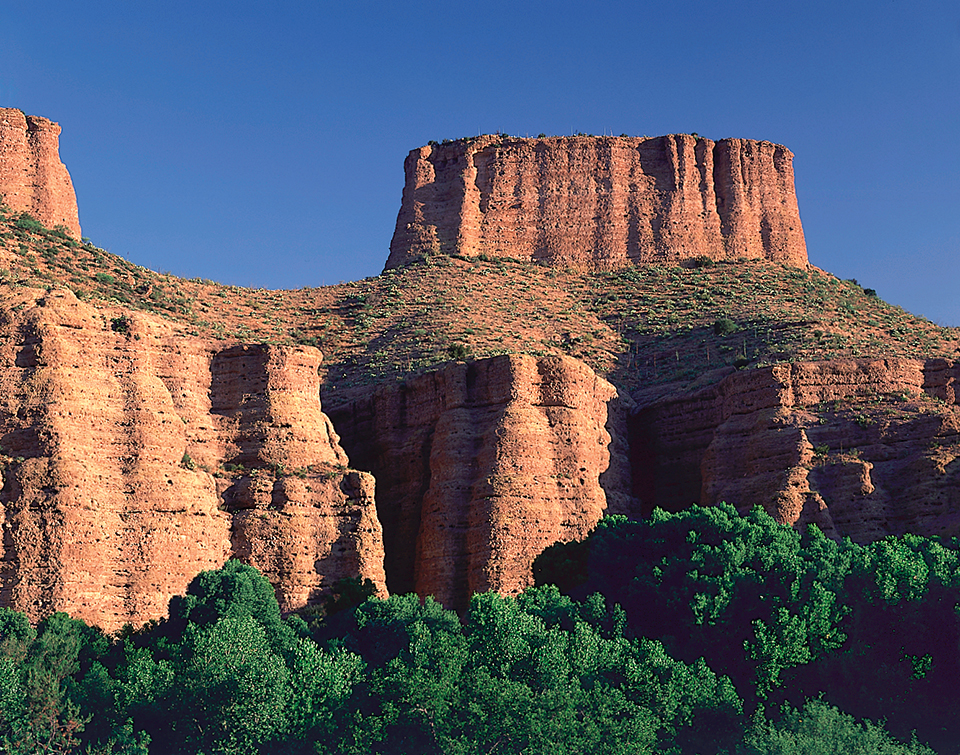
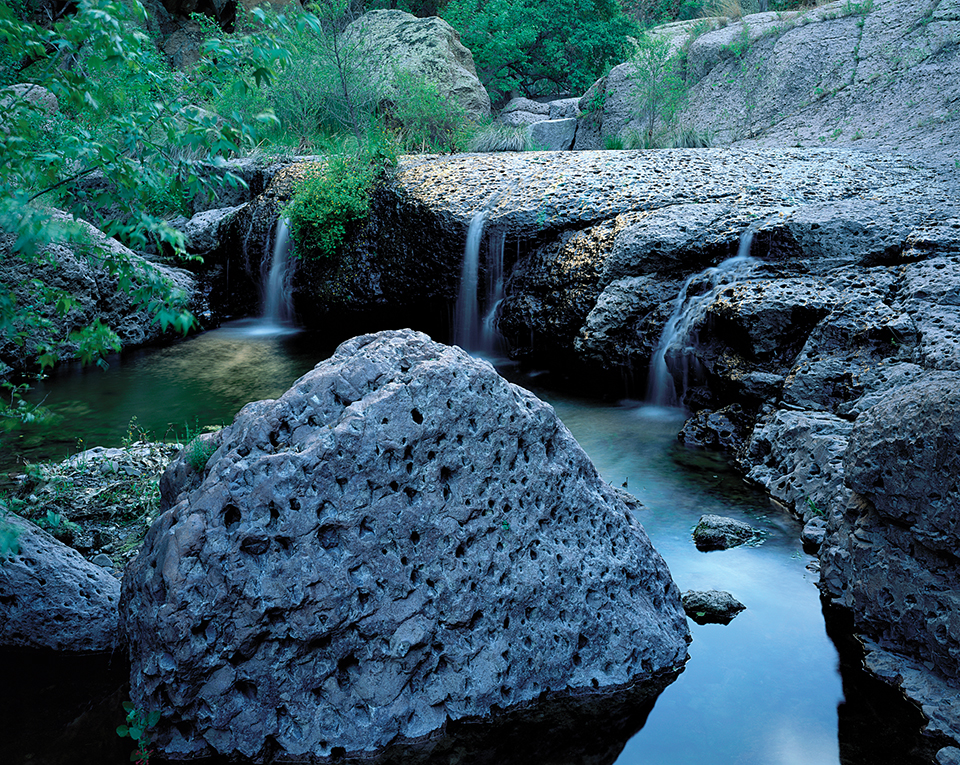
Quiet conversations of water moved through a forest. Words chattered across smooth, black stones as a clear stream turned one way and then another, threading among jail bars of tree roots. Where the sun reached through a canopy of sycamores and alders, light etched the water, igniting stones at the bottom of the stream.
Aravaipa Creek is famous for scenes like this, but this was not Aravaipa. It was one of Aravaipa’s numerous sisters, a small creek flowing out of the Galiuro Mountains in Southeast Arizona, its water eventually bound for Aravaipa itself. This is one of the nameless places, overgrown and heaped with boulders.
I walked along the stream with my young son, Jasper. He held my finger firmly, not yet comfortable walking on his own. He used his other hand to part grass in front of him. My wife and our friend had gone ahead to scout a side canyon in search of routes. Waiting for their return, Jasper and I strolled along the stream, following bends of moss and cobbles. I crouched under fallen lances of alder trees, twisting around to keep my finger available as Jasper led me through green shade and toward the mumble of water.
Places like this are secret and untroubled, like bits of legend scattered across the desert. Each of the Sky Island mountain ranges in Southeast Arizona, like the Galiuros, lets out veins of streams, allowing life to flourish. A radiocarbon test of some of this water revealed that it could be 15,000 years old. It’s probably left over from the last ice age, ancient water stored deep within the rocky cores of mountains, slowly bubbling up into daylight.
My son and I passed beneath mansions of sycamore trees, their leaves as big as hands. Branches of the larger trees cover half an acre of ground, fleshy bark knobbed with orifices — folds of wood and bark that looked like ears and nostrils, like fat-skinned wrinkles. Wild grape vines coil up the trunks and hang from branches. Life piled on life, a single organism of forest. Even alder trees toppled by floods had sprouted again, their branches turning vertical, sending leaves toward the meager skylight, and roots down through cobbles below, unable to resist another chance at living.
For variety, I turned us away from the stream. We followed a spur of a side drainage, its cobblestones damp with moss. Dark troops of oak trees gathered around us. We slowly rose into a field of cliffs, a huge canyon surrounding us, its walls weeping with springs. I hitched Jasper onto my side and climbed a little higher, reaching for holds through ferns and moss.
“Hold tight,” I said, and I felt Jasper’s arms instantly pinch at my side, his little shoes digging like spurs into my waist.
Now we were in the forest canopy, edgewise to the half-acre branches, able to see birds as they piped and warbled from their perches — a yellow breast, one dashed with green, shoulders of red. I stopped and swiped water off a rock with two fingers and brought my fingers to my lips, wondering if this was rain or snow that had fallen in Pleistocene times, my lips the first to touch it since then. Jasper leaned his head out, reaching a curious hand, wanting me to touch his lips, too. I did. He tasted spring water fresh out of the Earth with a little grit of stone, the clean savor of ice long melted.
Jasper gave me a squeeze and a high-pitched utterance, reminding me of his other needs. I pulled a strip of jerky from my pocket, chewed off its tip and then passed a sweet plum of meat into his mouth. He took it without response. If he felt gratitude, it showed only in the way he continued to hold onto me. I put my fingers in the spring water again and tapped them on his lips. He grinned.
My small family and I had been traveling for weeks in the area, rationing diapers, staying near dependable water sources for drinking and bathing. We set camps on canyon rims and along ridges. Our friend Colin, another wilderness traveler, came along to help, knowing that travel with a baby was much more work.
Later that day we all regrouped, and Colin and I set off to see what we could find. We were trying to grasp the lay of the immediate country, seeking routes that could later be traveled with a baby in tow. Colin was fast, and eventually I had to stop for a break. My feet were bleeding. We were wearing sandals instead of boots. Sandals proved better for making distance in this kind of country, getting in and out of water, sinking into wet sand and climbing out the other side. But they weren’t much good for protection.
I sat on a shelf of rock and pulled off one of my sandals. A splinter of a twig stuck out of the soft skin of my sole. I gripped it firmly between thumb and forefinger and pulled it out, eliciting a quick barb of pain. I hunkered down to a pool of fresh water, where I cupped my hands and washed my feet, rubbing dirt out of a score of minor wounds. I reached up and pinched off a leaf of lavender from a powder-blue-tinged plant beside me. I rubbed the leaf until it was moist on my fingers and dabbed it on the fresh, red abrasion on my right foot. I was ready to go again.
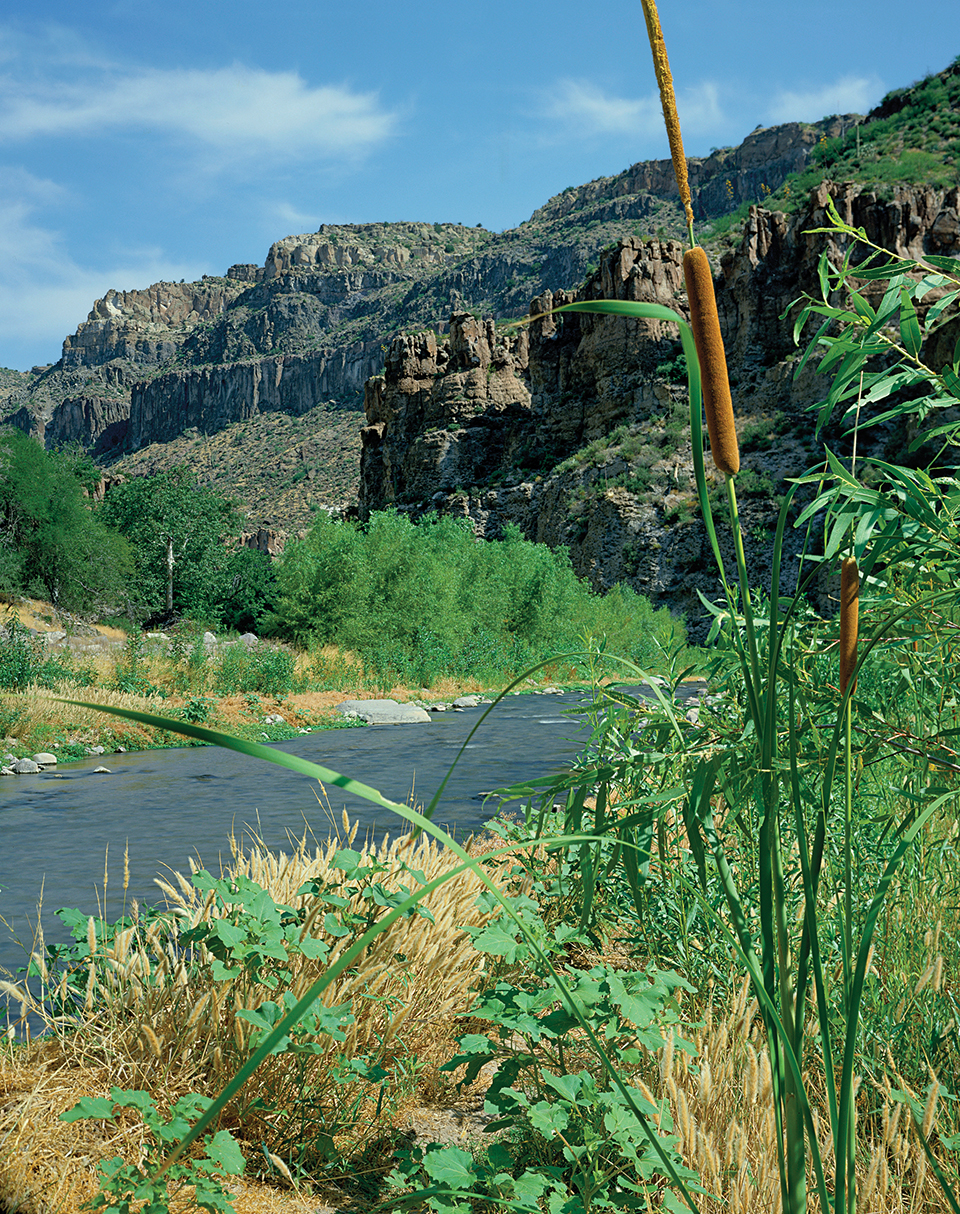
We found the tributaries of Aravaipa deeply incised, winding down through canyons and cliffs, restricting the number of routes. Just finding a way back to camp by dark was going to be a challenge. Colin and I reached a ridge to get a view, well above the forest. High desert vegetation surrounded us: agaves, mesquites, prickly pears and beargrass shaded by gnarled thickets of scrub oak. From there we saw down into the next canyon, and the one past that, and one past that again. The sisters of Aravaipa are many. My heart was drumming from the scramble, breath pushing in and out. I turned and looked behind us, seeing the same as what we saw ahead — bleached heads of stone standing up from canyons.
Colin and I trotted along the ridge until it gave out and embarked downward, hoping to enter the right drainage, the one that would lead toward our camp. We started running, taking advantage of the steep terrain. White-tailed deer bolted in front of us, flashing out of the brush and into sunlight. They sprinted along a slope beside us and we kept pace with them, breaking this way and that as we sank into the shadows of a new canyon, one we thought would take us home. Cliffs rose around us, enormous passageways opening, leading us to steep and rocky routes.
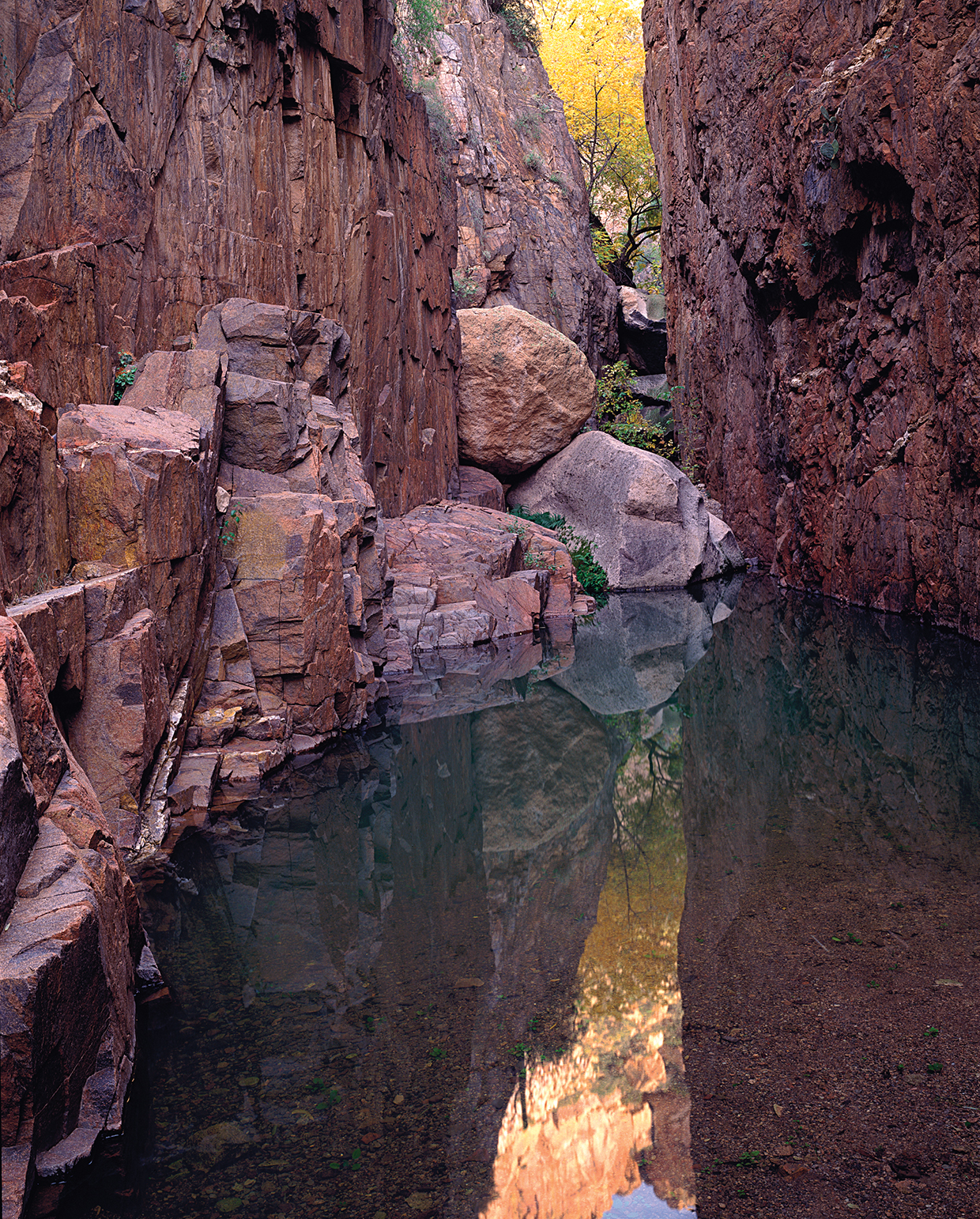
We moved quickly through the somber light of dusk. Gray tree frogs clung to walls around us. Their long, high songs swelled into the canyon. As we neared them, each frog jettisoned like tiny cliff divers plunking down into pools of water collected in the scoured, bedrock basins below. We climbed over the basins, and wedged ourselves down along a tightening corridor. There were no trails, no signs. We read the land carefully, but soon found ourselves trapped.
Our canyon had funneled into a plummet with cold, black holes of water drilled into the floor. Colin took one last running leap, bounding over several of these water tanks. He spanned the last one, and landed on its dry lip, teetering for a moment, peering out.
“Does it go?” I asked, wondering if there was a route, or if we were going to have to turn back. Colin looked straight down past the toes of his sandals, his arms stretched to both sides as if he were standing on a tightrope.
“Does it go?” I repeated.
“Dead end,” Colin said. He’d vaulted his way to a thin purchase of rock over a free-fall canyon.
I quickly scanned up the walls around me, seeing a few ledges I could use to climb out. Colin was an accomplished climber. I’d seen him do things on rock I would have thought physically impossible. He didn’t need my help.
“Good luck,” I told him. “I’ll see you down below somewhere.”
I climbed ledge by ledge. From higher up, I glanced at Colin still standing at an edge below me. He was taking a few breaths to consider his options. I could see now what he was faced with. Balanced on a few inches of bare stone with a pool of water as dark as onyx behind him, he was looking a couple hundred feet into empty space, the canyon dropping out from under him. Knowing he’d manage just fine, I didn’t look back at him again.
After about 10 minutes of inching around wall after wall, I found a slope of rock rubble. I skittered into a narrow crevasse, popping out the other side not far above the canyon floor.
Just as I expected, Colin was already ahead of me. He’d found some backdoor route and had beaten me down, no doubt losing some skin in the process, his blood still hot with adrenalin. We slid and scratched through sharp-edged rocks, setting some rolling, kicking up dust for 10, 20 feet. Toward the bottom, the rocks became boulders as big as washing machines. Below them were boulders the size of houses. We climbed cracks between them, descending into a canopy of sycamores.
When we reached the bottom, daylight was nearly gone. We found the stream where we’d started, and followed it, moving across beds of moss and broken tree stumps. With no more exposed rock, no more sudden falls, we walked with a lazy, exhausted stride, our feet painted in leaf dirt and blood. Sycamore trees sank into darkness as we felt our way along. We had headlamps in our packs but didn’t get them out. A last trace of light remained to show the way, a vaporous glow, as if a modicum of daylight had not been able to find its way out of the canyon.
A baby’s cry lifted from the darkness ahead. It was the call of my son’s hunger. It cried, comfort, warmth, need, echoing among trees, muted by leaves and trunks. Just as quickly, the voice was quieted. In the night beyond us, in a camp too far away for us to see, Jasper had been given whatever he needed. My body relaxed; I was almost home.