
Editor’s Note: As we begin a new year, we continue the celebration of our centennial with another classic from our archive. This month’s piece was written by Frank Waters, a prolific, award-winning author from New Mexico who spent his winters in Tucson. When he died at the age of 92, his eulogist said: “Frank Waters is unique in American literature. With the exception of William Faulkner, no other novelist has produced as many classics. And Frank is wiser and kinder than Faulkner, deeper than Hemingway, tougher than Steinbeck. This was a very great writer.”

No writer of worth has ever seriously attempted to describe Grand Canyon; no artist has ever adequately portrayed it. None ever will. For while it is the most compelling single area on the Earth’s surface, it is not a landscape. The regal, ermine-cloaked Rockies; the somber, moss-hung swamps and bayous of Florida and Louisiana; the romantic orange groves of California; the sweet, clean meadows of Ohio; the majestic bluffs along the Hudson; the poignantly beautiful prairies of Kansas; the dreamy plantations of the Deep South; the rugged grasslands of the Far West — all these and a hundred others offer true landscapes. Each has a distinctive tone, key, spirit and character, which hold true and unique despite their infinite variations. They can be known, loved and partially expressed.
The Grand Canyon is beyond comprehension. No one could possibly love it. It is not distinguished by any one dominant quality. It is not unique in the individual sense. It is universal.
One cannot define humanity. One can only define the terms of humanity expressed by its many components: beauty, cruelty, tenderness, strength, awe, horror, serenity, sadness, joy. But to define life — the blended summation of all its infinite aspects — is impossible.
The Grand Canyon in nature is like the humanity of man. It is the sum total of all the aspects of nature combined in one integrated whole. It is at once the smile and the frown upon the face of nature. In its heart is the savage, uncontrollable fury of all the inanimate universe, and at the same time the immeasurable serenity that succeeds it. It is creation.
Never static, never still, inconstant as the passing moment and yet endurable as time itself, it is the one great drama of evolutionary change perpetually recapitulated. Yet the Canyon refutes even this geological reality. In its depths, whole mountains contract and expand with the changing shadows. Clouds ebb in and out of the gorges like frothy tides. Peaks and buttes change shape and color constantly in the shifting light. None of this seems real. It is a realm of the fantastic unreal.
If I were forced to describe so sublime an immensity, I would define it with only one word. The ancient Sanskrit word for the nonexistent material world of the senses: maya, or “illusion.” It embodies all that man has ever achieved of the knowledge of reality: that all matter, as our own science now suspects, is but a manifestation of that primordial energy constituting the electron, whose ultimate source is mind, and hence illusory and insubstantial. Grand Canyon seems such a world. A world whose very mountains are but the shifting, dissolving, re-created thoughts of the One Omnipotent Mind. It is beyond sensory perception. It lies in the realm of metaphysics — the world of illusion, maya.
No one is ever prepared for the Canyon as one is for the gradually rising Rockies as he approaches across the plains. One simply crosses a flat plateau hirsute with cedar and great pines, and there at his feet it suddenly yawns.
The Rocky Mountains upside down; an immense intaglio instead of a cameo. A mountain chain, as it were, nearly 300 miles long, up to 18 miles wide, but a mile deep instead of a mile high.
Say this, and there is no more to be said. See it in one look, and there is nothing more to see.
A competent writer, justly noted in his generation for his appreciation of Western America, once described the first impact of the Canyon by relating that he had seen strong men break down and weep. Sensational bosh! I think more of the curt remark of that old Westerner who at his first sight is reported to have shrugged and said, “Now, by Jesus, I know where we can throw our old safety razor blades!”
Like all great things, the Canyon takes time to appreciate. So, be wary of your companion’s instant rhapsody of applause. Be more wary of that sacred hush affected by others. Simply take your look, turn on your heel and leave. The Canyon will be there if you ever return. And if you are drawn back, you will know then that it is a great experience not to be taken lightly, and not before you are ready for it.
El Tovar on the South Rim — Fred Harvey’s luxurious oasis at the terminus of the Santa Fe railroad spur and the highway from Williams, Arizona — has long been the stranger’s starting point. From here, convenient government roads lead to several other points of vantage: Hopi Point, Yavapai Point, Grandview Point, Desert View and Lipan Point, just off the road between these latter. At their tidy observation lookouts provided with telescopes, you can briefly encompass a faint idea of the main Canyon’s length of 277 miles and its average width of 12 miles.
For the first time, the absurdity of a letter to M.R. Tillotson, former superintendent of Grand Canyon National Park, will strike you as funny. He relates that a Hollywood movie director once wrote him, requesting aid in selecting a convenient, scenic spot where his cinematic hero could be filmed in the act of jumping a horse across the Canyon. Actually, the chasm is so long and wide that it has prevented the migration of animals to and from the forests on each side. Only on the Kaibab Plateau to the north are found the Kaibab white-tailed squirrels, known for their tufted ears.
Parachutists have been dropped on certain buttes to search for prehistoric forms of animal life possibly isolated in the Canyon. In this largest virgin forest in the United States roam queer dwarf burros that have strayed here, gone wild, inbred and become stunted. The North Rim abounds in deer. A government trapper killed 500 mountain lions in four years.
Winding down to the bottom are two easy horseback trails, Hermit and Bright Angel. Descend one of these, and the third dimension of the Canyon begins to be apparent: its appalling depth. A sheer drop of 1 mile from the South Rim, and 1,300 feet more from the North Rim. Remembering that 1 mile in altitude is comparable to 800 miles of latitude, you can travel here the equivalent distance from central Mexico to northern Canada. It is a trail that drops from a snowstorm at the rim into semitropical weather at the river below. And one which leads through all the zones of plant life from the mesquite of the Lower Sonora Zone, through the Upper Sonora and Transition, to the quaking aspen of the Canadian Zone.
In length, breadth and width the Canyon grows. Its mere immensity takes hold. Yet these dimensions are but its frame. Like a drug, the more of it you take in, the more you want. Often, riding through the forests along its rim, I have come across lone wanderers held there a month, a year, a lifetime, by nothing more than its strange and indefinable quality of compelling fascination. Ostensibly, there are vacationists, photographers and artists, mere sheepherders, old hunters and trappers — even those waiting for the world to come to an end. But it is the Canyon that holds them. It is the most powerful mesmer I know.
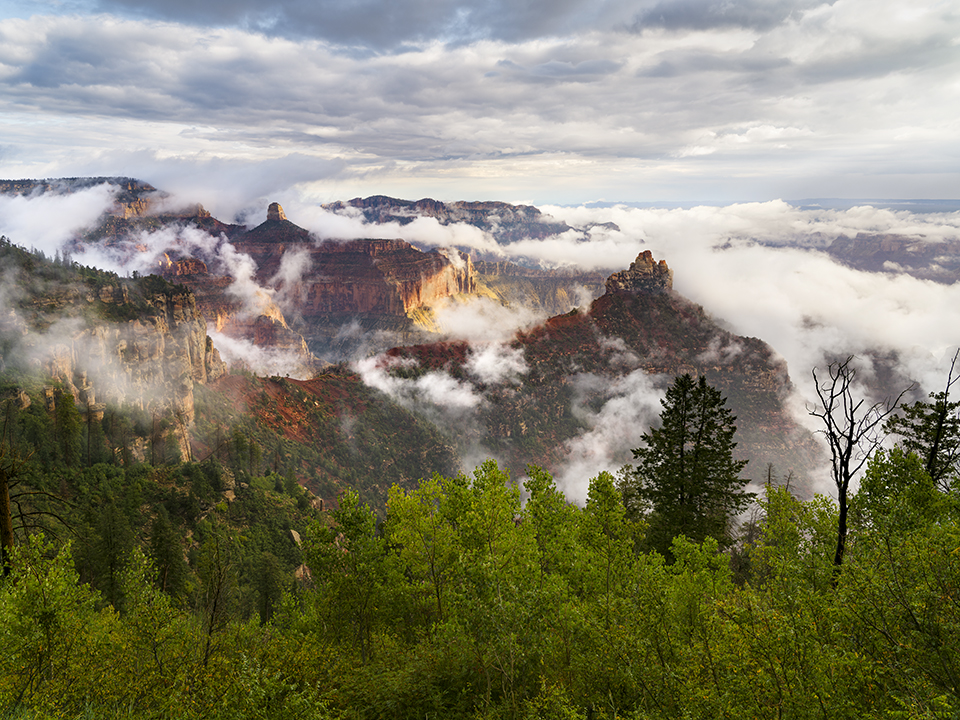
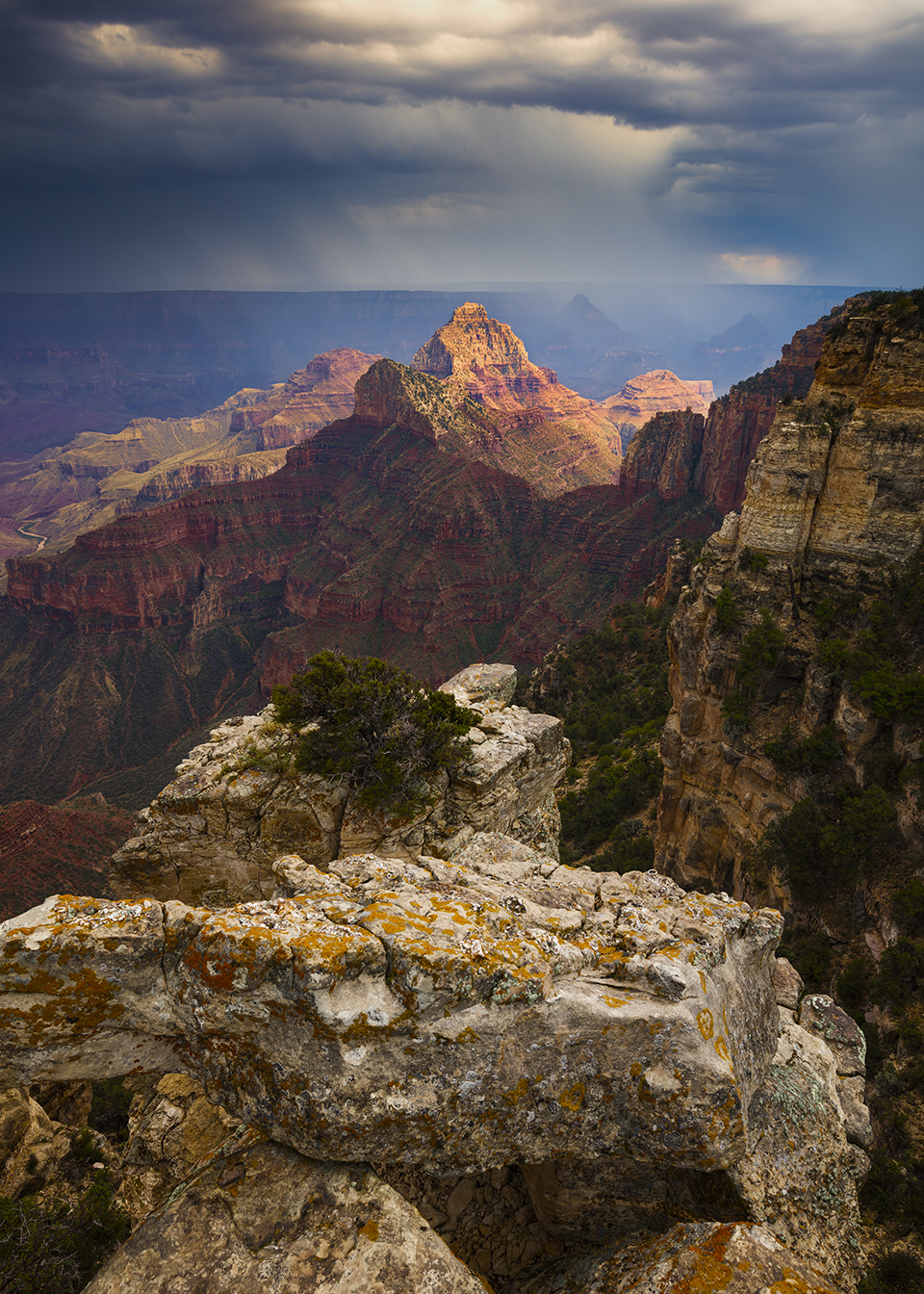
What is there in it that exerts so universal an appeal? For one thing, it contains every shape known to man. Lofty peaks, whole mountains, rise out of its depths. There are vast plateaus, flat-topped mesas, high buttes and monoliths. And all of these are carved in the semblance of pyramids, temples, castles; of pinnacles, spires, fluted columns and towers; porticoes and abutments, bridges and arches, terraces, balconies, balustrades. They are solid and fragile, bare and covered with latticework and delicate carving. It is a stage that seems expressly built to contain in perpetuity appropriate sets for every dynasty, every religion, every legend and myth-drama that man has known — a vast universal depository, as it were, of mankind’s structural and architectural heritage.
Cárdenas and his men, the first Europeans we know to look into the Canyon, saw in it shapes resembling the towers of their beloved Seville. Cardenas Butte is named for him; another for Coronado, who headed the first land expedition into the region; and Alarcon Terrace for the first ship captain to ascend the river.
Named for the pre-Columbian race of Mexico, which they conquered, is Aztec Amphitheater, and for the race that preceded it, Toltec Point. There is a point for ancient Centeōtl and one for Quetzal, which gave a name to the vanished, mysterious quetzal bird and the legendary, feathered serpent-god Quetzalcoatl.
For the Greeks, there are temples named for Apollo, Castor and Pollux; for the Romans, the temples of Jupiter, Juno and Diana.
The Christian Bible is not forgotten. There is a temple here for Solomon more enduring than one made of Lebanon cedars, and another for Sheba that will last as long as the fable of her beauty.
Here, far from Egypt’s land, is Cheops Pyramid; a Tower of Ra; and the temples of Horus, Isis and Osiris.
There is a Persian temple for Zoroaster; Chinese temples for Mencius and Confucius.
The immortal Hindu philosophers, saviors and deities — perhaps the oldest known to man — have here as everywhere their proper shrines. There are temples for Buddha, Brahma and Devi; a Krishna shrine; and a temple for Manu, who throughout the destruction and rebirth of all continents, all worlds, watches over the progressive evolution of all life, including that of man, its latest form.
Here as nowhere else are background and settings spacious and majestic enough for the great Germanic myth-drama. Across the titanic Canyon to the Walhalla Plateau could race the winged steeds of the Valkyries carrying heroes killed in battle. There is Wotans Throne; castles for Gunther and Freya; a lofty promontory named for Thor, with room to swing the mighty hammer whose blows echo back and forth from the Canyon walls; and Siegfried Pyre forever flaming in fiery rock.
So too are the English myth-dramas of the Arthurian legend and The Quest of the Holy Grail recapitulated in enduring stone. Here stands King Arthur’s Castle with that of Guinevere. There is another for Sir Galahad and one for the tragic maid Elaine to stand in, grieving at its casements for the peerless knight’s return. There rises Lancelot Point; there yawns Gawain Abyss. Holy Grail Temple still holds at dawn and sunset the light no man saw on its tragic quest. Here is a mighty stone named for the magic sword Excalibur — itself first drawn from stone. Still others are named for the magician Merlin, the traitor Mordred.
Point after point emerges to mark all these, simply named for the people who have always known this as their traditional homeland: Apache Point for the mother tribe and others for its subtribes, the Jicarillo, Mescalero and Mimbres Apaches; still others for the Hopi, Navajo, Hualapai, Pima, Yavapai, Papago, Cocopah and Comanche.
So, they loom out of time and space, a named minimum out of the vast anonymous multitude. What shape or form has man ever conceived of mind and built by hand that the Canyon does not hold? Is that its secret that holds a watcher at its brim — to see foretold in it the yet-unborn form of his wildest imagining, the shape of his secret longing?
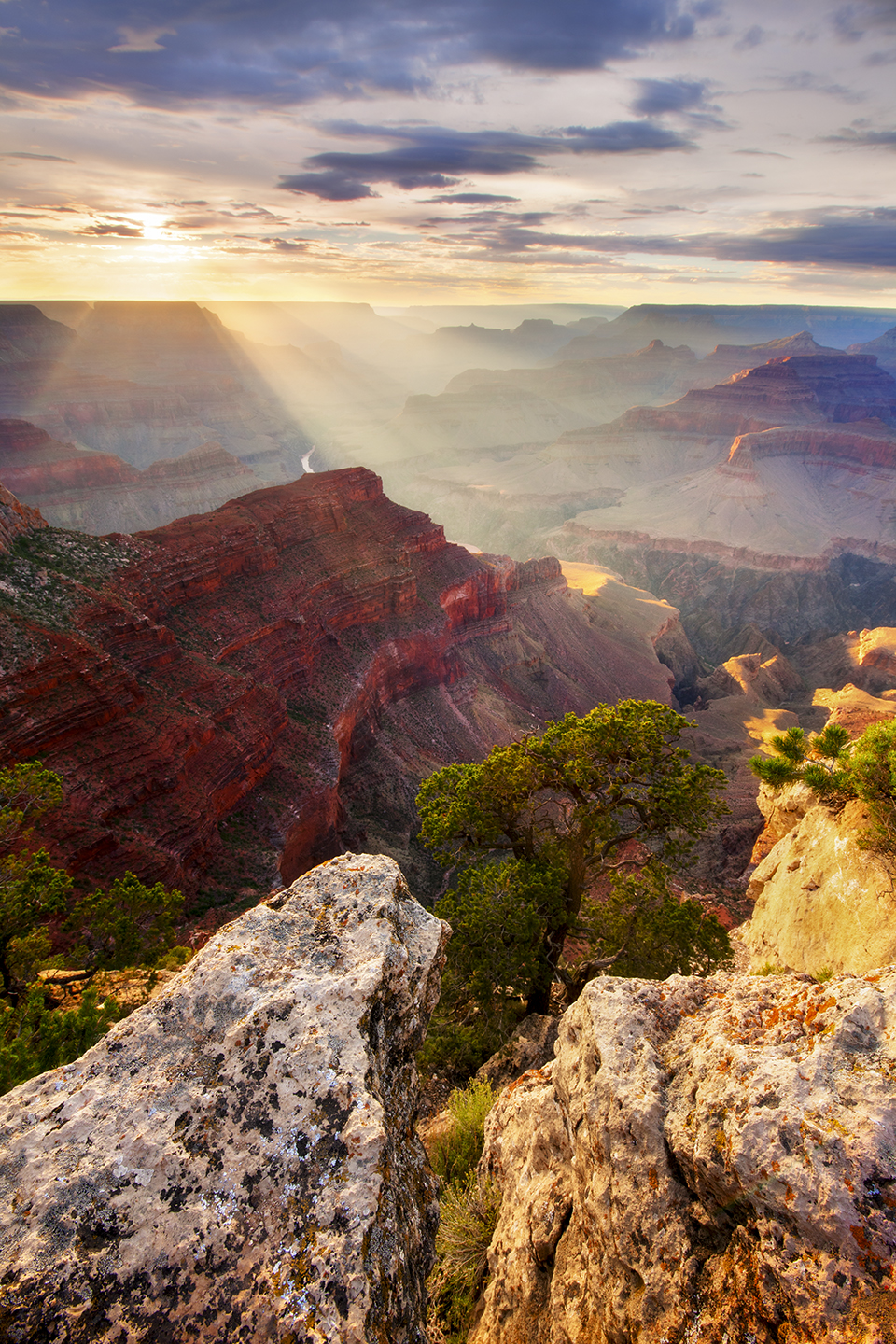
Why, many a man has hardly noticed shapes in it at all. They are merely blobs of color. Color so rich and rampant that it floods the whole chasm, so powerful that it dissolves like acid all the shapes within it. Here, if you will, is a drama whose characters are colors: the royal purples, the angry reds, the mellow russets and monkish browns, soothing blues, shrieking yellows, tragic blacks and mystic whites, cool greens, pale lavenders and anemic grays.
A lifetime is too short to watch their infinite variations in key and tone. They change with every season, every hour, and every change in light and weather.
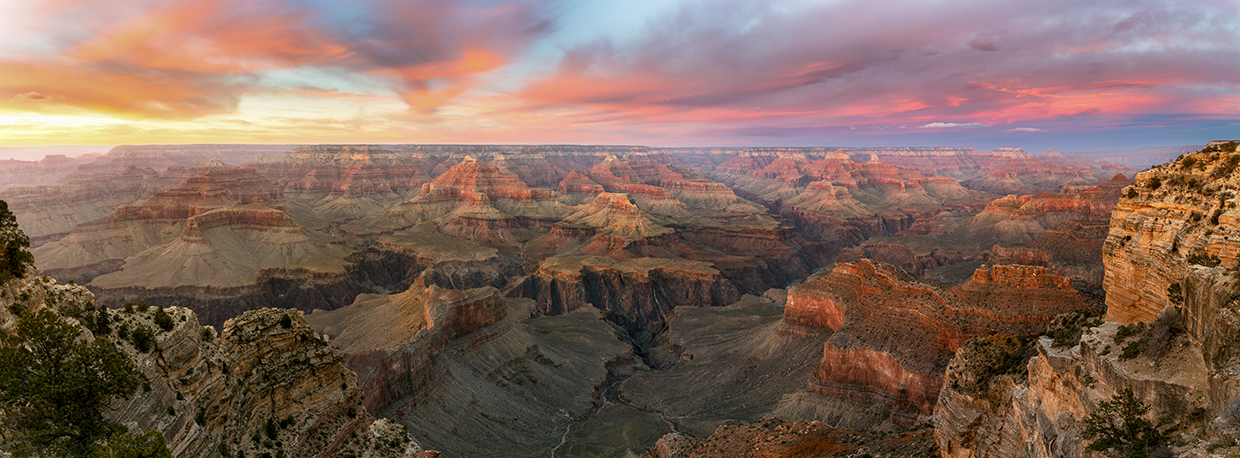
In the blinding glare of a summer’s noon, its tints are so muted that the Canyon seems a delicate pastel. But watch it at sunset. The yellows slowly deepen to orange, the salmon pinks to reds, the greens and blue-grays to damson blue, the lilacs to purple. Sunrise reverses the process. The whole chasm lifts bodily, inch by inch, toward light. The paint pot tips and spills over. The colors run and seep down the walls, collecting in pools below.
If it is a picture, winter frames it best. Preferably after a heavy snowfall, when the plateaus are solid white, and better yet when every twig and needle is still sheathed in ice. Deeply inset in such a frame, the Canyon has all the warmth and color of a child’s stereopticon slide held up to the table lamp. Into it snow never descends. A summer rainstorm is more potent. Then, mists and clouds are formed below. Like tiny puffs from Father’s pipe, they spurt out of the warm canyons and, swelling like balloons, gradually float to the surface.
But the cold, clear, cloudless days of October — that is its time. Its colors stand out flat and positive. They relate it not to the universal, but to the earth in which it is set. Red Supai Group sandstone, the rich red rock with the Indian name, the bright red Indian earth that stains land and river alike and gives both their name. Green Tonto Group shale, green as pine and sage, bright as turquoise, clear as the turquoise sky above. Red and green on limestone white. These are its distinctive colors, as they are the colors of the old Hopi ceremonial sashes, the masks of the giant Zuni Shalako, the Navajo blankets, the fine old blankets of Chimayo so faded with their lost and unduplicated colors.
In this, of course, I must own to a sentimental but helpless preference. This is my land, and to it I belong with all it expresses and with all by which it is expressed. It is merely a matter of vibration. We are each keyed to that band of the spectrum that determines our own tone.
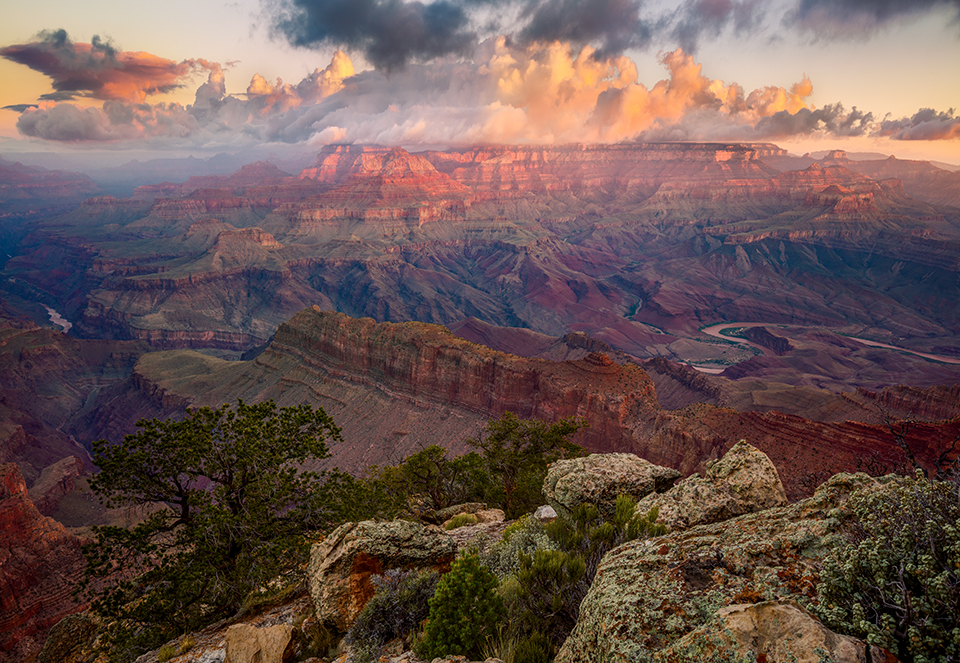
Little wonder, then, that the Canyon is universal in appeal. It is the complete spectrum, and in its vast range there is no one who does not find their own harmonic key. Color is a mysterious thing. Within the written memory of man, as we know, there was a time when he could not distinguish between the blue of the sky and the green of the forest. Still today there are colors not all of us can perceive. But they are there in the Canyon — a thousand gradations invisible and unnamed, yet each vibrating upon our consciousness. Is this the “music of the spheres” that fills us so with wonder, a celestial symphony of color that drives us to still another terminology to express the inexpressible feeling it evokes?
In an instant the whole thing is forgotten when suddenly, after midnight, a slash of lightning rips through the dark. One hears the bolt strike. It is as if it has cracked the hinge of a Canyon wall. A cliff caves in. It tears down another, and it another, like the collapse of a pack of stacked cards. A tremendous and prolonged shattering, accompanied by a thunderous concatenation traveling down the whole Canyon.
Before it is over, you have thrown off your blankets and raced half-naked to the rim. This is the end of the world as predicted. Bolt after bolt strikes into the gorge. In the hot, dry air, sheets of flame light up the crumbling buttes and peaks. A second later, they have vanished, swallowed by a vacuous immensity of flame red and pitch black.
It grows greater and greater to the echo of thunderclaps thrown back and forth from the remaining walls — an inferno bathed in fire, a chaotic underworld. This is the apocalypse, the most awful and most sublime sight you can experience. Before it, you cling to a piñon, insensible to self, the shrieking wind and the lash of rain.
As suddenly, it is over. The last reverberation dies away. Overpowering silence breaks louder upon the eardrums. In this monstrous, unearthly calm, the first light of day breaks over the cliff tops. They are still standing. And in the clarity of rain-washed dawn, you see a world reborn in the semblance of the old. But new, enthrallingly new!