

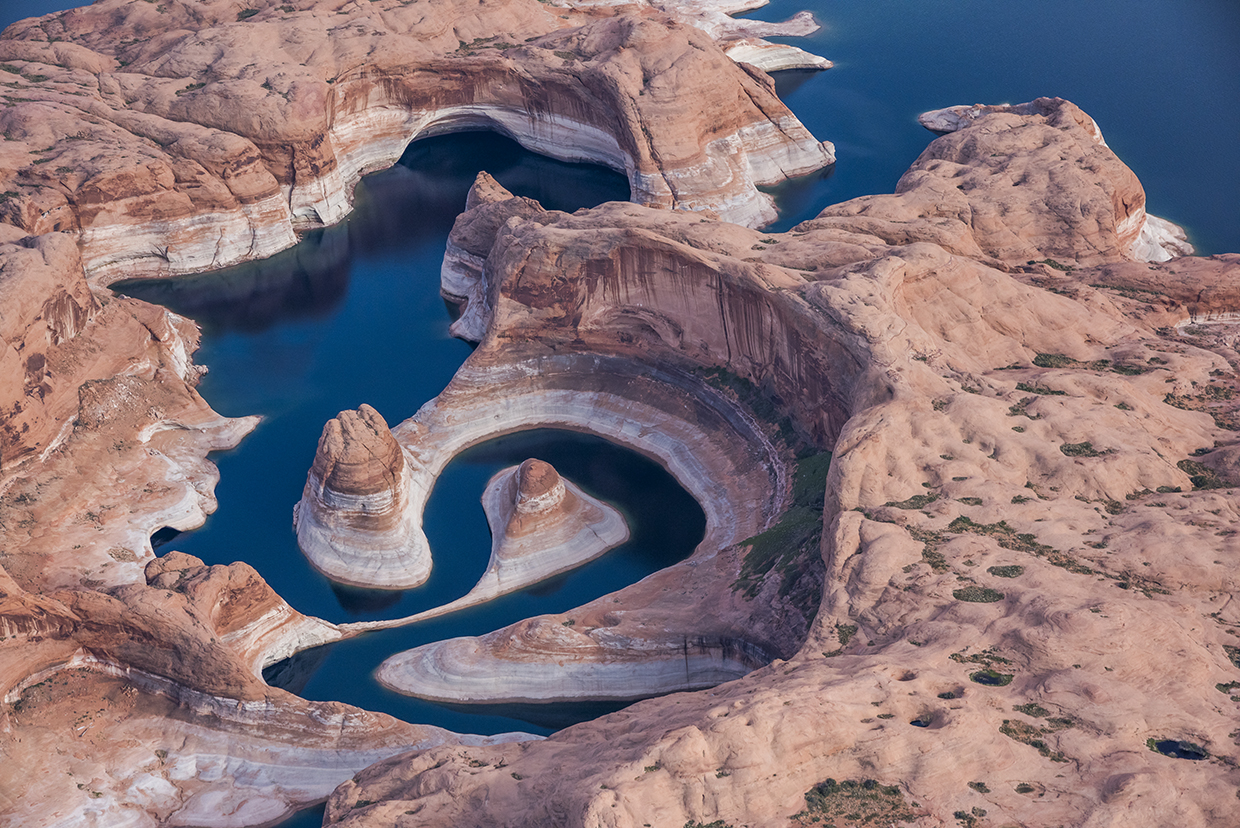
When plenty of water was sloshing around Lake Powell in the 1980s, I briefly encountered Floyd Dominy, who’d been the commissioner of the U.S. Bureau of Reclamation when Glen Canyon Dam was completed in 1966. I asked Dominy whether, during the intervening years, his perspective on the wisdom of building the controversial dam that flooded gorgeous Glen Canyon had changed. Dominy responded with a question of his own: “Do you have any idea how much gasoline is sold at Dangling Rope Marina?”
This curious answer was pure, cast-iron Dominy. He was an impassioned dam and irrigation man who possessed one simple yardstick for measuring the success of his projects: their water-controlling, power-generating economic impact. Big bucks were flowing because of gasoline sales, a rosy indicator. The magnificent canyon, accordingly, served best as a backdrop for Dominy’s successful river upgrade.
Today, some 40 years later, there’s trouble in river city. Dominy’s Dangling Rope Marina was permanently dismantled after 2021 because it would no longer fit within the shrinking confines of its side canyon. It joined Hite Marina, which closed for the same reason: a shockingly low lake level. Low water has also closed multiple launch ramps and forced intermittent shutdowns of the Bullfrog–Halls Crossing ferry service. Year by year, Lake Powell has been adjusting to unsettled times.
In 1963, Dominy’s big dam transformed Glen Canyon from a lonely river corridor into what would become a celebrated lake. The radical transition, praised by today’s lake boaters but eternally despised by river runners, seemed to be the end of the story. But more disruptions were brewing.
Three main factors are responsible for the upheavals at Glen Canyon National Recreation Area. First, the lake level has nose-dived to chronically low levels, currently about 155 feet below full. Climate change has strangled the Rocky Mountain snowpack on which reservoirs all along the Colorado River rely for replenishment. For decades, the big reservoirs did, in fact, routinely keep farms and cities slaked during dry years. But now, after repeated rescues, the reservoirs are nearing exhaustion.
At the same time, the states that draw water from the Colorado, including Arizona, have resisted reductions of their water allotments, even as a 25-year drought continues to torment the region. The result is a Lake Powell wallowing at about one-third of full volume. Finally (and ominously), if more snow-poor winters occur, the sinking lake level will soon end power production at Glen Canyon Dam. As brutal as it might now seem, we could be forced to accept actual water unavailability, rather than assumptions of unavailability calculated decades ago.
Second, a dramatic shift has occurred in the use the lake receives from boaters. In the 1960s, ’70s and ’80s, speedboats and houseboats were plain and practical, used for fishing and exploring. Today, the emphasis is on grandeur — not of landscapes, but of hardware. Speedboats have grown bigger and faster, and houseboats have morphed into what could be called “mansion-boats,” provisioned with fireplaces, hot tubs, outdoor showers, powerful generators, a maze of bedrooms and more. Many are gasoline guzzlers.
Third, for almost 40 years, Dangling Rope Marina was a patch of civilization in a remote section of Glen Canyon that could be reached only by boat. It was strategically located in the middle of a 100-mile section of lake between major marinas, and its recent loss has kept many boaters away from a central area of the lake and closer to fuel docks. The National Park Service has been working on a plan to replace the marina, but the planning has dragged on for years — because at low water levels, this part of the lake has no practical marina sites. The hope is that some location can be cleverly engineered to become a refueling center, if not a true marina.
The facts interlace: Lake Powell is shrinking, which caused the loss of a key marina, which inhibits the lake’s boating traffic, which makes the lake seem even smaller. Even Rainbow Bridge is sometimes difficult to reach. And just to be sure that the low lake bugs everyone (including river runners), the San Juan River, unable to find its silt-buried ancient channel, now drops into a former bay of Lake Powell as a waterfall. (Similarly, a ferocious rapid, Pearce Ferry Rapid, has developed where a puzzled Colorado River enters the former upper reaches of Lake Mead.)
With all this instability — the climate wavering, the snowpack variability, and the human habit and policy wobbliness — you have to wonder what might be next at Dominy’s lake.
And yet, one fundamental feature of Lake Powell has stayed rock steady: It is still the ultimate stronghold of the primeval Glen Canyon legacy of enchanting natural bridges, balanced boulders, buttes, spires and slot canyons. Glen Canyon and Lake Powell, even when ailing, remain uniquely topographically delightful.