
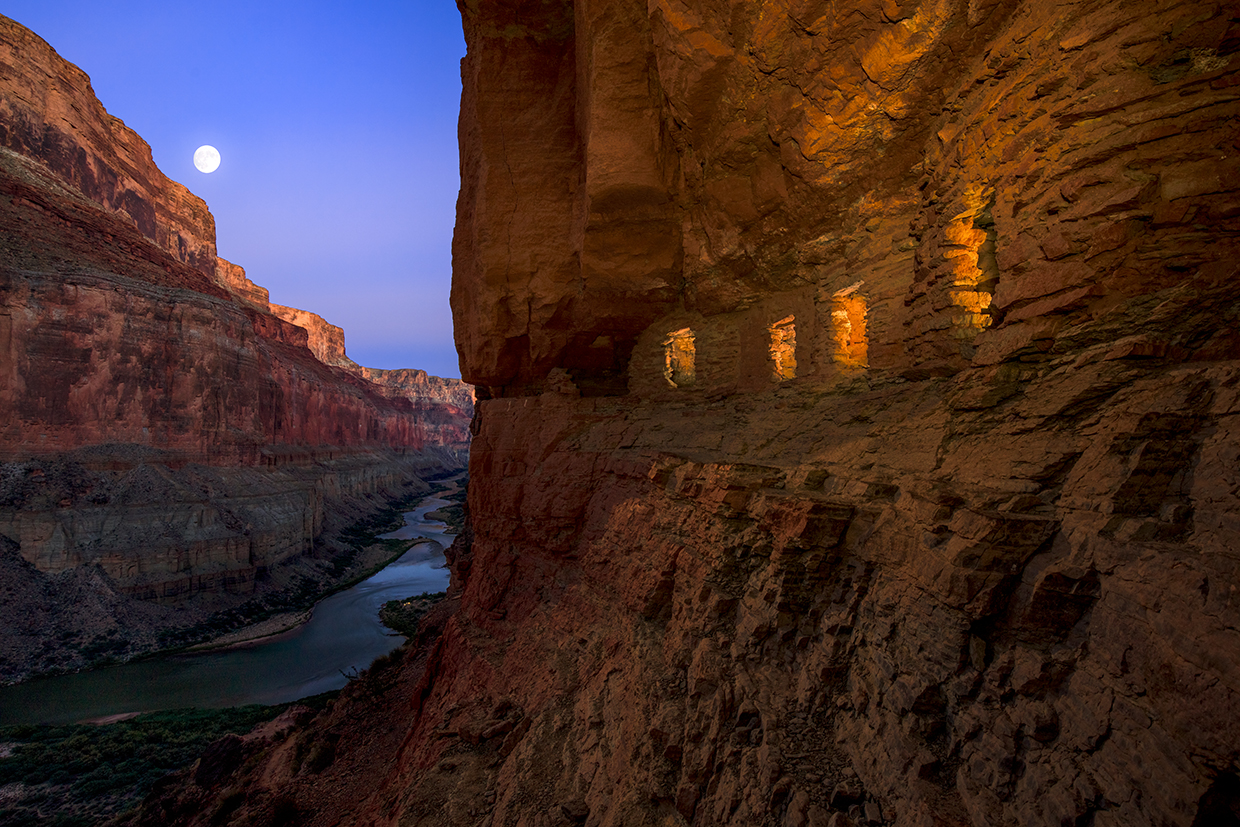
Moonrise Over Nankoweap was made on my first Colorado River trip, a photo expedition arranged and led by David Edwards. Dave created the opportunities, but being 80 years old at the time, he didn’t participate in the hikes (although he rowed a raft for 18 days).
We did a layover at Nankoweap, meaning we spent two nights, which gave me the opportunity to make the hike up to the granaries several times and allowed me to “preview” where the moon would rise.
I had seen numerous light-painted photographs of Nankoweap and knew there were several things I wanted to do differently. I wanted to get closer to the ruins and use a wide-angle lens to accentuate the sweep of the foreground rocks. I also wanted to give the impression that the granaries were illuminated from within, rather than by a broad, sweeping light source outside.
I shared my thoughts with Dave and the other river guides. We discussed my ideas and the approach I’d take in executing the image, and then addressed their concerns regarding the protection of the granaries and my safety. National Park Service regulations would not permit the placement of anything inside the granaries, and most importantly, all contact with the granaries was to be avoided. As for my safety, in order to illuminate the granaries, I’d have to walk up to each opening and briefly shine a light inside to give it a pop of light, all while walking on a relatively narrow ledge.

A tungsten-balanced light source would have been ideal, but all I had with me at the time was a headlamp and a Fenix “tactical” flashlight, both of which have light sources that run on the cool side. I experimented with trying to gel the lights, even going as far as using a cellophane wrapper out of our garbage (I wish I could remember what it was from), but ultimately I decided to go with the bare light and digitally balance it later in post.
On location, I experimented with both the headlamp and the Fenix light, but found that the Fenix tac light was much more practical to use, because it was easier to hold and had a thumb switch that allowed very short bursts of light. The exposure time was 30 seconds, which allowed me to move through the frame from opening to opening, giving each a pop of light.
I’ve processed this image several times. I initially shared it publicly as a single exposure with the moon blown out. Several photographers emailed me, encouraging me to replace the moon, which I did with a moon image made that evening for this exact reason.
Two images were used for the creation of the completed image. The base image was a single photo, and the moon was the second photo. The replacement moon was laid exactly where the moon was in the base image.