

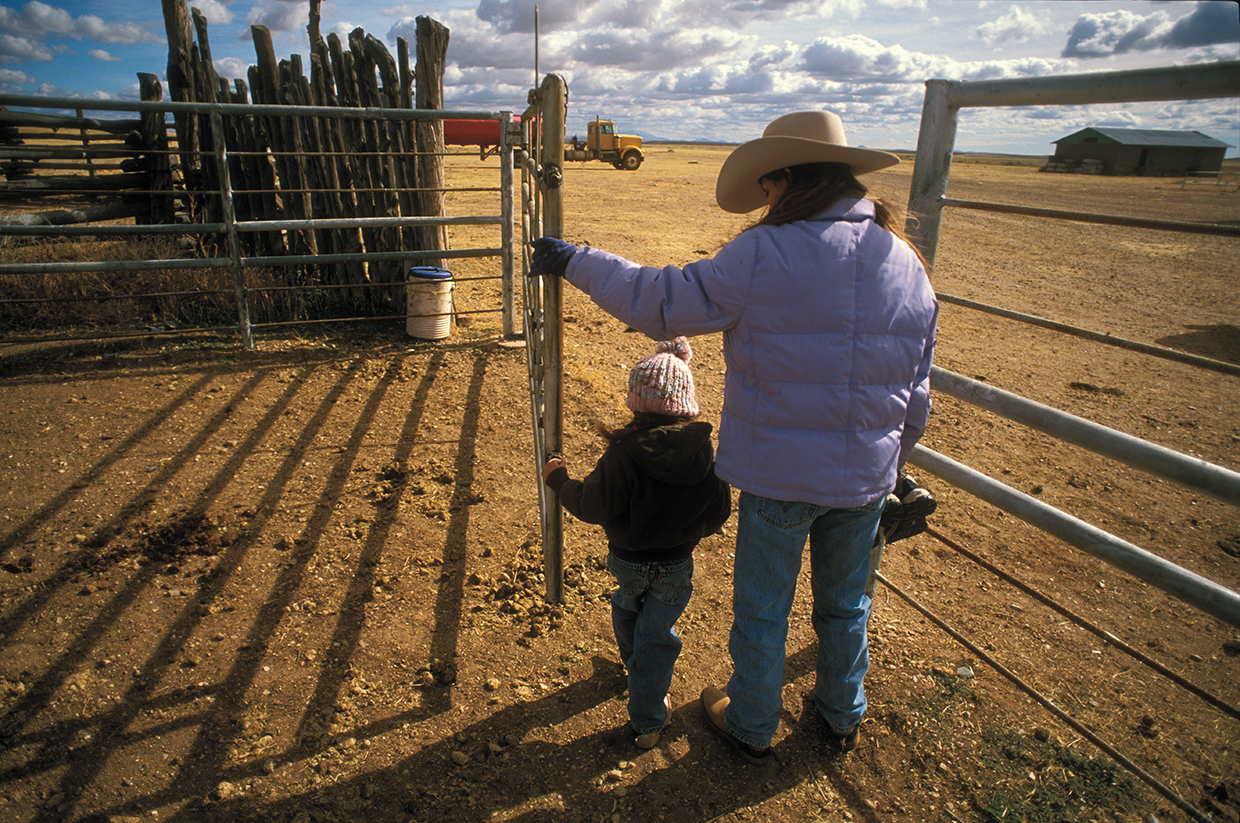
It’s close to noon on this windy Friday, and Victoria Howell Westlake has been up since 4 a.m. She’s preparing her second meal of the day, which, like the first, will feed a dozen or so hungry cowboys, including her father, husband and new brother-in-law.
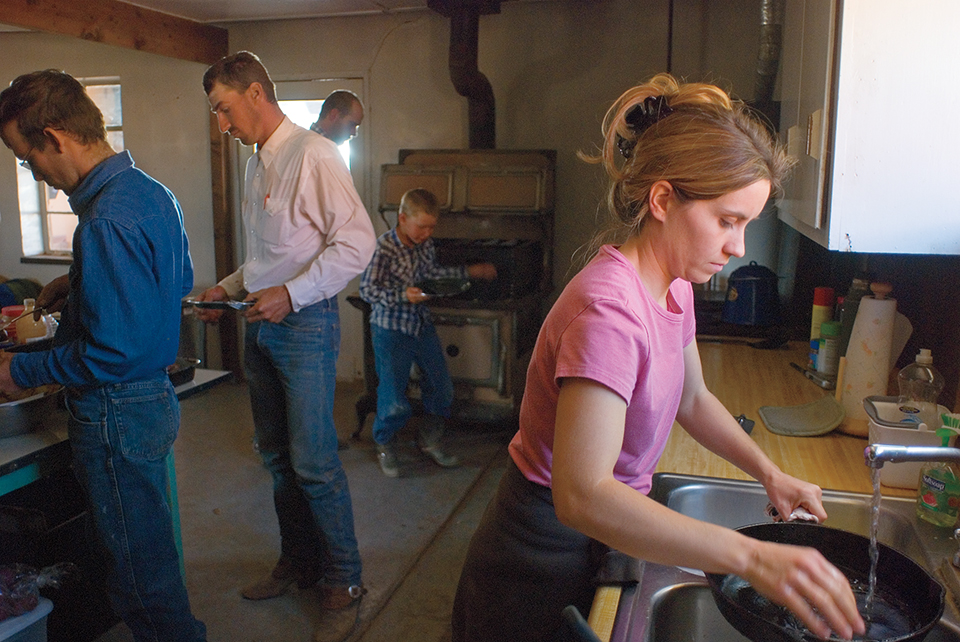
As huge beefsteaks sizzle on the outside grill, Victoria and her mother, Jamie Howell, scrub and slice potatoes inside the bunkhouse kitchen, and then Victoria drops them into a large cast-iron skillet on the gas stove. On the long Formica-topped table is a mouthwatering spread, laid out cafeteria-style. With the steaks are cowboy beans, greens, rolls, tall plastic pitchers of lemonade and ice tea, and a tantalizing blueberry cobbler.
The men file in, some with spurs jingling, all in jeans, cowboy hats off for this midday dinner, and serve themselves heaping plates as the women stand by. After the men’s plates are filled, Victoria, her mother, sister Danielle Howell Rodgers, Victoria’s young daughters, Katherine and Rebecca, and a couple of visitors join in the breaking of the bread. Or, rather, the freshly baked rolls.
It’s the last day of the fall roundup at the Redlands Camp of the Babbitts’ Cataract Ranch about 75 miles northeast of Flagstaff. The cowboys have gathered to wean the calves, perform “preg checks” and to “turn the cows out” to winter country.
Like many ranch families, the Howell men and women work hard together to keep the cattle business thriving. Jamie’s husband, Vic Howell, has been managing the Babbitt ranches for about a decade. Before him, his father, Bill Howell, worked as Babbitt ranch manager for 25 years.
Romantic images of the cowboy permeate American literature, arts, music and even advertising. Less attention has been paid to ranching women, who can be found in ranch kitchens and out on the range. The Howell family provides one snapshot of a way of life for ranchers in the American West today.
Family traditions are passed through the generations of this Northern Arizona ranching family. And not simply riding and roping. Both Jamie and Vic come from ranching families. Jamie grew up in Prescott and married Vic when she was 17; he was an older man at 19. Vic basically grew up on the Babbitt ranches. And now, all three of Vic and Jamie’s daughters have married cowboys they met while their future husbands worked for Vic. Two of those cowboys still work for their father-in-law.
“Vic’s thing was he wanted his girls to grow up and ranch and rope and ride and brand,” Jamie says after the cowboys give their thanks and leave the bunkhouse with full bellies. While Jamie and Victoria clean up the kitchen, Danielle, who married in the summer and is now pregnant, keeps watch over her nieces. “He would tell them, ‘You don’t have to do this [life], but you have to know how to.’”
“And he knew once we did it, we’d love it,” adds Victoria, who with her sisters is a fourth-generation ranch woman.
Danielle agrees.
“Because Dad didn’t make us do this, but he made us learn it so we’d know how, then it was ... like, ‘I’m not living in town; that’s the last thing I’d ever want to do,’ ” Danielle explains. “The last thing I’d want to do is marry some man who wanted to live in town.”
She didn’t. Danielle married Clay Rodgers, who, like the Howell girls, had grown up on the Babbitt ranches. Their wedding saw a Flagstaff church bursting at the seams with long-legged cowboys in their go-to-town jeans and best snap-button shirts, pretty cowgirls and a heap of children. A photo in the church vestibule shows Danielle in her white wedding dress donning a white cowboy hat.
The third Howell daughter is Cassandra Howell Oland, who lives with her husband about 40 miles southwest of Prescott, where she’s a ranch bookkeeper. Her husband, Ryan Oland, worked as a horse-breaker for Vic, and now shoes and breaks horses outside Prescott.
Cassandra didn’t join the family for the fall roundup. But she echoed her sisters’ and mother’s words one summer day in Flagstaff where she and her sisters traveled to get their toenails painted for Danielle’s wedding.
“Everything that Dad was part of, we were part of, too,” Cassandra says, picking out just the right faux rhinestone to be placed on her big toenail for the wedding. “He didn’t have boys, so he seized the opportunity of having girls. Dad gave us each a horse when we were born and wanted us definitely to be part of it all.”
All three Howell girls were home-schooled by their mom. “I don’t regret home-schooling them and being able to have children at home and teaching at home. We rodeoed with them and 4-H’d with them; the family 4-H club was a big part of the girls’ growing up,” Jamie says, stopping for a moment before shaping her next words. “We only have them for a short time. I was able to spend every day with them while they were little.”
Many ribbons, trophies and giant belt buckles were brought home by the girls’ efforts. Cassandra was the only one of the Howell girls who wasn’t 100 percent sure if ranch life was for her.
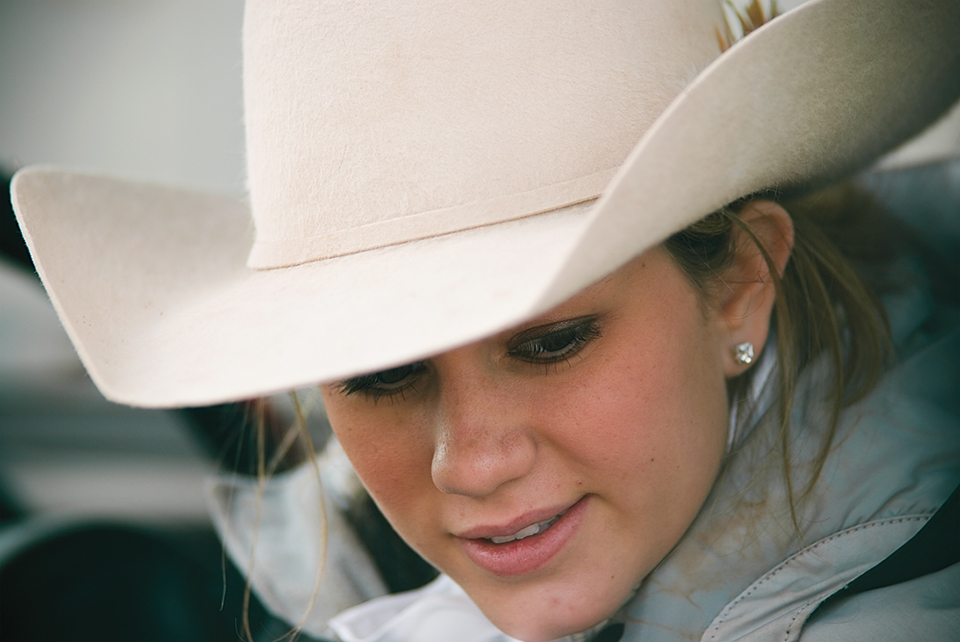
“When I was little, I wanted to be a beautician. Later I thought about going to New York and pursuing modeling,” says the second daughter, who, like her sisters, has long straight hair and a stunning smile. The second year of her marriage, she was pregnant with her first child. “We lived in Tucson, in an apartment,” Cassandra recalls. “I hated it. I can’t handle all those people. It wasn’t for me, and it wasn’t for my husband.”
t another family workday, this time in November, Victoria and Danielle join their husbands and father. Instead of cooking for a crew on this windy day marked by puffy clouds flying across the sun’s rays, the sisters mount up. The morning is filled with the constant lowing of heifers.
As their mom and aunt work the cattle, Katherine and Rebecca, the next potential generation of ranch women, watch from the other side of the fence, helping their dad weigh the heifers, and tossing stones at a stock tank.
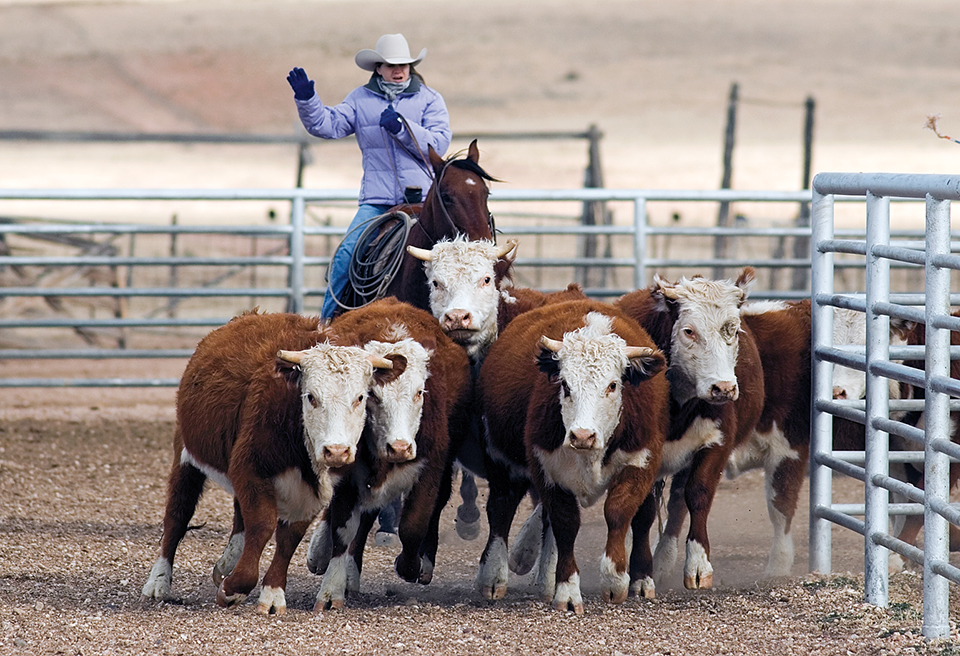
Both women wear jeans, boots, winter parkas and, of course, cowboy hats — a gray one for Victoria and a tawny one with a jaunty feather for Danielle. Danielle wears a white silky scarf around her neck to keep the dust out, and Victoria’s is silver.
Today’s work is to gather heifers from the pastures to the corrals at the Tin House camp — part of the Babbitts’ Espee Ranch, off State Route 64, about halfway between Williams and the South Rim of the Grand Canyon — and onto an 18-wheeler that will transport the animals to Oklahoma.
Victoria rides Piñon while Danielle rides Chocolate, the ranch’s fastest horse and one that helped both Cassandra and Danielle win numerous rodeo prizes, including trips to nationals for Danielle when she was in high school. Chocolate was awarded the state’s prestigious Horse of the Year award 2 years in a row, and carried Danielle around hundreds of barrels at a breathtaking clip.
The sisters look like they were born on horseback. Horse and rider become one, turning the horses like city girls might take a bicycle around a bend. The job requires moving often-reluctant cattle from one corral to the other to be weighed and then counted before being loaded onto the truck. The women lean over to pull gates closed, horses backing up, moving sideways, flowing with their riders. It’s a dusty job as the wind whips through camp.
Both women slap the ends of their coiled ropes over and over, nudging the heifers from one corral to another. Clay also rides the herd, as Scott, Victoria’s husband, stays outside the corral with the little girls.
“Hey,” Danielle calls out as one of the animals decides it’s not interested in moving into the weighing area with the rest of the herd. Danielle deftly turns Chocolate and the two race after the lone heifer to bring her back. Danielle clicks her tongue to get the animal moving.
As Victoria moves another bunch of heifers, she yells a harsh “hey, hey, hey, hey, hey.” Suddenly, the little voice of one of the girls floats on the air from outside of the corral. “Mommy, mommy, mommy.”
“In a minute, sweetheart,” Victoria answers from atop her mount. Her voice is now high and sing-songy, the perpetual mother’s call. Then it’s back to the raspy “hey, hey, hey, hey, hey” as she focuses again on the cattle running in front of Piñon.
It’s been a few years now since Victoria has worked on horseback. She’s content in both jobs, but says it’s fun to mount back up and work the cattle.
“It’s like riding a bike. You never forget,” she says after the job is finished. When she and Danielle are asked if the men will cook for them, they both laugh quietly.
“I wish,” Victoria says. “It’s so much more work now because of having them [her daughters]. You’ve got to get them ready, get yourself ready, do all this, and then go home and work.”
Growing up, Victoria, being the eldest, was often her dad’s main sidekick. “He’d say to me things like, ‘You pick out a good bull,’ and I would,” Victoria remembers. “I didn’t cook, I didn’t do stuff in the kitchen until now. When Scott and I got married, I still helped. I was out there with him 3 days a week, maybe 4.”
Vic Howell is thrilled that all three of his daughters are living the ranching life.
“It’s a great way to raise kids,” he says while holding his granddaughter Rebecca during a local cowboy rodeo. “I hope it stays around. I hope we don’t lose it. American standards live through the ranching life: truth, honesty, fairness and values.
“I’m happy to see our girls choosing men who continue that lifestyle,” he adds. “They didn’t move to New York City or L.A. to lose that.”
Little Katherine is already in love with the life. She wears pink cowboy boots, no matter what else makes up her outfit of the day.
“She’s been riding forever, but by herself since she was 4,” Victoria says. She remembers earlier in the year when Katherine had just turned 4 and she ran barrels for the first time — at a lope and atop one of the safer horses on the ranch. She was not pleased. “She said, ‘I just want to ride on Chocolate, and go faster and faster and faster.’ And when I cooked for the cowboys last spring, Katherine thought it was wonderful — all this food and all these guys.”
Today, there’s no telling what life choices will be made by the fifth-generation Howell cowgirls — Katherine, Rebecca and their youngest cousins — but one thing remains clear: This family will keep working together to keep the ranching tradition alive. And the Howell women will continue to support an American way of life, far from the America of malls, lattes and instant messaging.