
When Joanne Cacciatore set out from an Arizona trailhead in April 2015, she was looking forward to an enjoyable hike in a beautiful landscape. But a few minutes into her trek, she encountered a horse that would not only interrupt the trip, but also change her life.
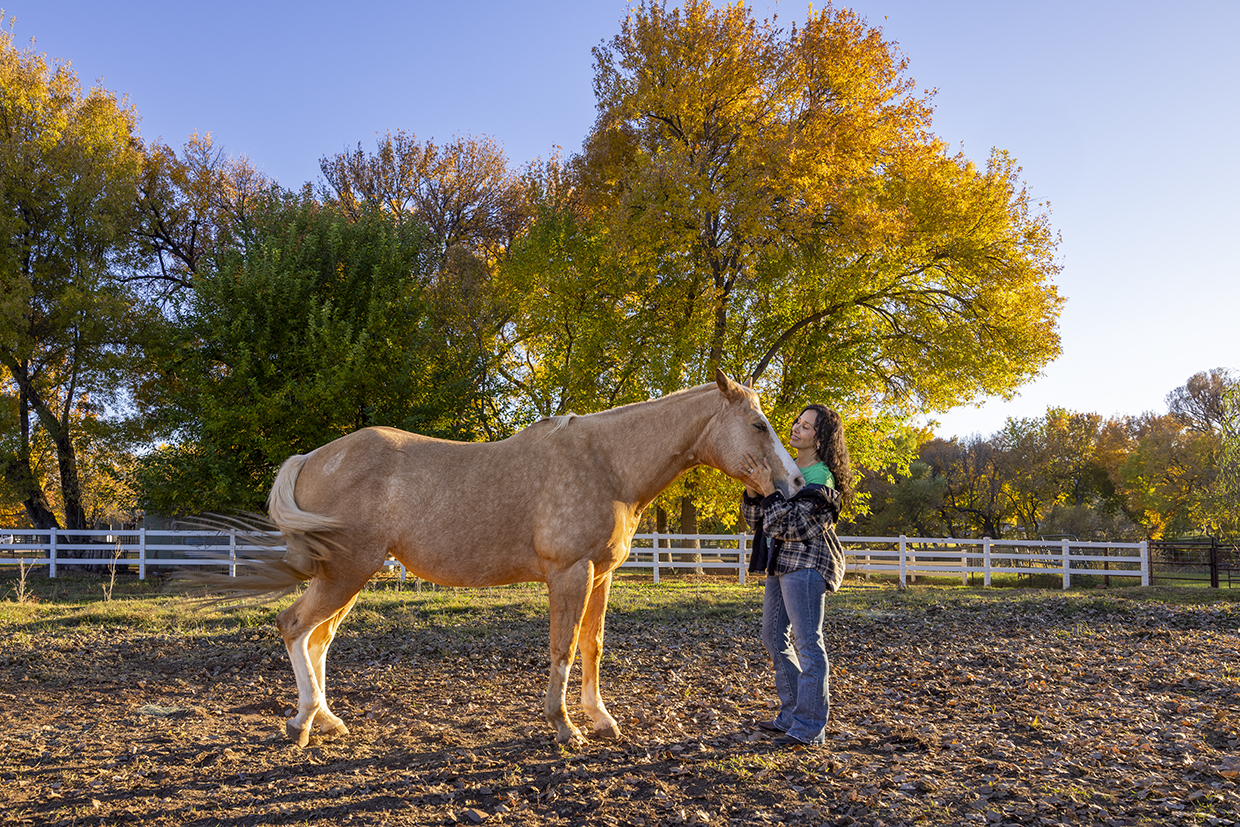
The pack animal had been severely abused and was barely able to stand. Open sores on its back were so deep that exposed bone was visible. Although Cacciatore (pictured) is a lifelong animal lover, the Arizona State University professor had never owned a horse and knew little about equine care. But she decided the horse on the trail had to be rescued — and that she was the person to do it.
After turning around and making some phone calls, Cacciatore rescued the animal three days later. She housed him in a small pasture near Sedona and enlisted veterinarians to help with his numerous medical issues, including being at least 600 pounds underweight. An O’odham client suggested the horse’s name should be Chemakoh, which means “two souls who came together in a moment.”
When she rescued Chemakoh, Cacciatore’s academic focus at ASU was on finding ways to help people cope with traumatic grief — a topic she began researching in 1994, after the death of her infant daughter. As she showered Chemakoh with love in 2015, his health began to improve, but she also noticed the impact he had on her clients. The rescue experience showed her an approach to grief counseling and support that she hadn’t previously explored in her research. And from that soul-nourishing synergy between animals and humans, the Selah Carefarm was born.
A decade after Chemakoh’s rescue, he’s healthy, enjoys all the food he can eat and shares a large pasture with several other rescued horses. The 20-acre Selah Carefarm, in Central Arizona, is now home to some 60 rescued animals and counting. In addition to the horses, there are about a dozen goats, several donkeys, an alpaca, a pig, chickens, cows, sheep, dogs and cats.
The sanctuary, nestled against the tree-lined banks of Oak Creek, is funded through private donations. Clients visit alone or attend guided group retreats after experiencing a traumatic loss, such as the death of a child or the unexpected death of a family member.
The method focuses on coping with tragedy through immersion in the natural world, rather than running from the pain or treating grief as a medical disease.
“Animals give us a sense of emotional connection and belonging,” Cacciatore says while surrounded by goats jockeying for her attention. She notes that studies have proven that proximity to animals helps release calming hormones such as oxytocin in the human brain.
“When my daughter died, the best source of support was my two dogs,” she adds. “They never averted their gaze when I was crying. They would just lie next to me and put their head on my lap and be sad with me.”
Before Cacciatore and her husband bought the land to create the carefarm, it was a vineyard where many native plants had been removed to grow grapes. Over the past decade, the two have restored the landscape with willows and other native plants that are thriving in a healing oasis.
“Things come and grow here,” Cacciatore says while a goat closes her eyes as Cacciatore strokes her head. “There is a mutual respect and compassion for the Earth and our animal brethren. And in that context, everything prospers.” She’s documented her successes with the carefarm model in academic papers, and she’s also the author of the critically acclaimed book Bearing the Unbearable: Love, Loss, and the Heartbreaking Path of Grief.
The facility became a lifeline for Rachel Cox after her 3-year-old son Zaadii was killed in 2015. Cox was walking across a store parking lot in Flagstaff with her young daughter in one hand and Zaadii in the other; a distracted driver ran into them, and her son did not survive.
For Cox, it was not just the animals that helped her cope, but the community of fellow grieving parents with whom she bonded. “We were all going through hell,” she recalls of her first experience at one of Cacciatore’s retreats for bereaved parents. She says she was initially filled with anger about the accident and wanted to escape group discussions that caused her to relive the trauma. But then, there was a shift.
“I began to experience community with the other parents,” she says, and it became the only place she felt free to express whatever came up. “The carefarm gives you the space to cry and to laugh at a time when it feels like laughing isn’t appropriate,” she adds.
Since Zaadii’s death, Cox has become a regular visitor. When she walks the grounds beneath restored willow groves, she says, she feels Zaadii’s playful presence. One of her favorite activities is bouncing on a trampoline — something the goats also enjoy. “There is nothing like bereaved moms jumping on a trampoline with goats,” she says, laughing.
Cacciatore says the job of the animals at the Selah Carefarm is simply to live and heal. It isn’t a petting zoo, and the horses aren’t ridden since “they have already carried enough.” But the mere presence of the rescued animals is powerful medicine for visitors just the same.
“I have had so many people tell me that Chemakoh is what inspired them to keep going,” Cacciatore says. “Animals who were rescued and are now safe give us a pragmatic view of what’s possible. These animals have been beaten and cast aside, and yet, with love and compassion, they learn to trust in the world again.”