

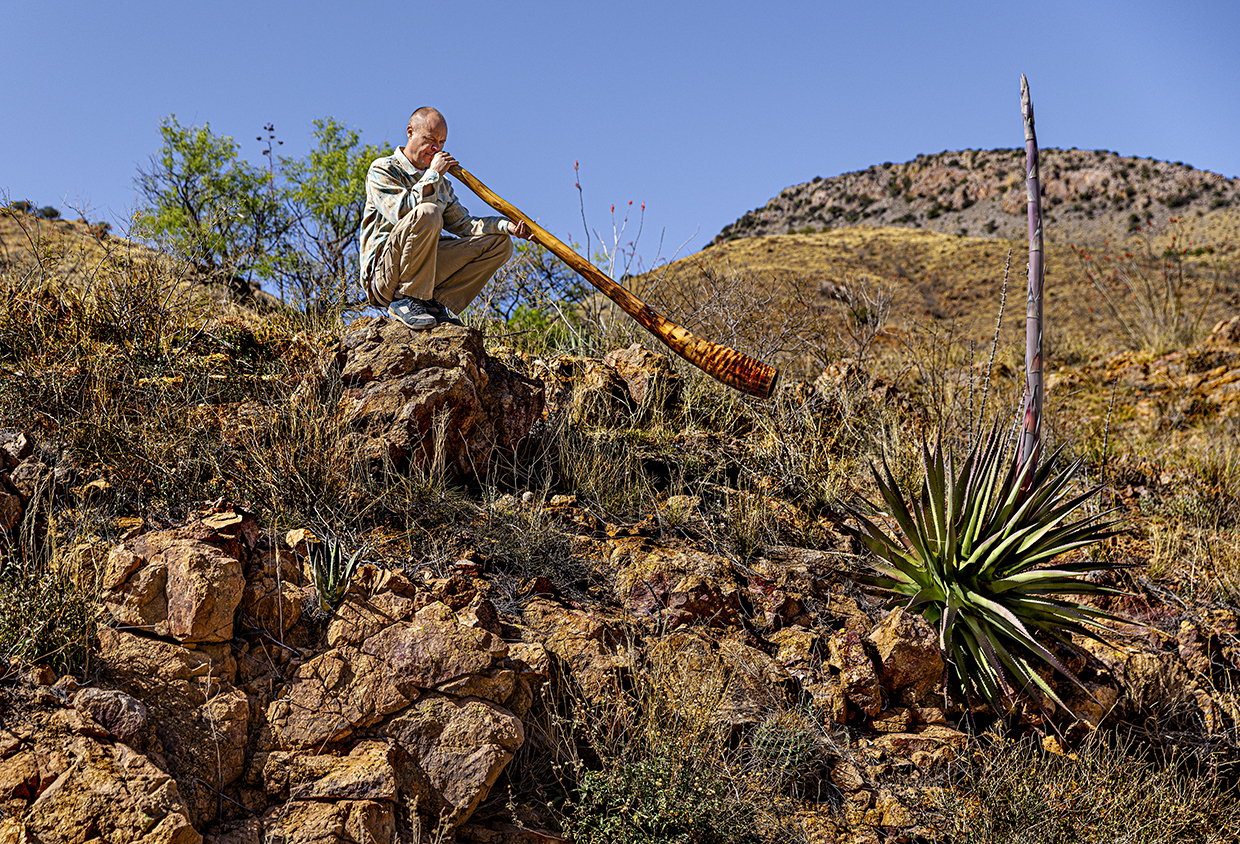
Kyle Bert breathes new life into the hollowed stalks of departed agave flowers. Literally.
When an agave reaches the end of its life, it spends its last gasp growing an asparagus-like stalk, with flowering branches, that can reach 50 feet into the air. And after dropping the seeds that become its children, the dead agave stands in wait for years in the Sonoran Desert, dotting the sky with its signature skeleton.
For a special few of these stalks, that’s where Bert (pictured), an artist and the owner of Desert Mountain Didgeridoos, comes in. Over the past 25 years, he’s used agave stalks to craft more than 700 didgeridoos.
The didgeridoo is one of the oldest musical instruments in the world, developed by Aboriginal tribes in Australia more than 1,000 years ago. Originally made from a whole tree branch hollowed by termites, didgeridoos can be crafted out of any hollow tube — even a PVC pipe. The instruments produce deep, resonant vibrations that amplify the voice of the musician, whether they’re buzzing their lips, singing, shouting or growling like a wild beast.
Agave stalks make an ideal base for a didgeridoo, particularly when they’ve been maturing in the desert for five years or longer. Bert calls the instruments produced from these stalks the “old souls”; their sound is deeper and denser, with a character shaped by pecking birds, burrowing insects, wind, dust, heat and rain. Older stalks also develop intense red and pink pigmentation from their time baking in the sun, and a select few become infected with a white fungus that further modulates their color and texture — a process similar to that of highly prized spalted wood.
Agave stalks have a hardwood shell filled with soft pulp. After cutting the stalk to size, Bert bores from both ends using drill extensions fitted with wire brush and drum sanding attachments that shred the pulp from the inside without damaging the hard exterior. He then carves a mouthpiece out of resonant tone woods, taking into consideration the wood’s visual and acoustic compatibility with the stalk. The mouthpiece is permanently attached to the hollow stalk with a resin that amplifies the resonance.
Surface cracks and holes are sanded down, and some are filled with crushed local turquoise mixed with resin. Bert sometimes collaborates with friends who paint and wood-burn the instruments, adding their own artistic vision. After a final coat of resin, the instrument is complete. Every didgeridoo is unique, and the sound of each is a surprise — which is why one of Bert’s greatest joys is playing the newly constructed instrument. He cherishes the anticipation so much that he puts off playing it for the first time, to let the excitement build.
That relationship is therapeutic, too. The first time he ever played a “didge,” he says, he felt a lifetime of anxiety begin to dissipate. And he’s not alone: Many didgeridoo players associate a personal transformation — whether spiritual, psychological or physical — with picking up the instrument.
That’s partly because playing the didgeridoo requires extensive breath control. A continuous drone sound is sustained through a technique called circular breathing, in which air stored in the cheeks is expelled while the player breathes in through the nose. The didgeridoo catches that breath and turns it into frequencies that are at and below the lower threshold of human hearing, but can be felt in the listener’s chest and abdomen.
Not surprisingly, studies have shown myriad wellness benefits from playing the didgeridoo, including better lung capacity, better overall health and reduced anxiety. And a 2005 study in the British Medical Journal found that playing the didgeridoo helps reduce snoring and sleep apnea by strengthening airway muscles.
Whether Desert Mountain Didgeridoos’ customers see health benefits or not, Bert says he hopes his handcrafted instruments bring people the same joy, self-expression and connection that they bring him — while allowing them to carry a piece of the desert wherever they go.
Desert Mountain Didgeridoos
Tucson, AZ
United States