

Editor’s Note: The celebration of our centennial continues with another wonderful piece from another wonderful writer. This month, it’s J.B. Priestley, the eminent novelist, playwright and essayist who was drawn to Arizona and wrote a book titled Midnight on the Desert, an autobiographical account of his time in Wickenburg. More than a decade later, he wrote a piece for us related to that experience. Of all the writers in our archive, Mr. Priestley is the closest we’ve ever come to having a knight write a story for us —
like David Bowie and Stephen Hawking, he was offered and refused a knighthood from Buckingham Palace. “He wasn’t keen on elitism,” Sophie Whittall, his granddaughter, says.
It is now more than 11 years since I last saw Arizona. This is a long time — much too long. And nobody must imagine that the Priestley family have fallen out of love with Arizona. First, there was the war, with duties that kept us here. And now there is the currency problem. We British must not spend dollars, not even the dollars we earn. This may seem outrageous, until you remember that those dollars enable us to buy things we need urgently. I will admit (come closer, will you?) that by arranging to have some important business in Hollywood, I could probably conjure enough dollars out of His Majesty’s Treasury to give me a glorious little stopover in Arizona. But I could do this only for myself, not for the rest of the family, and if I went sneaking off by myself in this fashion, they might not speak to me when I came back.
Yes, feeling runs as high as that. The desert crept into all our hearts. Every month we take a peep or two through the tantalising little windows of Arizona Highways, and — although this house high above the white cliffs of the Isle of Wight has its own glorious views — as we take our peep through those little windows, we heave a few sighs and curse this new world of the economists and the passport officials. And we begin to remember again. What do we remember? Well, here I shall speak for myself.
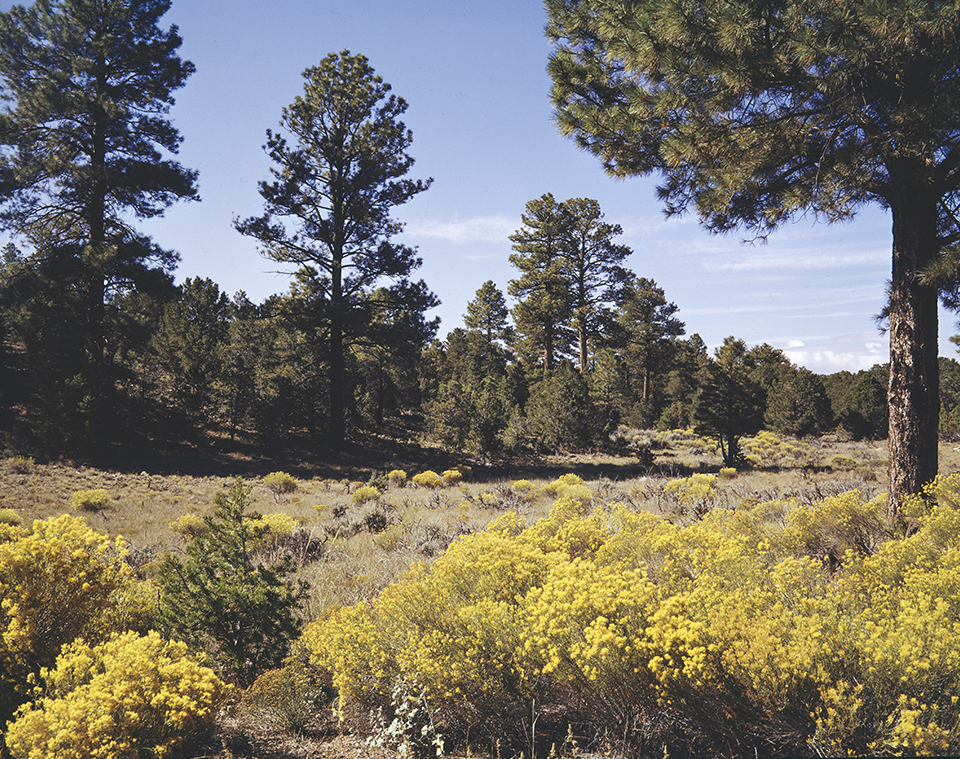
My mind returns first to Remuda Ranch at Wickenburg, where we stayed so long. There was the shack near the river that Jack Burden (whose early death must have been a great loss to the whole Wickenburg community) built for me to work in, a shack that may still be seen not only at Remuda but also on the cover of the English edition of my Midnight on the Desert. I think, too, of that fine circular fireplace in the living room of Remuda Ranch, and I can only hope that, in spite of many improvements and enlargements around there, the fireplace, which could not be improved and could hardly be enlarged, still dominates the room. Then various favourite spots in the neighbourhood are remembered. Vulture, for instance, and that place up the river where we had so many picnics. They tell me that Wickenburg itself, which was growing fast in our time, has shot up and spread past our recognition.
I remember highways. The first of them is the familiar stretch between Wickenburg and Phoenix. (When my wife and I, without the children, paid our first visit to Remuda, we left our baggage at Phoenix and were astonished when the Burdens said casually they would send in to Phoenix for it. Fresh from England, we were surprised by the Arizona conception of distance, which regarded 50 miles as we regard 5.) Then, as I often had to go to Hollywood, there was the almost equally familiar trail to Los Angeles, U.S. Highway 60, which took us to Salome, where we had many a long, cool drink. Not quite so familiar, though sufficiently well remembered, was the other road north, on the way to the Grand Canyon or Boulder Dam or the Indian reservation, which went through Prescott. But we never saw this pleasant town at the right time, for we were always going through it in winter and we usually found ourselves shivering a little up there.
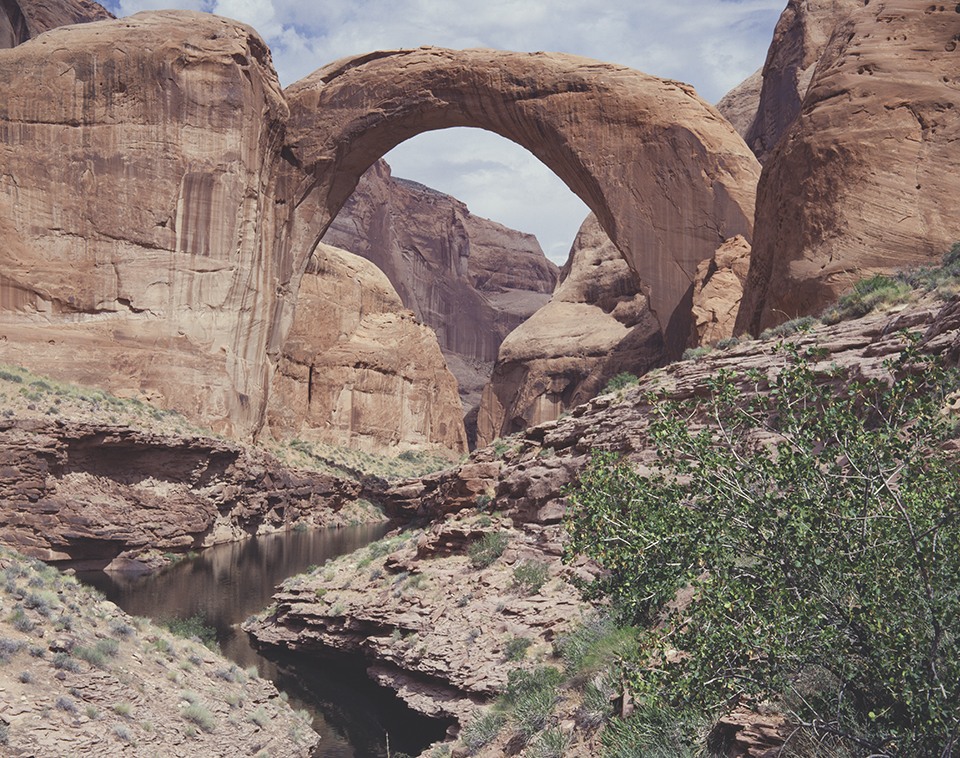
Now I have found a large cardboard box, packed with old road maps, booklets and photographs of us at Remuda, Phantom Ranch, going up and down the Grand Canyon. Looking at the maps, I realise with deep regret how much of Arizona we left unexplored. For instance, all the Coolidge Dam country and the desert both east and west of Tucson. (But we did definitely prefer the rough and rolling country near Wickenburg to the more conventional desert territory farther south, and so belong to the Phoenix and not to the Tucson party.) And I think we took the Yuma trail to California only once. On the other hand, we did a good deal of wandering — in a station wagon — around the north of the state. My wife and three of the daughters, very young then, went twice as far as Rainbow Bridge, and I was up there once. But unfortunately, owing to a change in the weather and the danger of being badly held up, we all missed visiting Monument Valley, which is about the top of the list of places to be seen on any future trip.
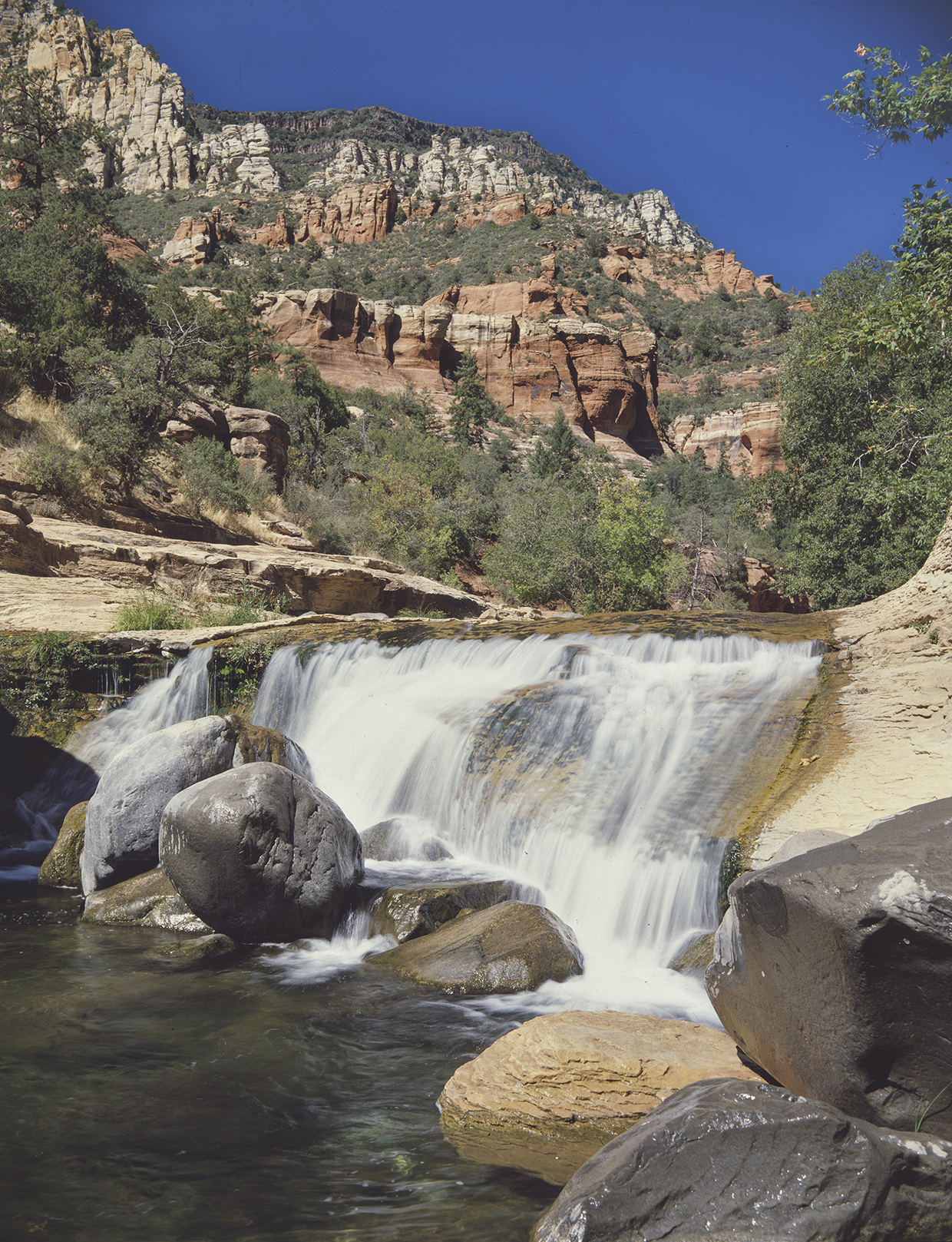
Among my most enchanting memories of Arizona is the time — alas, all too short — we spent in Oak Creek Canyon, which to me especially had a peculiar magic of its own, like some fabled garden of the Hesperides in classical legend. Before I die, I should like to live some weeks in that bright, hidden oasis, out of this world, meditating and dreaming in the sunlight of its early spring, storing up thoughts and impressions for a book. I have a suspicion that Oak Creek is perhaps underrated, but heaven forbid that it should suddenly become popular and become a resort filled with swimming pools and cocktail bars.
Although I am far removed from being a globetrotter, it happens that in my time, I have hit a few high spots of travel. I have sailed up the Nile as far as the Southern Sudan; I have been to the South Seas; I have visited Lake Louise in the Canadian Rockies; I have seen both from the ground and high in the air the grand romantic scenery of the Caucasus. But I have yet to see anything that challenges the fantastic wonderland of Northern Arizona. Most famous places fall below our idea and expectation of them. They are good, but not as good as all that. But the Grand Canyon just goes on taking your breath away. Some of the recent pictures of it in Arizona Highways have been among the best specimens of colour photography that I have ever seen, but no camera can capture that huge miracle of shifting light and shade. And it shines in the memory like an old, well-tested friendship. Just to remember that it is still there, and far too large to be messed about and spoilt, makes me glad. And if I were back in the Southwest, I should soon be heading for Flagstaff, Williams or Ash Fork, to gape again into that vast, glowing abyss.
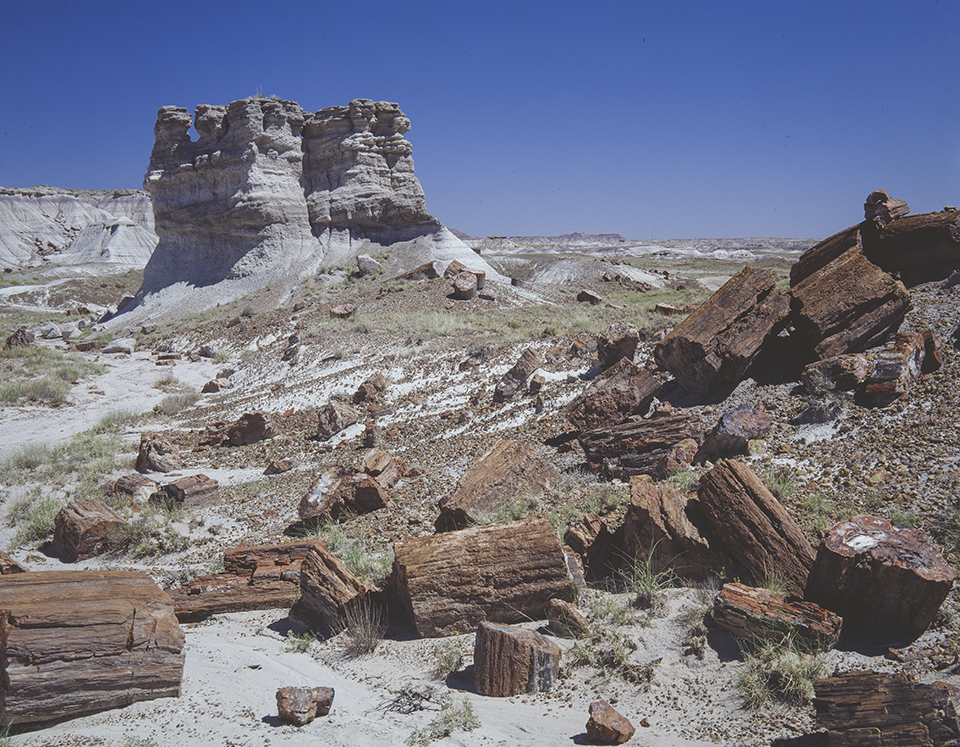
Yet some of the country east of the Grand Canyon proper, the country reached through Cameron, has perhaps a more romantic strangeness and a more delicate beauty than anything to be seen from the familiar tourist spots along the rims. Who, having once seen them, could forget the Vermilion Cliffs and the Painted Desert and the Petrified Forest? Or the stupendous landscape that unfolds itself for the guest up at Rainbow Lodge?
But Arizona is something more than a collection of natural marvels and multicoloured landscapes. Thus, I remember with delight the diamond air itself, through which whole ranges of amethyst mountains, a hundred miles away, can be clearly distinguished. And what fun it used to be, travelling the highways on a hot morning, to watch the mirages, to see the hills melt and dissolve and then reshape themselves! How can I forget the glorious sunsets and the nights that followed, cool and crisp as a nut? We occasionally run across people here who have followed these same trails in their time, and you should see the way in which our faces light up when we compare experiences.
Then there are the people. I am not going to mention names, if only because some who ought to be on the list would inevitably be left out, so that more harm than good might be done. But what a horrible business it would be, visiting this magnificent state and being enchanted by its scenery and climate, if the people themselves were unpleasant! Imagine returning from one of the canyons or a desert sunset and then having to face a lot of sour, sneering, unfriendly types! But of course, it was never like that. Wherever we went in Arizona, we always seemed to meet the kind of people we like: sensible and friendly, quiet at the right times but ready for fun and games, too. During the ’30s, with lecture tours and various journalistic jobs on hand, I travelled extensively in the U.S., particularly throughout the Middle West, and in spite of rumours to the contrary, I always got along with most Americans I met on these journeys, but I do not hesitate to declare that it was in the Southwest — and especially in Arizona — that I found myself most at ease with everybody. They were our sort of folk. And as a playwright and radio speaker, I am perhaps unusually sensitive to the pitch and cadence of the human voice, and I always enjoyed listening to the deep drawl of the honest-to-God Arizona man. It was just the voice you wanted to listen to at the fireside after a long day in the sun.
Voices, faces, bluebirds and scarlet birds, cactus and pine, mountains dissolving in the morning mirage or glowing like jewels in the sunset, the sweet clear air, the blaze of stars at midnight — they all return to memory and come haunting our dreams. I would not live outside Britain these days even if I were offered a king’s ransom, for not only do I love this battered old island of ours, but I believe wholeheartedly in the great social experiment we are making; but to have another long holiday in Arizona, with the whole family along — ah! — that would be happiness indeed. But until — if ever — that can be contrived again, we must be content with the delightful little windows and tantalising glimpses offered us every month by Arizona Highways, to which I now offer in return my thanks and good wishes.