

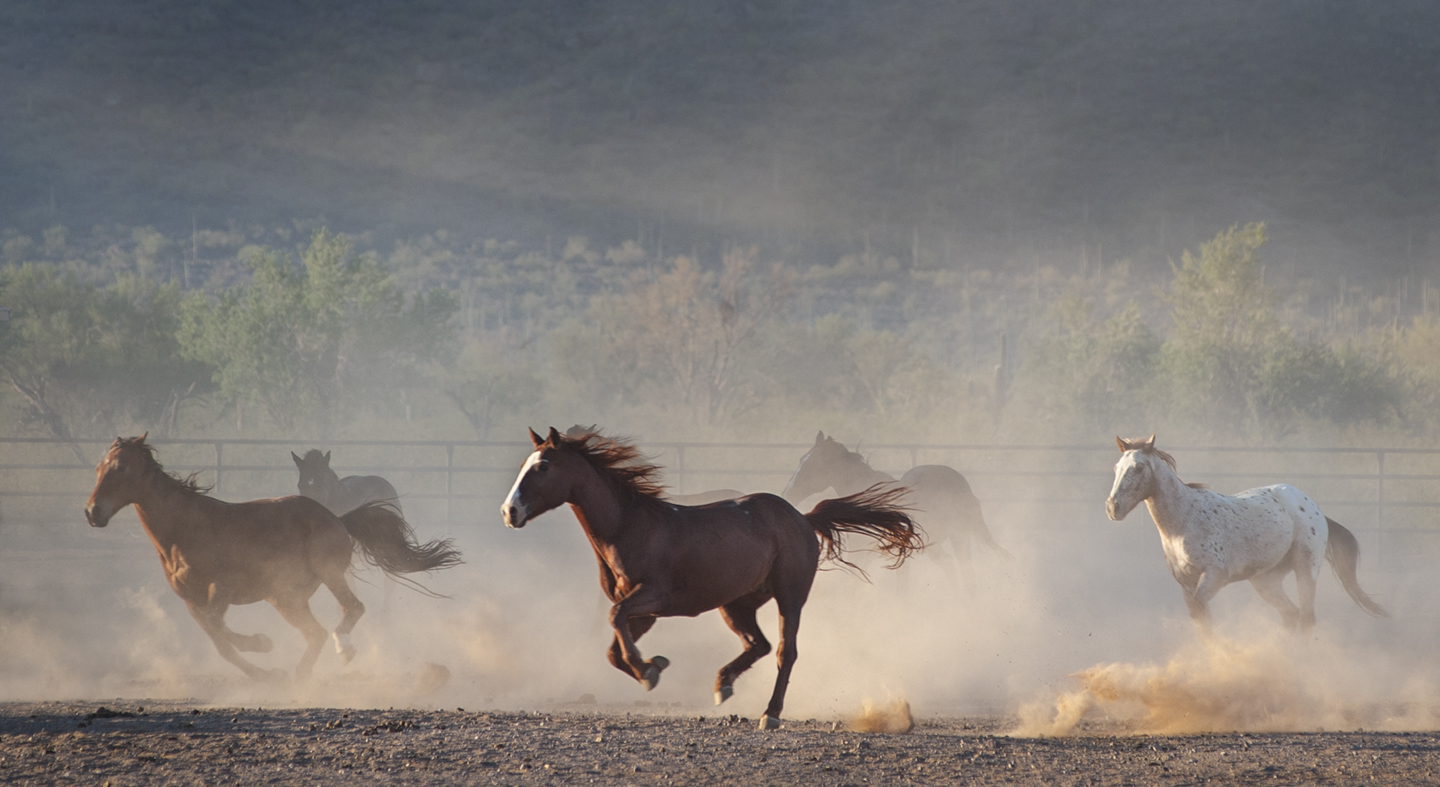
When Allen and Cynthia True bought the White Stallion Ranch in 1965, it was a secluded property nestled against the Tucson Mountains and what later became Saguaro National Park, just northwest of Tucson. The ranch offered acres of desert vegetation, sweeping mountain views, and a vacation escape with a taste of Western culture that was particularly alluring to travelers from the Northeast and overseas.
Like most dude ranches, the White Stallion served as an all-inclusive vacation destination that allowed guests to experience the West through activities such as horseback riding and hiking. And it was one of more 60 dude ranches across the state. Now, it’s one of 10. Urban sprawl, which affects formerly untouched swaths of desert or homesteads from the early 1900s, is also a threat to dude ranches — some of which have been operating for nearly 100 years.
Even the White Stallion, tucked behind the mountains, has experienced suburban expansion knocking at its door. Large subdivisions have sprung up across the road, and developers have offered top dollar for the property itself — raising questions for ranchers, wranglers and Arizona lawmakers about the future of the dude ranch industry.
Although the origins of the White Stallion Ranch are unconfirmed, it likely was established by squatters who had cattle. After a homesteader got the deed to the land in the 1930s and sold it, the ranch went through several owners and names before it became the White Stallion.
For the True family, purchasing the property meant uprooting their lives in Colorado and entering an unfamiliar business. But the venture ended up being a success, and Allen raised his two sons on the property. The True brothers, Russell and Michael, run the ranch today with their respective wives, Laura and Kristin.
“My mother, her quote for the rest of her life was, ‘I told [Allen] if I could look at these mountains every morning when I wake up, he can throw our lives away,’” Russell True says, between laughs.
The ranch’s stunning location — with tall mountains, orange-splashed sunset skies and comfortable desert winters — began to attract droves of visitors, too. For the next several decades, the ranch was a destination for those curious about cowboy culture or just searching for a sliver of the simpler life. And things do seem much simpler there. Everyone eats their meals together, and there are no TVs or landline phones in the adobe-style guest rooms. If you want a movie fix, you’ll have to pop a VHS tape into a VCR in the game room.
Deborah Plum, the White Stallion’s general manager, started visiting the ranch when she was 2. She recounts her childhood family vacations, full of meals around the communal tables in the ranch’s dining room and early morning horseback rides. Some of her parents’ long-term friendships were forged over mealtime chats while unwinding from a day in the desert sun.
“My parents, New Yorkers, decided they wanted to live their sort of ‘city slicker’ dream of coming out to a dude ranch,” she says. “They came out once, got addicted and started coming every single year that I was growing up.”
Dude ranches seem to have that effect on their guests. Most people you encounter at these ranches say the same thing: “We’ve been coming here for decades.” It’s a product of the authenticity of Western hospitality, along with a universal fascination with cowboys and their four-legged companions. “I think that horses are just their own enigma,” Plum says. “People are always fascinated by them and just interested in this odd dynamic of a creature that's very domesticated, but also has a wild element to it.”
When dude ranches sprang up across the United States, they served as vacation escapes for the wealthy and famous, with last names such as Rockefeller, Roosevelt, Vanderbilt and Carnegie. “Dude ranches were the only place for the elite to go out and get this experience in the West, in these big, unspoiled places, and fish for giant rainbow trout and watch the moose, elk, deer and bighorn,” True says. “It was mind-boggling to these people.”
That infatuation with the West seems to have increased, due to the tandem rise of mainstream country music and Western-themed TV shows such as Yellowstone. Nobody knows that better than Lynn Downey, award-winning author of Western titles such as American Dude Ranch: A Touch of the Cowboy and the Thrill of the West. “That’s what the dude ranch gives its guests: a chance to tap into a way of life that is so different from their own experience,” she says. “It’s a unique kind of vacation. You don’t just stay at a dude ranch for a week. You live on a dude ranch.”
But this preservation of Western culture is becoming increasingly more difficult to capture in Arizona. “As one of the fastest-growing states, you are dealing with a lot of sprawling, urban growth in areas that were kind of homesteaded at random and then became ranches,” Plum says. “It’s not like anyone was putting in preservation acts and protecting them at the time.”
True mentions the Lazy K Bar Guest Ranch, which once stood just a short drive over the mountains from the White Stallion. When the ranch was established, the founders could never have predicted how urban sprawl would affect them, considering that the town of Marana wouldn’t become incorporated for several decades. As the area became more developed, it became challenging to take guests for horseback rides and other outdoor activities. Today, a subdivision of suburban neighborhoods bearing the name Lazy K stands in the ranch’s place, and the area surrounding it is unrecognizable. What used to be a natural desert landscape is now a retirement community, an elementary school, a grocery store and a Starbucks.
This level of development has started creeping over the mountains, and True says he gets top-dollar offers for his land from housing developers every couple of years. He doesn’t seem too concerned when these types of offers come, though. The way he sees it, if he and his brother were in the business for the money, they would have sold the property years ago. Even then, they probably would have gotten the land back, since every time serious developers have knocked on their door, economic crises, such as the 2008 housing crisis or the COVID-19 recession, have been at their heels.
Although the Trues don’t plan to sell the ranch anytime soon, the hounding from housing developers raises a bigger question: What are ranchers, lawmakers and communities doing to preserve and protect these historical places — many of which have more than a century of history and some of the oldest standing architecture in the state?
“If you talk to Russell or Michael, you’ll find them using the term ‘stewards of the land,’” Plum says. “They don’t really see themselves as just owners. They’re people that are there to preserve it, protect it and take care of it.”
Mary Miller, who owns and operates the Elkhorn Ranch with her husband and his family, is also passionate about preserving the land. Her ranch is located in a rural pocket of southern Tucson, and although Miller has seen minimal threats of suburban sprawl, she still works in her community to ensure that the landscape remains protected.
“We put a lot of effort into thinking beyond our ranch and more serving the valley as a whole,” she says. “The scenic and the undeveloped ranching nature of our area is a big part of our ambience, so we believe in that mission, but it's also an important part of what makes this place unique.”
Some ranches have resorted to selling to corporations as a way to keep the business alive. Bryce Albright, the executive director of the DRA, says that’s become more common across the West, not just in Arizona. Most of these corporate ranches ask the original families to continue to run the properties to keep their traditional feel. “I just think that when the family exits, you've got longtime guests that knew that family and how they ran it, that’s when you start to see things kind of disconnect,” Albright says.
But corporations alone can’t save the industry. For years, Arizona ranchers pushed for the state to step in and protect historic dude ranches. Their message was clear: Without lawmakers working to preserve this land, it’s a challenge for ranchers to do it all on their own, especially when they’re facing pressure to sell.
In 2022, the state passed two bills in an effort to address this issue. The first established the Arizona Dude Ranch Heritage Trail Program, aimed to honor and aid in the preservation of dude ranches across the state. The program has three primary guidelines: Each ranch must have been in business for at least 25 years, inhabit a minimum of 1,000 continuous acres and offer traditional guest ranching activities.
The second bill stated that ranches that qualified for the Arizona Dude Ranch Heritage Trail Program would receive an adjustment in their property tax valuation. Today, eight ranches, including the Elkhorn and the White Stallion, have qualified for the program, but it hasn’t panned out as they’d hoped. Russell True, who was a strong advocate for both bills, admits that property taxes for his ranch haven’t changed in the way he was promised.
“Essentially, as I understand, it was not crafted correctly, and some county assessors refused to accept it — and in one case used it as an excuse to raise taxes,” he says.
Miller says she hopes the bills will at least garner attention and drum up tourism for dude ranches. “I think that the public sector and policy can make a difference,” she says. “The tourism dollars that come from dude ranches [are] probably small relative to many things, but I think that the images, the ambience and the marketing concepts that can be celebrated from this industry are disproportionately important for Arizona.”
Without strong support from lawmakers and the state, ranchers such as True and Miller continue to do everything they can to keep this industry thriving. While there may be few remaining dude ranches in the state, True says, the ones that remain serve as “quality” examples of authentic Western life. They prioritize giving guests a traditional ranch experience, one that values taking care of animals, emphasizing hospitality and respecting the land.
And despite the obstacles, there’s a strong sense of optimism in the dude ranching industry. Perhaps it's the natural tenacity and grit of cowboy culture, or the support of loyal guests who’ve been returning to their beloved Western getaways for decades. But the timeless charm of the West refuses to be suppressed or forgotten.
“You can’t bury the West — it might be quiet for a while, but its appeal is too universal, even if some of its story has been manufactured by movies and books,” Downey says. “It represents personal freedom, especially in times of societal upheaval.”
— Amalie Rhebeck is a student at the Walter Cronkite School of Journalism and Mass Communication at Arizona State University. This is her first contribution to Arizona Highways.